US coin · series

The Half Dollar That Put a Wildcat on American Money

Vermont's 1927 commemorative — Ira Allen on one face, a snarling catamount on the other.

The Half Dollar That Put a Wildcat on American Money
Photograph by Wikimedia Commons user Bobby131313 · public domain · source

In 1927, the United States struck a half dollar with a wild cougar on the back — teeth bared, walking straight at you. It marked 150 years since a ragtag Vermont militia helped break the British at Bennington, and the cat was no accident.

The story behind the coin

In August 1777, the Revolution was going badly. A British army under General Burgoyne was driving down from Canada toward the Hudson, splitting the colonies in two. To feed his troops he sent a raiding force toward a supply depot at Bennington, in the disputed territory that would become Vermont.

He never reached it. American militia — including the Green Mountain Boys, the rough frontier fighters who had made the region ungovernable for years — met the raiders and crushed them. The Battle of Bennington bled Burgoyne of men he could not replace. Weeks later he surrendered at Saratoga, the turning point that brought France into the war.

Vermont remembered. The same year, 1777, it declared itself an independent republic — a small nation that would not join the United States for fourteen more years. So when the 150th anniversary came around, the state had two milestones to honor at once: a battle that helped win a war, and the moment it declared itself free. Congress agreed. On February 24, 1925, President Calvin Coolidge — himself a Vermonter by birth — signed the act authorizing a commemorative half dollar.

The design — and the fight over it

A commemorative half dollar is a legal-tender 50-cent coin struck to mark an event, usually sold above face value to raise money for a cause. The obverse — the heads side — and the reverse both carry custom art instead of the standard circulating design. Getting that art approved was its own battle.

The first sculptor hired, Sherry Fry, proposed putting the tall Bennington Battle Monument on the reverse — the tails side. The Commission of Fine Arts, the federal body that vetted coin designs, rejected it. Its chairman pushed for something far stranger: a catamount, the old New England word for a mountain lion. The animal nodded to the Catamount Tavern in Bennington, the inn where the Green Mountain Boys had plotted their rebellion under a stuffed wildcat snarling toward New York. Fry walked away from the project. The Mint brought in Charles Keck instead.

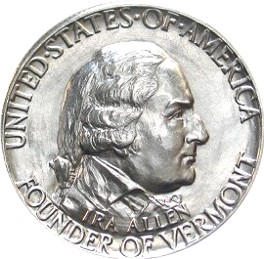
Keck delivered both sides. The obverse carries an idealized portrait of Ira Allen — younger brother of Ethan Allen, a founder of the state and of the University of Vermont — in a periwig, ringed by the words "FOUNDER OF VERMONT." The reverse is the catamount itself, prowling left, lean and alert, above "BATTLE OF BENNINGTON" and the twin dates 1777–1927. It is one of the rare U.S. coins to put a living predator front and center — no eagle, no allegory, just a cat that looks like it might leap off the metal.

Key facts

Year struck
1927 (Philadelphia, no mint mark)
Event honored
150th anniversary of the Battle of Bennington & Vermont independence (1777)
Designer
Charles Keck (both obverse and reverse)
Obverse
Ira Allen, 'Founder of Vermont'
Reverse
A catamount (cougar) walking left
Composition
90% silver, 10% copper
Weight / diameter
12.5 g / 30.6 mm, reeded edge
Silver content
About 0.3617 troy oz (11.25 g) of silver
Struck
40,034 pieces
Melted by 1934
11,892 returned and destroyed
Net distributed
About 28,142 coins
Issue price
$1 per coin
Sponsor
Bennington Battle Monument and Historical Association

Collecting it

There is only one Vermont half dollar to chase — one year, one mint, one design. That makes it a single-coin "type," and it sits on most collectors' checklists of the classic early commemoratives (the run of silver issues struck from 1892 to 1954). So the game is not about hunting a rare date. It is about condition.

The Mint struck 40,034 coins in early 1927, but the public never warmed to them. Almost a third went unsold and were shipped back for melting — 11,892 of them by 1934 — leaving roughly 28,142 in collectors' hands. That sounds scarce, and in top grades it is. Many surviving coins show contact marks or weak strike on the high points of the design. A strike is how fully the press pushed metal into the die — the engraved steel stamp — and Keck's bold, high-relief portrait of Allen is unforgiving: the highest points wear and bag-mark first. Sharp, clean, original examples in the upper Mint State grades command a real premium over typical survivors.

One word of caution that the coin's popularity earned it: the Vermont half dollar has been counterfeited. As with any commemorative worth real money, a coin certified by a major grading service — sealed in a holder, or "slab" — carries far more confidence than a raw, unverified piece.

Questions collectors ask

What is the animal on the back of the 1927 Vermont half dollar?

It is a catamount — an old New England name for a mountain lion or cougar. It honors the Catamount Tavern in Bennington, where the Green Mountain Boys met to plan their rebellion. The Commission of Fine Arts chose it over the originally proposed Bennington Battle Monument.

Who is on the front of the coin?

Ira Allen, a founder of Vermont and of the University of Vermont, and the younger brother of Green Mountain Boys leader Ethan Allen. The portrait is idealized rather than taken from life.

How many Vermont half dollars were made?

The Philadelphia Mint struck 40,034 in early 1927, but the coin sold poorly. By 1934, 11,892 unsold pieces had been returned and melted, leaving roughly 28,142 distributed to collectors.

Why is it called the 'sesquicentennial' half dollar?

Sesquicentennial means a 150th anniversary. The coin marks 150 years since the 1777 Battle of Bennington and Vermont's declaration of independence as a republic — the twin dates 1777–1927 appear on the reverse.

Is there a rare date or mint mark to look for?

No. There is only one issue — 1927, struck at Philadelphia with no mint mark. Value comes from condition (grade) and eye appeal, not from a scarce variety.

Sources