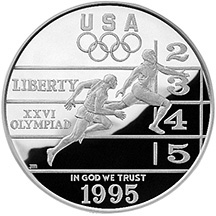
The story behind the coin
In 1996, Atlanta hosted the Centennial Olympic Games — a hundred years after the first modern Olympics in Athens. The U.S. Mint wanted to mark the occasion in coin. It did not hold back.
Congress authorized not one coin, not a small set, but sixteen — four gold $5 pieces, eight silver dollars, and four copper-nickel half dollars — under the 1996 Atlanta Centennial Olympic Games Commemorative Coin Act (Public Law 102-390). It was the largest U.S. commemorative coin program ever attempted. The coins were dated across two years, 1995 and 1996, each honoring a different sport or Olympic theme. The Track & Field dollar, dated 1995, was one of the first wave.
There was a money motive behind the art. Every coin carried a surcharge — an extra amount baked into the price, above the coin's metal and minting cost. For each silver dollar, that surcharge was $10, and it flowed (through an entity called Atlanta Centennial Olympic Properties) to the Atlanta Committee for the Olympic Games and the United States Olympic Committee. In plain terms: buy the coin, help pay for the Games.
The ambition backfired in an interesting way. Sixteen coins, released close together at collector prices, was simply more than the market wanted to absorb. Sales came in low — among the lowest of any modern commemoratives — and the Mint reportedly took a multimillion-dollar loss on the program. The unhappy ending for the Mint became a quiet gift to collectors: many of these coins ended up with surprisingly small mintages, which is the whole reason a few of them are chased today.