US coin · series

The Coin That Honors the Night the Lights Came On

In 2004 the U.S. Mint put Edison's 1879 light bulb on a silver dollar — 125 years to the year.

The Coin That Honors the Night the Lights Came On
U.S. Mint (www.usmint.gov) — work of the U.S. Government, no individual photographer credited · public domain · source

One night in October 1879, a thread of carbonized cotton glowed inside a glass bulb in Menlo Park, New Jersey, and kept glowing for more than half a day. A century and a quarter later, the U.S. Mint cast that moment in silver — and used the proceeds to fund the very museums that keep Edison's story alive.

The story behind the coin

Thomas Edison did not invent the light bulb. He invented the good one — the first one that worked long enough, cheaply enough, and reliably enough to actually light a home. That distinction is the whole reason this coin exists.

On the night of October 21–22, 1879, in his Menlo Park laboratory, Edison and his team tested a bulb with a filament of carbonized cotton thread. It glowed for somewhere between thirteen and fifteen hours (the surviving records differ on the exact count) before it burned out. After testing well over a thousand materials looking for a filament that would last, this was the breakthrough. By New Year's Eve he was lighting up Menlo Park for crowds who arrived by special train to see night turned into day.

Fast-forward 125 years. In 1998 Congress passed the Thomas Alva Edison Commemorative Coin Act — Public Law 105-331, signed by President Bill Clinton on October 31, 1998 — directing the Mint to strike a silver dollar for the lamp's 125th anniversary. The Mint released it on February 11, 2004, Edison's birthday. The reverse carries the dates plainly: 1879–2004.

The design

The two sides split the work neatly: the man on one side, his invention on the other.

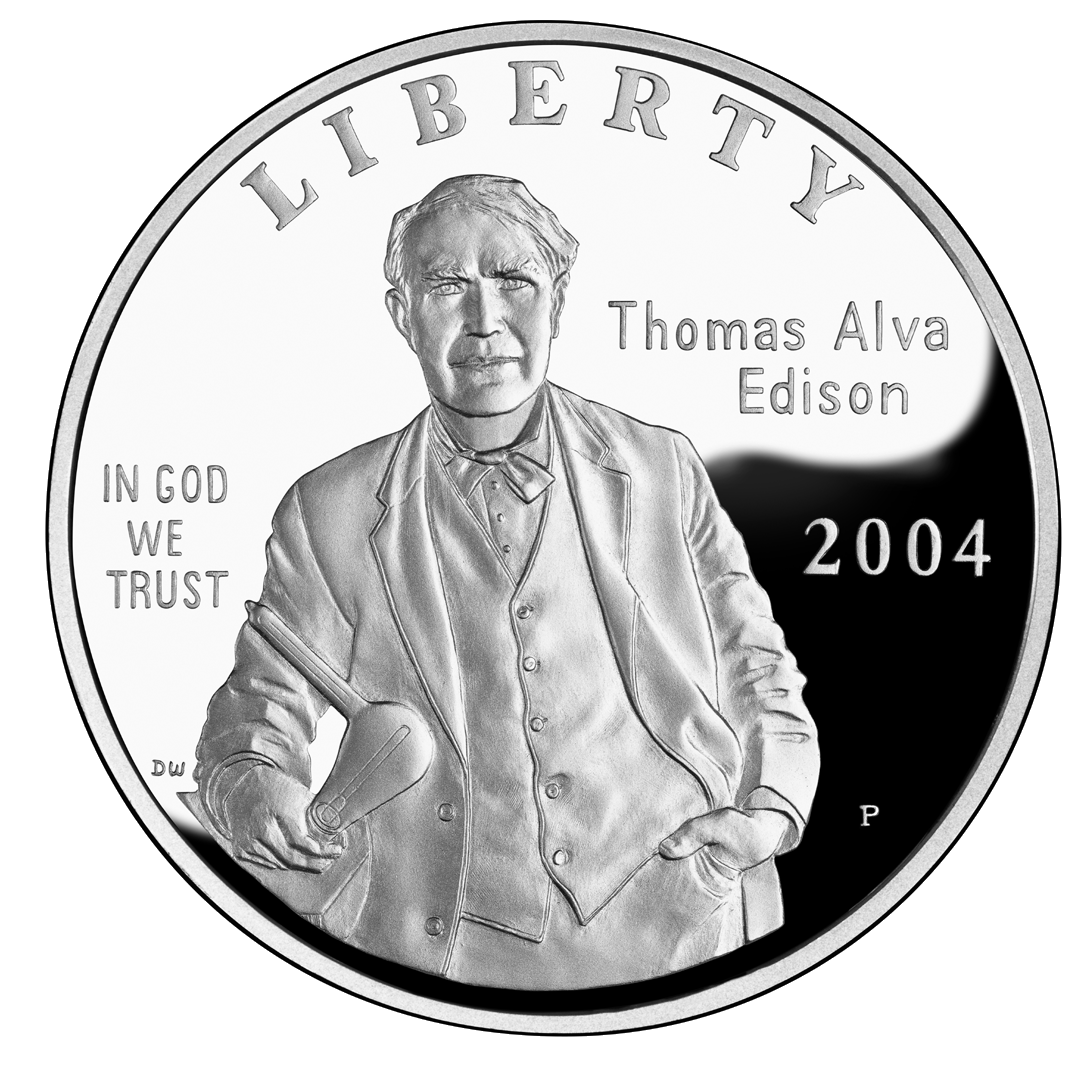
The obverse — the heads side — was designed by U.S. Mint sculptor-engraver Donna Weaver. It shows Edison in his laboratory, holding one of his early experimental bulbs, with the inscriptions LIBERTY, THOMAS ALVA EDISON, IN GOD WE TRUST, and the date 2004. It is a working portrait, not a statesman's pose — the inventor caught mid-experiment, the bulb in his hand.

The reverse — the tails side — is by John Mercanti, the Mint's longtime engraver best known for the Silver Eagle. He rendered Edison's 1879 bulb with rays of light streaming outward, ringed above by 125TH ANNIVERSARY OF THE LIGHT BULB and below by 1879–2004, UNITED STATES OF AMERICA, ONE DOLLAR, and E PLURIBUS UNUM. The whole coin is a single idea told twice: the filament that changed the world.

Every coin was struck at the Philadelphia Mint and carries its mint mark — the small letter showing where it was made — a "P."

Key facts

Year struck
2004 (released February 11, 2004)
Denomination
One dollar (commemorative, not for circulation)
Commemorates
125th anniversary of Edison's practical light bulb (1879)
Obverse designer
Donna Weaver (Edison holding an experimental bulb)
Reverse designer
John Mercanti (Edison's 1879 bulb, light radiating)
Composition
90% silver, 10% copper
Weight / diameter
26.73 g / 38.1 mm
Mint mark
P (Philadelphia)
Authorized maximum
500,000 coins
Proof mintage
211,055
Uncirculated mintage
92,150
Surcharge
$10 per coin, to eight Edison-legacy organizations

Collecting it

This is a modern commemorative, so the appeal is not rarity in the knife's-edge sense — you can still buy one without a hunt. The interest lies in the split between the two versions and the silver inside.

The Mint sold the coin two ways: a proof (the mirror-finish version, struck on polished dies for collectors) and an uncirculated (the standard satin finish). The proof was the popular one, with 211,055 sold; the uncirculated trailed at 92,150. That makes the uncirculated the scarcer of the pair — worth knowing if you want the harder one to find. Together they came to roughly 303,000 coins, well under the 500,000 Congress allowed, so demand never strained the cap.

Because the coin is 90% silver and weighs nearly an ounce, its base value rises and falls with the silver market — a floor that the cheapest modern commemoratives in clad metal don't have. For collectors, the prizes are the top-graded examples: coins certified in the highest mint-state and proof grades, where the strike is flawless and the surfaces untouched. Those high grades are where this otherwise affordable coin gets genuinely scarce.

Questions collectors ask

What does the 2004 Edison silver dollar commemorate?

It marks the 125th anniversary of Thomas Edison's practical incandescent light bulb. He achieved the breakthrough in October 1879 at Menlo Park, New Jersey, with a carbonized-cotton filament — and the reverse of the coin spells out the dates 1879–2004.

Who designed the Edison commemorative dollar?

Two U.S. Mint engravers split it. Donna Weaver designed the obverse — Edison holding an early experimental bulb. John Mercanti, the engraver behind the American Silver Eagle, designed the reverse: Edison's 1879 bulb with light radiating outward.

Is the 2004 Edison dollar real silver?

Yes. It is 90% silver and 10% copper, weighing 26.73 grams. That silver content gives it a metal-value floor that tracks the silver market, on top of any collector premium.

How many Edison silver dollars were made?

The Mint sold 211,055 proof coins and 92,150 uncirculated coins — about 303,000 in total — against an authorized maximum of 500,000. The uncirculated version is the scarcer of the two.

Where did the $10 surcharge on each coin go?

By law, $10 from every coin sold went to eight organizations that preserve Edison's legacy, including the Edison Institute, the Edison Plaza Museum, the Edison Birthplace Association, the Edison Memorial Tower, and the National Park Service. Buying the coin helped fund the places that keep his story.

Sources