US coin · series

The 1943 Steel Cent: the year the penny went to war

Copper was needed for shell casings and wire — so for one year, America made its smallest coin out of steel.

The 1943 Steel Cent: the year the penny went to war
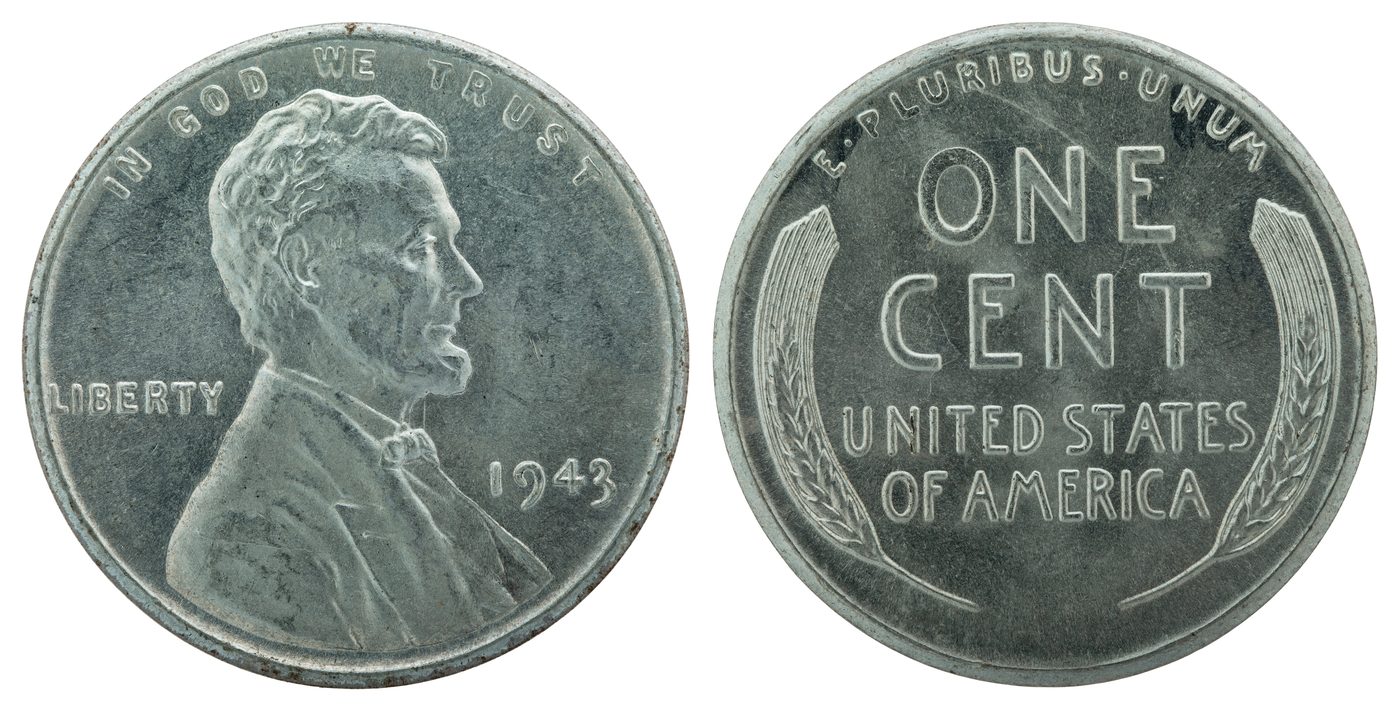
National Numismatic Collection, National Museum of American History (Smithsonian Institution); photograph by Jaclyn Nash · public domain · source

In 1943, the U.S. Mint did something it had never done before and would never do again: it struck more than a billion pennies out of zinc-coated steel. Copper was a weapon of war, and the cent had to give it up.

The story behind the coin

By 1943, the United States was two years into a war that ran on copper. The metal went into shell casings, telephone wire, and the electrical guts of ships and aircraft. The humble one-cent piece — 95% copper since the 1860s — suddenly looked like a small fortune in strategic material being stamped out a billion times a year and dropped into pockets.

So the Mint changed the recipe. Congress and the Treasury authorized a one-year substitute, and on February 23, 1943, the Philadelphia Mint began striking cents from low-carbon steel coated with a thin skin of zinc. The zinc was there to fight rust and give the coin a bright, silvery shine. The steel underneath made it the only regular-issue U.S. coin ever struck on a magnetic planchet — a planchet being the blank metal disc a coin is stamped from.

The public did not love it. The new cents looked like dimes at a glance, and cashiers and vending machines kept confusing the two. Worse, the zinc coating protected the faces but not the edges — when the Mint punched blanks out of coated sheet, the cut exposed bare steel. Within months, circulating steel cents began to spot, darken, and rust. The experiment lasted exactly one year. For 1944 the Mint switched to recycled copper from spent military shell casings, and the steel cent became history — and, almost immediately, a curiosity.

The design and who made it

The steel cent wears a famous face. The obverse — the heads side — carries the profile of Abraham Lincoln created by sculptor Victor David Brenner, the same portrait the cent had used since 1909. The reverse — the tails side — shows two curving ears of durum wheat framing the words ONE CENT, which is why these coins are nicknamed "wheat pennies." Brenner designed both sides.

Nothing about the artwork changed in 1943. The whole transformation was in the metal. That makes the steel cent a rare thing in numismatics: a coin whose entire story is told not by a new design, but by what it was forced to be made of. Hold one and it feels wrong — too light, oddly cold, faintly magnetic. That wrongness is the point. It is a Lincoln cent wearing the uniform of a country at war.

One small grace note in the design history: Brenner's initials, VDB, caused a national uproar when the cent debuted in 1909 — critics called them advertising, and the Mint scrubbed them off within days. They returned, tiny, on Lincoln's shoulder in 1918, and they ride there on every steel cent too.

Key facts

Year struck
1943 (one year only)
Designer
Victor David Brenner (obverse and reverse)
Composition
Low-carbon steel with a thin zinc coating (~99% steel)
Weight
~2.7 g (vs. ~3.11 g for the copper cent)
Diameter
19.05 mm
Edge
Plain
Mints
Philadelphia (no mint mark), Denver (D), San Francisco (S)
Mintage — 1943 (Philadelphia)
684,628,670
Mintage — 1943-D (Denver)
217,660,000
Mintage — 1943-S (San Francisco)
191,550,000
Magnetic?
Yes — the only regular-issue U.S. coin that sticks to a magnet

Collecting it: key dates, varieties, and condition

With over a billion struck across three mints, the everyday 1943 steel cent is one of the most common coins in American history — you can still buy a worn one for pocket change. The chase is about condition and anomalies, not scarcity.

High grades are genuinely hard. Steel cents corrode. The exposed edges spotted in circulation, and even uncirculated coins often show storage rust or carbon flecks decades on. A truly pristine, fully lustrous steel cent — and especially one that has been professionally re-graded as problem-free — is far scarcer than the giant mintages suggest. Collectors prize sharp, spot-free examples precisely because the metal fought so hard against staying that way.

The famous error runs the other way. When the Mint switched to steel, a few leftover bronze (copper-alloy) blanks from 1942 were still in the presses and got struck with 1943 dies. These 1943 copper/bronze cents are among the most legendary error coins in the world — only a few dozen are known across all three mints, with Philadelphia examples most numerous, a small handful from San Francisco, and just one confirmed from Denver. That unique 1943-D bronze cent sold for $1.7 million in 2010. (A simple test separates dream from reality: a real 1943 cent is steel and sticks to a magnet. A copper one does not — but the overwhelming majority of "non-magnetic" 1943 cents are ordinary steel coins plated with copper by hobbyists, not Mint errors.)

The mirror-image error exists too. A few 1944 steel cents were struck the next year on leftover steel blanks after the Mint had gone back to copper. They are rarer than the 1943 coppers, though they command less because the story is less famous.

The headline variety is the 1943-D/D. On some Denver coins the D mint mark was punched twice, leaving a bold second D to the northeast of the first — a repunched mint mark, cataloged as FS-501. It is the most popular repunched mint mark in the entire Lincoln series, scarce in every grade and a strong premium even when worn.

Questions collectors ask

Why is the 1943 penny made of steel?

Copper was a critical war material in 1943 — it went into ammunition, wire, and military equipment. To conserve it, the U.S. Mint struck that year's cents from zinc-coated steel instead of the usual copper alloy. It was a one-year wartime measure; the Mint returned to copper (from recycled shell casings) in 1944.

How can I tell a real 1943 steel cent from a valuable 1943 copper penny?

Use a magnet. A genuine steel cent is magnetic and will stick; the rare copper error will not. But be careful — most 'non-magnetic' 1943 cents are ordinary steel coins that someone copper-plated. A true 1943 bronze cent is one of the rarest U.S. error coins and should be authenticated by a professional grading service.

Is a 1943 steel penny worth a lot of money?

Usually no. More than a billion were made, so a circulated steel cent is worth a few cents to a small premium. Value rises sharply for fully lustrous, rust-free examples in top grades, and for special varieties like the 1943-D/D repunched mint mark. The headline-grabbing prices belong to the copper error, not the regular steel coin.

Who designed the 1943 steel cent?

Victor David Brenner, who created both sides of the Lincoln cent back in 1909 — the Lincoln portrait on the obverse and the wheat-ears reverse. The design didn't change in 1943; only the metal did.

Why do so many 1943 pennies look dark or rusty?

The zinc coating protected the faces but not the edges, which were left as bare steel when the blanks were punched. Exposed to air and handling, the steel corroded. That's why pristine, untoned steel cents are far harder to find than the enormous mintage implies.

Sources