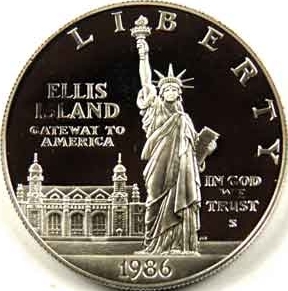
The story behind the coin
By the early 1980s, the most famous statue in America was falling apart. A century of salt air had eaten at her iron skeleton and copper skin. The torch leaked. The whole monument needed a top-to-bottom overhaul, and the bill ran into the hundreds of millions of dollars.
So Congress turned to an old idea: let the coin pay for itself. The Statue of Liberty–Ellis Island Commemorative Coin Act — Public Law 99-61, signed in 1985 — authorized a three-coin set timed to the statue's 100th birthday in 1986. A copper-nickel half dollar, this 90% silver dollar, and a small gold five-dollar piece. Every coin carried a built-in surcharge — a markup on top of the coin's face and metal value — and that money went straight to the Statue of Liberty–Ellis Island Foundation.
The plan worked on a scale nobody had seen before. The program was sold through roughly 16,000 bank branches and 3,500 department stores — Sears and K-Mart among them — backed by television and print ads. Gross sales reached about $292.8 million, and the surcharges brought in roughly $78 million for the restoration. People were not just buying a coin. They felt like they were chipping in to save the statue.