US coin · series

The 1995 Special Olympics Dollar — the first U.S. coin to honor a living woman

A silver dollar that broke a rule almost as old as the Mint itself.

The 1995 Special Olympics Dollar — the first U.S. coin to honor a living woman
United States Mint (usmint.gov) · public domain · source

For most of American history, the U.S. Mint refused to put a living person on a coin. In 1995, it broke that habit for one woman — Eunice Kennedy Shriver, who built the Special Olympics out of a backyard summer camp.

The rule it broke

For most of its history, the U.S. Mint kept the living off its coins. The instinct went back to the founders, who had watched kings stamp their own faces on money and wanted no part of it. Real Americans waited until they were dead to appear on a coin.

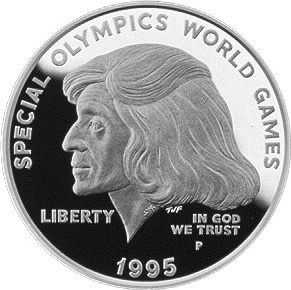
The 1995 Special Olympics dollar broke that rule. Its obverse — the heads side — carries the portrait of Eunice Kennedy Shriver, and when the coin was struck, she was very much alive. It was the first U.S. coin to portray a living woman.

Shriver earned it. In 1962 she opened a day camp for children with intellectual disabilities in her own backyard in Maryland — at a time when those children were routinely hidden away in institutions. That camp grew into the Special Olympics: by 1995 it filled stadiums. The coin was timed to the 1995 Special Olympics World Summer Games in New Haven, Connecticut, where more than 7,000 athletes from over 140 nations competed and President Bill Clinton opened the games at the Yale Bowl.

What the coin shows

The portrait was painted by Jamie Wyeth — the third generation of America's most famous painting family, son of Andrew, grandson of N.C. Wyeth. He gave the Mint the art; U.S. Mint sculptor-engraver T. James Ferrell did the hard part, translating a painter's likeness into low relief that a die could strike a third of a million times.

The reverse — the tails side — was designed by Mint sculptor-engraver Thomas D. Rogers Jr. It pairs a Special Olympics medal with a single rose, wrapped around a line from Shriver herself: "As we hope for the best in them, hope is reborn in us." It is rare for a U.S. coin to quote a living person. This one does, and signs it: "Eunice Kennedy Shriver, Founder."

The coin is a full-size silver dollar — 90% silver, just over 26 grams, the same heft as a Morgan or Peace dollar. It was never meant to spend. Like every modern U.S. commemorative, it was sold straight to collectors and supporters, with the proceeds going to a cause.

Key facts

Year struck
1995
Denomination
Silver dollar ($1)
Honoree
Eunice Kennedy Shriver, founder of the Special Olympics
Occasion
1995 Special Olympics World Summer Games, New Haven, CT
Obverse
Jamie Wyeth (art); T. James Ferrell (sculptor-engraver)
Reverse
Thomas D. Rogers Jr.
Composition
90% silver, 10% copper — 26.73 g, 38.1 mm, reeded edge
Proof mintage
351,764 (1995-P, Philadelphia)
Uncirculated mintage
89,301 (1995-W, West Point)
Maximum authorized
800,000 coins
Surcharge
$10 per coin to the 1995 Special Olympics World Games Organizing Committee
Authorizing act
Public Law 103-328, §204 (Sept. 29, 1994)
Milestone
First U.S. coin to portray a living woman

Collecting it

This is an affordable coin to own, and that is part of its appeal — a genuine first in U.S. coinage that does not cost a fortune. It came in two versions, and the split between them is the whole story for collectors.

The proof — struck at Philadelphia with the "P" mint mark, mirror fields, frosted devices — sold 351,764 coins. The uncirculated business strike, made at West Point with a "W" mint mark, sold only 89,301. That makes the 1995-W the scarcer of the pair by a wide margin, and it is the one collectors of the series watch.

A "mint mark," for the curious, is the small letter showing which Mint struck the coin. As with most modern commemoratives, condition is the real lever on value: the difference between an ordinary uncirculated example and a top-graded one — a flawless strike with no contact marks — can be the difference between a few dollars and a real premium. Because these were sold to collectors and stored carefully, high grades are common enough that only the very best stand out.

Questions collectors ask

Why is the 1995 Special Olympics dollar historically important?

It was the first U.S. coin to portray a living woman — Eunice Kennedy Shriver, the founder of the Special Olympics. The U.S. Mint had long avoided putting living people on coins, a tradition rooted in the founders' distaste for monarchs stamping their own faces on money.

Who is on the 1995 Special Olympics silver dollar?

Eunice Kennedy Shriver, who started the Special Olympics from a backyard day camp in 1962. Her portrait, on the obverse, was painted by artist Jamie Wyeth and sculpted for the coin by Mint engraver T. James Ferrell.

What is the difference between the 1995-P and 1995-W versions?

The 1995-P is the proof — a mirror-finish collector coin struck at Philadelphia, with a mintage of 351,764. The 1995-W is the uncirculated business strike from West Point, with a mintage of just 89,301, making it the scarcer of the two.

Is the 1995 Special Olympics dollar real silver?

Yes. It is 90% silver and 10% copper, weighs 26.73 grams, and measures 38.1 mm across — the same specifications as a classic U.S. silver dollar. It was never meant to circulate; it was sold to collectors.

What does the quote on the reverse say?

The reverse carries Eunice Kennedy Shriver's own words: 'As we hope for the best in them, hope is reborn in us.' It is one of the rare instances of a U.S. coin quoting a living person, and it is credited to her by name.

Sources