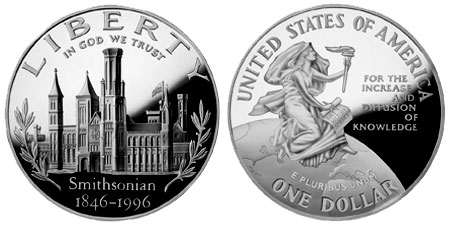
The story behind the coin
Start with the puzzle the coin quietly celebrates. James Smithson was a British scientist — wealthy, illegitimate, and, as far as the record shows, with no friends and no business in the United States. When he died in Italy in 1829, his will carried an extraordinary footnote: if his only heir died childless, his entire fortune was to go "to the United States of America, to found at Washington, under the name of the Smithsonian Institution, an Establishment for the increase and diffusion of knowledge."
The heir did die childless. So in the late 1830s a diplomat sailed home from England with eleven boxes holding 104,960 gold sovereigns — the melted-down fortune of a man Washington had never heard of. Congress argued for a decade about what to do with it. On August 10, 1846, President James K. Polk signed the act that turned a dead stranger's money into the Smithsonian Institution.
That date is why this coin exists. In 1996 the Smithsonian turned 150, and Congress authorized a commemorative silver dollar (and a companion $5 gold coin) to mark the anniversary — the Smithsonian Institution Sesquicentennial Commemorative Coin Act of 1995. The reason for the timing is right there on the coin: the obverse — the heads side — carries a dual date, 1846–1996, the institution's birth year beside its 150th.