US coin · series

The Granite Lady on a Silver Dollar

How the 1906 earthquake's lone survivor put Morgan's eagle back on a U.S. dollar a century later

The Granite Lady on a Silver Dollar
United States Mint (credit: https://www.usmint.gov/learn/coin-and-medal-programs/commemorative-coins) · public domain · source

In 1906, the earth split open beneath San Francisco and fire took almost everything that the shaking left standing. One granite building held. A hundred years later, the U.S. Mint put it on a silver dollar — and quietly revived a design that had been gone since 1921.

The story behind the coin

On the morning of April 18, 1906, a massive earthquake struck San Francisco. The fires that followed burned for three days and leveled much of the city. The U.S. Mint on Fifth and Mission Streets — a heavy granite-and-sandstone fortress finished in 1874 — was one of the few large buildings to come through it intact. Staff and soldiers fought the flames with the building's own water wells while millions of dollars in gold and silver sat in the vaults below.

It survived, and then it went to work. With the city's banks in ashes, the Old Mint became the place where money could still move. It helped clear relief funds and kept commerce alive while San Francisco dug out. The building earned a nickname that stuck: the Granite Lady.

A century later, Congress decided the anniversary deserved a coin. The San Francisco Old Mint Commemorative Coin Act — introduced by Representative Nancy Pelosi and signed into law on June 15, 2006, as Public Law 109-230 — authorized a silver dollar and a five-dollar gold piece to mark the Old Mint's hundredth-anniversary moment. A surcharge of $10 on each silver dollar went to the San Francisco Museum and Historical Society to help restore the building itself. The coin paid for the rescue of its own subject.

The design

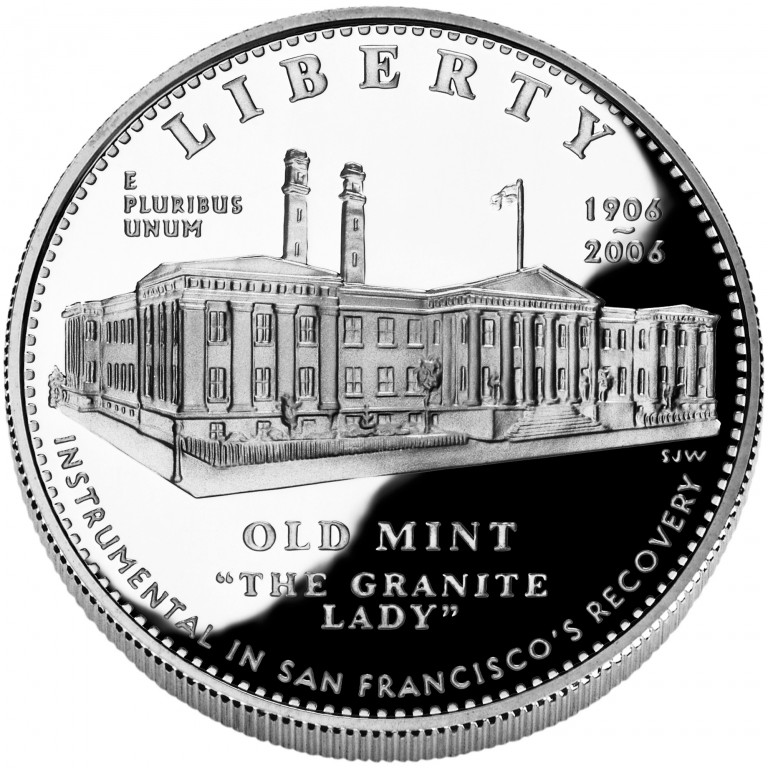
The obverse — the heads side — shows the Old Mint seen from its left corner, the building solid and four-square as it stood through the quake. The view was adapted by sculptor Sheryl J. Winter from a medal honoring the Mint, and the inscriptions tell the whole story in a few words: OLD MINT, THE GRANITE LADY, and the line INSTRUMENTAL IN SAN FRANCISCO'S RECOVERY, with the dates 1906 and 2006.

The reverse is where collectors lean in. It is the eagle from the Morgan dollar — the spread-winged bird clutching arrows and an olive branch that George T. Morgan engraved in the 1870s and that rode the most famous silver dollar in American history. Mint sculptor Joseph Menna built a fresh model for it, working from a 1904 San Francisco Morgan dollar so the revived eagle would carry the right feel. The choice was deliberate: a coin about the San Francisco Mint, wearing a design that the San Francisco Mint had struck by the millions.

Here is the detail that makes the page worth your time. Morgan's reverse last appeared on a circulating-style U.S. silver dollar in 1921, the design's final year before the Peace dollar replaced it. The 2006 commemorative brought it back after an 85-year absence — the first U.S. silver dollar to carry Morgan's eagle in more than three generations. (The Mint would not revive the full Morgan dollar as its own product until 2021.)

Key facts

Year struck
2006
Mint mark
S — San Francisco
Denomination
$1 (silver commemorative)
Composition
90% silver, 10% copper (.900 fine)
Weight
26.73 g
Diameter
38.1 mm
Edge
Reeded
Obverse designer
Sheryl J. Winter
Reverse designer
George T. Morgan (eagle); model by Joseph Menna
Mintage — Proof
160,870
Mintage — Uncirculated
67,100
Surcharge
$10 per coin, to the San Francisco Museum and Historical Society
Authorizing act
Public Law 109-230 (signed June 15, 2006)

Collecting it

This is a modern commemorative, and modern commemoratives are bought, not found in change — so survival is rarely the issue. Both finishes were sold by the Mint already in collector packaging. The proof (a mirror-field, frosted-device strike made for collectors) is the more common of the two, with 160,870 struck. The uncirculated business-strike finish is the scarcer issue at 67,100 — a fraction of the 500,000-coin ceiling Congress had allowed, which tells you the program sold modestly against its cap.

For a coin like this, the value lever is grade. Most examples grade high straight from the Mint, so the premium pieces are the ones a grading service certifies at the very top of the scale — the deep-cameo proofs and the near-flawless uncirculated coins. Two collector instincts also lift demand here: people who chase the modern commemorative series want both finishes, and Morgan dollar enthusiasts want the only modern coin that carries Morgan's eagle on a silver dollar before the 2021 revival. That overlap is the quiet engine under this coin.

Questions collectors ask

Why does a 2006 coin have the Morgan dollar eagle on the back?

The Old Mint in San Francisco struck Morgan dollars by the millions, so the Mint chose Morgan's eagle for a coin honoring that building. Sculptor Joseph Menna built a new model from a 1904 San Francisco Morgan dollar. It was the first time Morgan's reverse appeared on a U.S. silver dollar since 1921 — the design's final year before the Peace dollar — an 85-year gap closed for this one issue.

What is the 'Granite Lady'?

It's the nickname for the old San Francisco Mint building, finished in 1874. Built largely of granite and sandstone, it was one of the few large structures to survive the 1906 earthquake and the fires that followed, and it kept the city's money moving during the recovery.

Is the uncirculated or the proof version scarcer?

The uncirculated business-strike finish is scarcer, with 67,100 struck against 160,870 proofs. Both were sold by the Mint to collectors, so neither is rare in absolute terms — top-grade certified examples carry the premium.

What was the extra $10 on the price for?

Every silver dollar carried a $10 surcharge that went to the San Francisco Museum and Historical Society to help rehabilitate the Old Mint as a museum. The coin helped fund the restoration of the very building it depicts.

How much silver is in it?

It weighs 26.73 grams and is 90% silver — the same standard composition as a classic U.S. silver dollar — giving it just under three-quarters of a troy ounce of pure silver.

Sources