US coin · series

The Coin for a Games That Had Something to Prove

A crystal snowflake, a mountain skyline, and the silver dollar that helped pay for the 2002 Winter Olympics.

The Coin for a Games That Had Something to Prove
United States Mint (credit: usmint.gov) · public domain · source

In 2002, Salt Lake City hosted a Winter Olympics still trailing a bribery scandal that had nearly burned the Games down. The U.S. Mint struck a silver dollar to celebrate it — and to help fund it. The coin sold for more than its silver was worth, and the extra went straight to the people putting on the show.

The story behind the coin

Three years before the torch was lit, the 2002 Salt Lake City Games were nearly the most famous Olympics that never happened. An investigation revealed that members of the Salt Lake bid committee had showered International Olympic Committee delegates with cash, gifts, and favors to win the vote. The fallout forced resignations, federal charges, and a hard look at how host cities got chosen at all.

So when Congress authorized a commemorative coin for the Games, it was doing two things at once. It was honoring the first Winter Olympics on U.S. soil since Lake Placid in 1980 — and it was helping pay for an event that needed all the goodwill, and the money, it could get.

The authorizing law was the 2002 Winter Olympic Commemorative Coin Act, signed on November 6, 2000 — Public Law 106-435. It cleared the Mint to strike two coins: a $5 gold piece and this silver dollar. Every coin carried a built-in donation. The dollar cost collectors $10 above its price, and that surcharge was split evenly between the Salt Lake Organizing Committee and the United States Olympic Committee. Buying the coin meant funding the Games.

The coins went on sale in late 2001, ahead of the February 2002 opening ceremony. They are the keepsakes of a Games that, against the odds, became remembered for the events on the ice and snow rather than the scandal in the boardroom.

The design

The silver dollar is built around the emblem of the 2002 Games — a stylized crystal snowflake, meant to evoke ice, light, and the high desert winter of the Wasatch Mountains. The obverse — the heads side — places that crystal emblem against an angular, geometric pattern the organizers called "Rhythm of the Land," with the five Olympic rings below. It is a deliberately modern look, sharp and faceted, a long way from the eagles and allegorical figures of older U.S. coins. This side was designed by John Mercanti, the Mint's chief engraver and the man whose initials sit on hundreds of millions of American Silver Eagles.

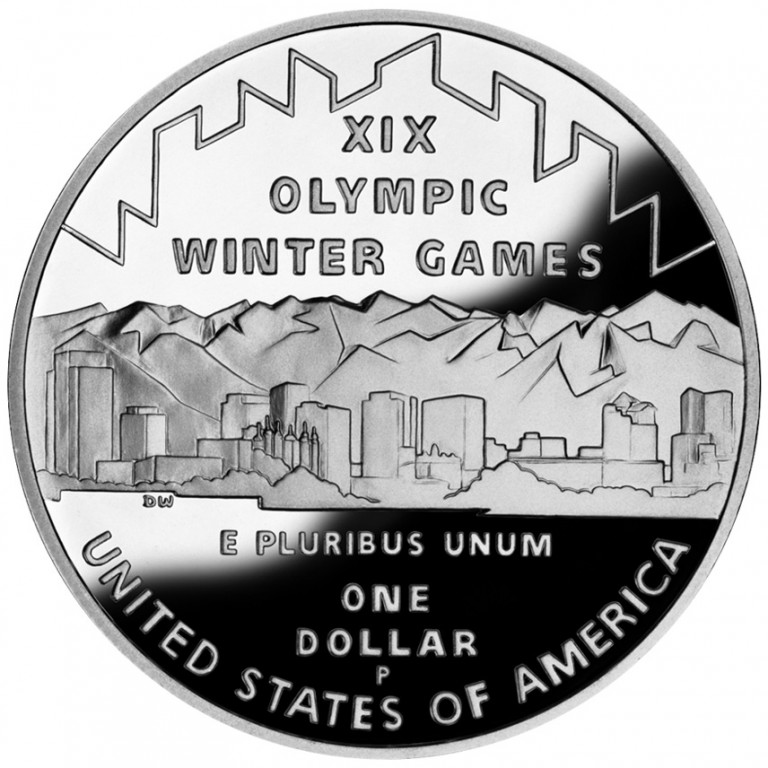
The reverse — the tails side — turns from emblem to place. Donna Weaver, then a Mint sculptor-engraver, depicted the Salt Lake City skyline with the Rocky Mountains rising behind it, the "Rhythm of the Land" motif arcing across the top and "XIX OLYMPIC WINTER GAMES" naming the event. (The Roman numeral XIX marks this as the nineteenth Winter Games.) Together the two sides do the job a host-city coin is supposed to do: one face says Olympics, the other says here.

The same design team carried across the program. Weaver designed both sides of the companion $5 gold coin, whose reverse shows a stylized Olympic flame burning in a cauldron.

Key facts

Denomination
Silver dollar ($1)
Year struck
2002
Authorizing law
Public Law 106-435 — 2002 Winter Olympic Commemorative Coin Act (Nov 6, 2000)
Obverse designer
John Mercanti (crystal emblem, Olympic rings)
Reverse designer
Donna Weaver (Salt Lake skyline, Rocky Mountains)
Composition
90% silver, 10% copper
Weight
26.73 g
Diameter
38.1 mm (1.5 in)
Edge
Reeded
Mint / mark
Philadelphia (P)
Mintage — uncirculated
40,257
Mintage — proof
166,864
Surcharge
$10 per coin, split between the Salt Lake Organizing Committee and the U.S. Olympic Committee

Collecting it

This is a modern commemorative, not a rarity in the way a 19th-century key date is — but the numbers still tell a story. The Mint was allowed to strike up to 400,000 silver dollars across both finishes. It came nowhere close. Only 40,257 of the uncirculated (business-strike) coins and 166,864 proofs were sold, for roughly 207,000 total — barely half the ceiling.

A proof is a coin struck on polished dies for mirror-like fields and frosted devices, made for collectors rather than change. An uncirculated commemorative is struck for collectors too, but with an ordinary matte-bright finish. Here the uncirculated coin is the scarcer of the two — fewer than a third as many were made. That flips the usual instinct, where proofs are the harder coins to find, and it's the first thing a collector notices about this issue.

Because every example was sold to collectors and shipped in Mint packaging, surviving coins are overwhelmingly high grade; the chase is for the very top of the scale — flawless MS70 and PF70 examples — rather than for the coin itself. Slabs from PCGS and NGC sometimes label the dollar as "Mercanti signed," tied to the Mint engraver whose work appears on the obverse; that signature designation, not the date, is what drives premiums on this issue.

Questions collectors ask

Is the 2002 Salt Lake City silver dollar real silver?

Yes. It's struck in 90% silver and 10% copper, weighs 26.73 grams, and measures 38.1 mm across — the classic U.S. silver-dollar standard. It contains about three-quarters of a troy ounce of pure silver.

How many 2002 Olympic silver dollars were made?

Around 207,000 total: 40,257 uncirculated coins and 166,864 proofs, all struck at Philadelphia. Congress authorized up to 400,000, so the program sold barely half its ceiling.

Who designed the coin?

John Mercanti designed the obverse — the crystal snowflake emblem of the Games with the Olympic rings. Donna Weaver designed the reverse, the Salt Lake City skyline against the Rocky Mountains. Weaver also designed both sides of the companion $5 gold coin.

Why does my coin cost more than its silver value?

When the Mint sold it, the price included a $10 surcharge that went to fund the Games — split between the Salt Lake Organizing Committee and the U.S. Olympic Committee. Today, value above the silver depends on grade and packaging, with top-graded examples and 'Mercanti signed' slabs commanding the most.

What does XIX mean on the coin?

It's Roman numerals for 19. Salt Lake City hosted the nineteenth Winter Olympic Games, which is why the coin reads 'XIX Olympic Winter Games.'

Sources