US coin · series

The Rhode Island Tercentenary Half Dollar

50,000 coins, gone in six hours — and a scandal that helped end an era

The Rhode Island Tercentenary Half Dollar
Wikimedia Commons user Bobby131313 (own work) · public domain · source

In March 1936, Rhode Island put a brand-new silver half dollar on sale for a dollar. Banks were reportedly wiped out within six hours. Within weeks, the same coins were changing hands for three times that — and the outcry helped bring the whole US commemorative program crashing down.

The coin that sold out in six hours

In 1936, the United States was awash in commemorative half dollars. Cities and committees had figured out a clever trick: get Congress to authorize a special coin, buy it from the Mint at face value, and sell it to collectors at a markup — with the profit funding a local cause. The Rhode Island Tercentenary half dollar was one of dozens born that year.

It marked 300 years since Roger Williams founded Providence in 1636. Williams had been thrown out of the Massachusetts Bay Colony for preaching that church and state should stay separate. He bought land from the Narragansett people and started his own settlement on what he called religious liberty. Three centuries later, the state wanted a coin to remember it.

The trouble started the moment the coin went on sale. On March 5, 1936, Rhode Island banks offered it at a dollar apiece — and reportedly ran dry within six hours. Collectors who had mailed in orders got nothing. Meanwhile, large stocks somehow stayed in the hands of a few insiders, who were soon advertising the coins at $7.50 a set, then $9. The full mintage was just 50,000 pieces, split across three mints, and the squeeze was on.

What's on the coin

The half dollar was designed by John Howard Benson and Arthur Graham Carey, two sculptors who ran a stonecutting firm in Newport, Rhode Island. That background shows: the relief — the raised, three-dimensional part of the design — has a carved, monumental feel.

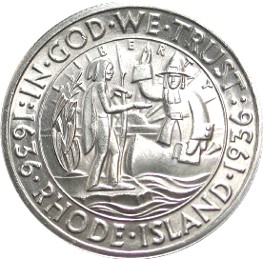
The obverse — the heads side — shows Roger Williams kneeling in a canoe, one hand raised in friendship, a Bible in the other, being greeted by a Narragansett man on the shore. Behind the Narragansett stands a stalk of corn, a nod to the aid Native people gave the early colonists. A rising sun stands in for the religious freedom Williams promised. Curiously, for a coin honoring Providence's 300th birthday, the city is never named on it.

The reverse — the tails side — carries the "Anchor of Hope" from Rhode Island's state seal, with the single-word state motto, HOPE. Both sides were struck in standard 90% silver, the same alloy as the circulating half dollars of the day.

Key facts

Year struck
1936
Occasion
300th anniversary of the founding of Providence (1636)
Designers
John Howard Benson and Arthur Graham Carey
Composition
90% silver, 10% copper
Weight
12.5 g
Diameter
30.61 mm
Edge
Reeded
Authorizing act
May 2, 1935
On sale
March 5, 1936, at $1 each
Total mintage
50,000 (Philadelphia 20,013; Denver 15,010; San Francisco 15,011 — including assay coins)
Mint marks
D (Denver), S (San Francisco); Philadelphia coins unmarked

Collecting it today

Because exactly 50,000 were made and divided across three mints, the Rhode Island is one of the more affordable "three-mint" commemoratives — collectors often chase the matched set of Philadelphia, Denver (D), and San Francisco (S) coins. The mint mark sits beneath the corn stalk on the obverse.

No single coin is dramatically rarer than the others; the three mintages are close in size. What drives value here is condition. Like most commemoratives, these coins were sold to collectors and stored carefully, so worn examples are uncommon — but pristine, fully struck pieces with original luster are another matter. The premium climbs sharply in the highest mint-state grades, and a few exceptional coins have brought four-figure and even five-figure prices at auction.

For the historically minded, the Rhode Island carries a second value: it's a primary artifact of the 1936 commemorative bubble. The scandal it helped trigger pushed Congress to wind down the program by 1939 — making this coin a marker of the moment the whole experiment began to unravel.

Questions collectors ask

Why did the Rhode Island half dollar cause a scandal?

It went on sale at $1 in March 1936 and reportedly sold out at banks within six hours, leaving mail-order collectors empty-handed — while insiders still held large stocks and quickly advertised the coins at $7.50, then $9 per three-coin set. The price gouging fed a wave of collector complaints. It became one of the examples Congress cited when it ended commemorative coin authorizations in 1939.

How many were made?

50,000 total, the full authorized amount: 20,013 at Philadelphia, 15,010 at Denver, and 15,011 at San Francisco (the small extras over round numbers were reserved as assay coins for testing). That makes it scarce by modern standards but not among the rarest classic commemoratives.

Who is on the front of the coin?

Roger Williams, the founder of Providence, shown kneeling in a canoe and being greeted by a Narragansett man. Williams had been banished from Massachusetts for his beliefs and founded Rhode Island on the principle of religious liberty. Oddly, the coin never actually names the city of Providence.

What do the D and S mint marks mean?

They show which mint struck the coin: D for Denver and S for San Francisco. Coins with no mint mark were struck at Philadelphia. The mark is found beneath the corn stalk on the obverse.

Is it real silver?

Yes. The coin is 90% silver and 10% copper, the standard US half-dollar alloy of the era, with roughly 0.36 troy ounces of silver.

Sources