US coin · series

The Oregon Trail Memorial Half Dollar

The most admired American commemorative — and the one that helped end the whole program.

The Oregon Trail Memorial Half Dollar
Heritage Auctions (image); U.S. Mint (coin) · public domain · source

In 1926 the Mint struck a half dollar to honor the pioneers who walked west. It was so beautiful that almost no one objected. Then it kept being struck — 1928, 1933, 1934, on and off until 1939 — in ever-smaller batches sold at ever-higher prices, until even collectors had had enough.

The coin that wouldn't stop

Most US commemorative coins of the early 1900s were struck for one anniversary, in one year, and then never again. The Oregon Trail Memorial half dollar broke that pattern completely. It was struck across 14 years and four different sets of dies, at three different mints — the longest run of any classic US commemorative.

That happened because of a single line in the law. The authorizing act — Public Law 325, signed May 17, 1926 — let the government strike up to six million of these half dollars, but set no deadline and no mint limit. The sponsoring group could come back for more, year after year, as long as demand held.

The sponsor was the Oregon Trail Memorial Association, founded by Ezra Meeker — a genuine pioneer who had crossed the trail by ox-drawn wagon in 1852. At 95, Meeker testified before the Senate to win the coin's approval. He died in December 1928, but the Association lived on, and so did its half dollar. A commemorative — a coin issued to mark an event or honor a person, sold above face value to raise money for a cause — became, in effect, a fundraising machine that never switched off.

That's the tension that makes this coin worth knowing. Numismatic historian Don Taxay called it "the most beautiful as well as the most truly 'American'" of US coins. The dealer-historian Q. David Bowers agreed it was beautiful — "but circumstances surrounding their issuance leave much to be desired." Both things are true at once.

The design: a continent on one side

The artistry is not in dispute. The coin came from the husband-and-wife sculpting team of Laura Gardin Fraser and James Earle Fraser — two of the finest American medallic artists of their day. He had already given the country the Buffalo nickel; she would later design coins and medals of her own renown.

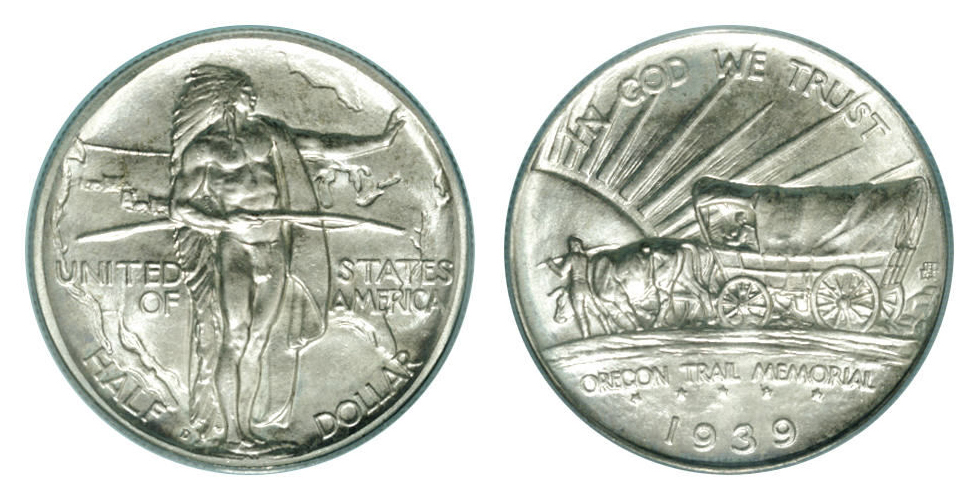
Laura Gardin Fraser designed the obverse — the "heads" side. A Native American figure stands tall, one arm outstretched, set against an outline map of the United States. Across that map runs a thin line of covered wagons, tracing the route of the Oregon Trail itself from the settled East toward the Pacific. It is one of the rare US coins where the whole country is the picture.

James Earle Fraser designed the reverse — the "tails" side. A Conestoga wagon, drawn by oxen, rolls west into a huge setting sun whose rays fill the field. There's a small historical wrinkle worth knowing: the trail pioneers mostly used lighter "prairie schooner" wagons, not the heavier Conestoga. The Conestoga simply looks the part — sleek and iconic — so that's what generations of artists, Fraser included, reached for. It's a beautiful image and a slightly romanticized one, which suits this coin perfectly.

Key facts

Denomination
Half dollar (50 cents)
Years struck
1926-1939 (intermittently)
Designers
Laura Gardin Fraser (obverse), James Earle Fraser (reverse)
Authorizing act
Public Law 325, signed May 17, 1926
Sponsor
Oregon Trail Memorial Association (founded by Ezra Meeker)
Mints
Philadelphia (no mark), Denver (D), San Francisco (S)
Composition
90% silver, 10% copper
Weight
12.5 g
Diameter
30.61 mm
Edge
Reeded
Authorized maximum
6,000,000
Total struck
~264,419
Net distributed (after melts)
~202,928 (about 61,317 melted)
Scarcest issues
1939 P/D/S set — about 3,004-3,005 each

Collecting it: the dates that matter

For a coin struck over 14 years, the Oregon Trail is unusually approachable in some dates and genuinely scarce in others — and the story explains the prices.

The first two issues are the common ones. The 1926 Philadelphia coin (about 47,955 distributed) and the 1926-S from San Francisco (about 83,055) were made when enthusiasm was high and buyers turned out in numbers. These are the dates most collectors start with.

Then the math changes. As early buyers stopped reordering, the Association cut the batches smaller and smaller — and raised prices. The 1928 issue was held back and not even released until 1933. The Depression-era and late-1930s strikes were tiny by comparison: the 1933-D (the first commemorative ever struck at the Denver Mint, about 5,008 pieces), the 1936-S (about 5,006), and the run of three-coin "PDS sets" — one each from Philadelphia, Denver, and San Francisco, sold together.

The 1939 set is the prize. Just over 3,000 coins from each mint — the lowest mintages of the whole series — packaged and sold as a set for $7.50, a steep price in 1939. A collector who wanted a complete date-and-mint run had to buy these scarce, expensive late sets, exactly as the sellers intended.

That tactic is what soured the coin's reputation. Collectors complained loudly about being squeezed for "new" coins that were really the same design at higher prices. The backlash reached Congress, which on August 5, 1939 abruptly ended every standing commemorative authorization — including this one. The Oregon Trail half dollar didn't just outlast its peers; it helped kill them. In condition, most surviving pieces are well struck and were saved by collectors, so problem-free Mint State examples are common; truly superb gems (MS-67 and finer) are scarce and command strong premiums.

Questions collectors ask

Why was the Oregon Trail half dollar struck for so many years?

The 1926 law that authorized it set no expiration date and no limit on how many mints could strike it — only a six-million-coin ceiling. The sponsoring Oregon Trail Memorial Association used that loophole to order fresh batches on and off from 1926 to 1939, far longer than any other classic US commemorative.

Which Oregon Trail half dollar is the rarest?

The 1939 issues. About 3,004 to 3,005 coins were distributed from each of the three mints (Philadelphia, Denver, San Francisco) — the lowest mintages in the series — and they were sold only as a three-coin set, originally for $7.50.

Who designed the Oregon Trail half dollar?

The husband-and-wife sculptors Laura Gardin Fraser and James Earle Fraser. She designed the obverse — a Native American standing before a map of the United States with the trail of wagons across it. He designed the reverse — a Conestoga wagon rolling into the setting sun.

Is the Oregon Trail half dollar made of silver?

Yes. It's 90% silver and 10% copper, weighs 12.5 grams, and contains about 0.362 troy ounces of silver — the same alloy as a regular US silver half dollar of the era.

How did this coin affect the US commemorative program?

Its endless reissues at rising prices became a textbook case of commemorative abuse. Collector anger over the practice was a major reason Congress terminated all existing commemorative coin authorizations on August 5, 1939.

Sources