US coin · series

The Native American Dollar: a coin that retells history every year

One face stays. The other changes annually — a rolling tribute to Native American contributions, struck in 'golden' brass that holds no gold at all.

The Native American Dollar: a coin that retells history every year
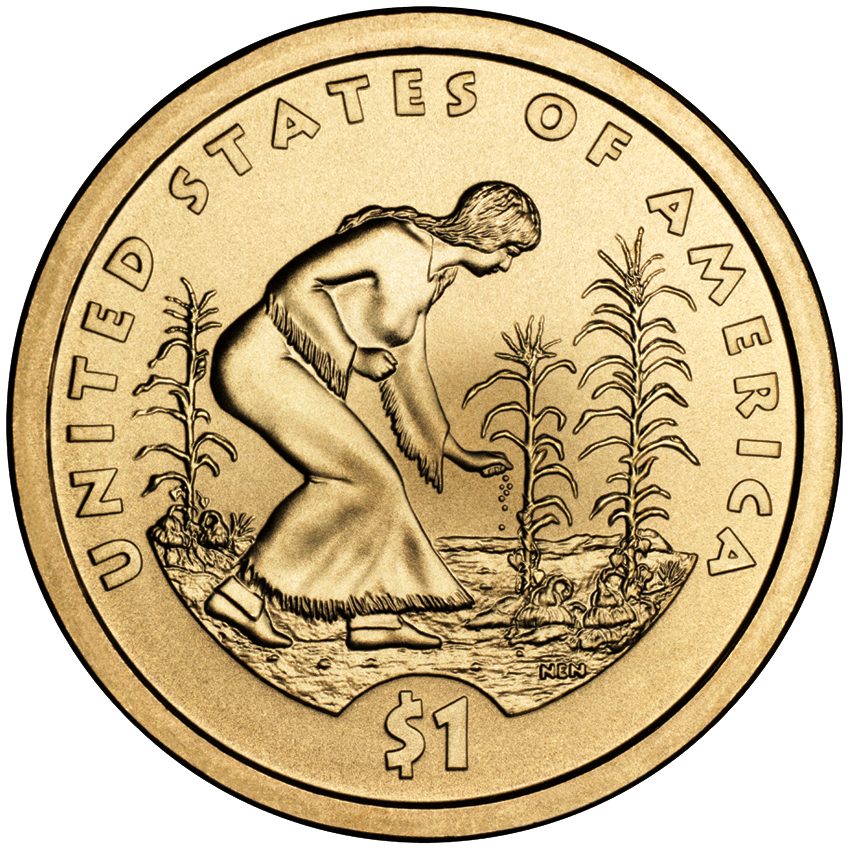
United States Mint (reverse design "Three Sisters" by Mint sculptor-engraver Norman E. Nemeth) · public domain · source

Most coins say one thing for decades. The Native American Dollar says something new every January. Sacagawea has held the front since 2000, but since 2009 the back has carried a different chapter of Native American history each year — agriculture, treaties, code talkers, astronauts. It is the most restless design in the U.S. coin cabinet, and a quiet error hidden in its edge once sold for almost ten thousand dollars.

The story behind the coin

By 2002, the U.S. government had a dollar-coin problem. More than 200 million Sacagawea dollars sat unspent in bags in federal vaults. Americans simply preferred the paper dollar, and no amount of golden shine could change that habit.

So Congress tried a different tack: make the coin interesting. The Native American $1 Coin Act, signed on September 20, 2007, kept Sacagawea on the front but ordered the Mint to put a brand-new design on the back every single year — each one "celebrating the important contributions made by Indian tribes and individual Native Americans to the development of the United States."

The first of these new coins appeared in 2009. The idea was part civic history lesson, part collector hook. If the dollar wouldn't circulate, at least it could teach — and give people a reason to keep one. The series is still running today, which means the Native American Dollar has quietly become one of the longest-running annual design programs the Mint has ever attempted.

The design and who made it

The front — the obverse, the heads side — has not changed since the coin's debut in 2000. It shows Sacagawea, the young Shoshone woman who guided the Lewis and Clark expedition, carrying her infant son Jean Baptiste on her back. She looks straight out at you, which broke with the old tradition of profile portraits. The sculptor was Glenna Goodacre, who modeled the face on a living Shoshone woman, Randy'L He-dow Teton. Goodacre's Sacagawea is the constant; everything else moves.

The back — the reverse, the tails side — is where the program lives. A new theme arrives each year, designed by a rotating cast of Mint sculptor-engravers and outside artists. The 2009 inaugural reverse, Three Sisters Agriculture by Mint sculptor Norman E. Nemeth, shows a Native woman planting the three crops — corn, beans, and squash — that traditional farmers grew together so each plant helped the others. Later years brought the Hiawatha Belt and the Great Law of Peace (2010), the 1621 Wampanoag treaty (2011), WWI and WWII Code Talkers (2016), the athlete Jim Thorpe (2018), and Native Americans in space (2019), among many more.

Two more things changed in 2009. The Mint moved the date, mint mark, and "E PLURIBUS UNUM" off the faces and onto the edge — the thin rim — as raised lettering, freeing the whole reverse for art. And the coin's nickname misleads almost everyone: it is the "golden dollar," but there is no gold in it. The color comes from manganese brass clad over a copper core.

Key facts

Years struck
2009–present (annual reverse designs)
Obverse designer
Glenna Goodacre — Sacagawea & infant son (unchanged since 2000)
2009 reverse designer
Norman E. Nemeth — 'Three Sisters Agriculture'
Composition
Manganese-brass clad over copper core (no gold) — 88.5% Cu, 6% Zn, 3.5% Mn, 2% Ni overall
Weight / Diameter
8.1 g / 26.49 mm
Edge
Lettered — date, mint mark, E PLURIBUS UNUM (new in 2009)
Authorizing law
Native American $1 Coin Act (Pub. L. 110-82, 2007)
Circulation status
Collector-only after 2011; mintages fell sharply from 2012

Collecting it

For the first three years, these were everyday-money coins. The 2009-P had a mintage of 39,200,000 and the 2010-D the highest of the series at 48,720,000. Then the math changed. Like the Presidential dollars beside them, the Native American dollars piled up unused, and in late 2011 the Treasury announced that future dollar coins would be made for collectors only.

The drop is dramatic, and it is the heart of why collectors chase the later dates. From tens of millions a year, 2012 production collapsed to 2,800,000 (P) and 3,080,000 (D). The early collector-only dates run scarcer still — the 2013-P and 2013-D each at 1,820,000, and the 2015-D at just 2,240,000. None of these ever went into general circulation, so they were never spent, lost, or worn. They survive almost entirely as pristine collector coins, which is exactly why a high grade — the mint-fresh, undamaged condition graders certify on a 70-point scale — is the prize. A common date in an exceptional grade can be worth far more than its scarcer sibling in an ordinary one.

The famous chase, though, is an accident. Because the edge lettering is stamped in a separate step from striking the faces, a few coins slipped through with a blank, smooth edge — the 2009 Missing Edge Lettering error. One celebrated early example reportedly sold for just under $10,000. That kind of money is the exception, not the rule, but it is why every serious collector tips a Native American Dollar on its side before deciding it's just pocket change.

Questions collectors ask

Is the Native American 'golden dollar' actually made of gold?

No. Despite the nickname and the color, there is no gold in it. The golden tone comes from a manganese-brass outer layer clad over a copper core. Its metal value is small; its value to collectors comes from condition, scarce dates, and errors.

Why are the 2012-and-later coins worth more than the early ones?

After 2011 the U.S. Mint stopped making these for circulation and produced them only for collectors. Mintages fell from tens of millions to a few million — for example, 2,800,000 for 2012-P and 1,820,000 for 2013-P — so the later dates are much harder to find.

What is the 2009 'missing edge lettering' error?

The date, mint mark, and E PLURIBUS UNUM are stamped onto the edge in a step separate from striking the faces. A small number of 2009 coins missed that step and have a blank, smooth edge. They are scarce and collectible; one early example reportedly sold for nearly $10,000.

Who is on the front, and who designed it?

Sacagawea, the Shoshone woman who guided the Lewis and Clark expedition, shown carrying her infant son Jean Baptiste. The portrait was sculpted by Glenna Goodacre and has stayed the same since 2000, even as the reverse design changes every year.

Is this the same as the Sacagawea dollar from 2000–2008?

It is the same coin family with the same Sacagawea front. The difference is the back: 2000–2008 used Thomas D. Rogers's soaring eagle, while from 2009 on a new Native American history theme appears each year. The 2009 coins also added lettering to the edge.

Sources