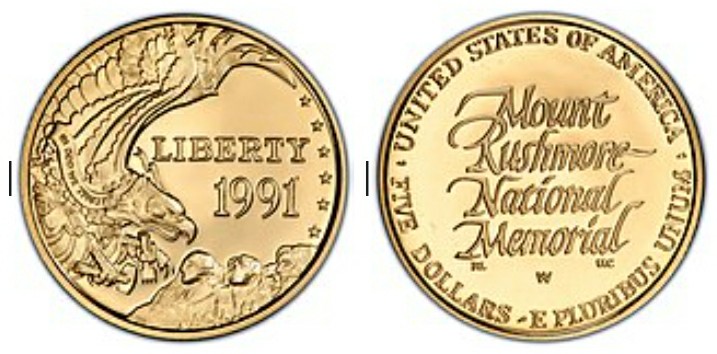
The story behind the coin
In 1927, a Danish-immigrant sculptor named Gutzon Borglum pointed at a bare granite cliff in the Black Hills of South Dakota and decided to carve four presidents into it. It took fourteen years, hundreds of workers, and a great deal of dynamite. Borglum died in 1941, months before the job was finished; his son Lincoln drilled the last details that October.
By 1991, that face of stone — Washington, Jefferson, Theodore Roosevelt, and Lincoln, each head as tall as a six-story building — was fifty years old and badly weathered. The cracks needed sealing. The visitor facilities were dated. Money had to come from somewhere.
So Congress did what it had been doing more and more often since the 1980s: it turned an anniversary into a fundraiser. The Mount Rushmore Commemorative Coin Act (Public Law 101-332, signed July 16, 1990) authorized a three-coin set — a copper-nickel half dollar, a silver dollar, and this gold $5 piece — and tacked a surcharge onto each one. A surcharge is a built-in donation: every buyer paid extra, and that extra went to a cause. For the gold coin, the surcharge was $35. Half of all the surcharges went to pay down the national debt; the other half went to the Mount Rushmore National Memorial Society of the Black Hills, to help repair and improve the monument the coin celebrates.