US coin · series

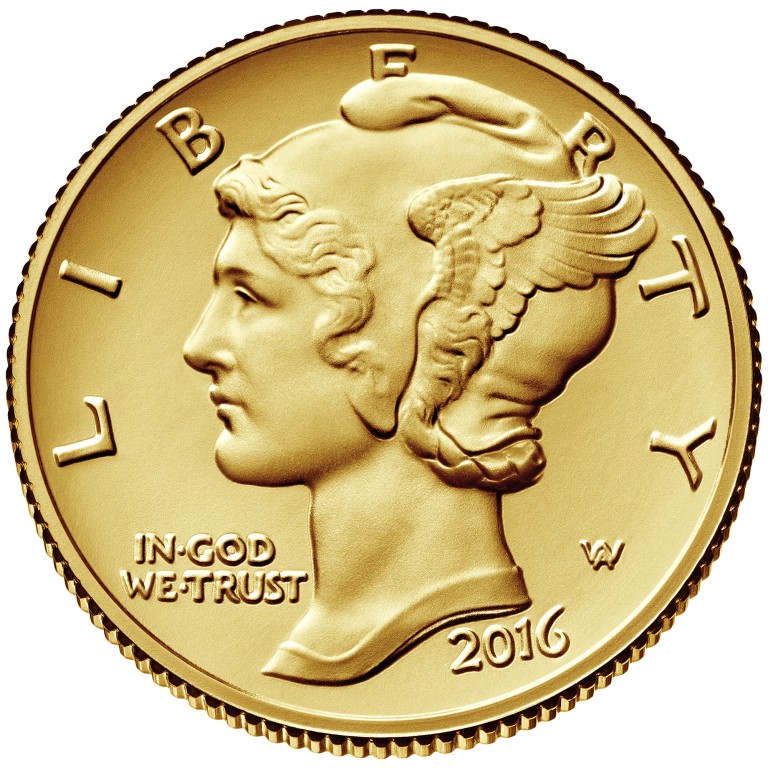
The 2016 Gold Mercury Dime: a beloved design, reborn in 24-karat

One hundred years after Adolph Weinman's dime first reached pockets, the Mint struck it again — this time in pure gold.

The 2016 Gold Mercury Dime: a beloved design, reborn in 24-karat
United States Mint · public domain · source

In 1916, a sculptor's winged Liberty turned a ten-cent coin into a small work of art. A century later, the U.S. Mint shrank that same design onto a tenth of an ounce of pure gold — and collectors bought it out in under an hour.

The story behind the coin

In 2016, the U.S. Mint threw a hundredth-birthday party for three of the most loved coins it ever made. In 1916, three new silver designs had arrived all at once — a dime, a quarter, and a half dollar — sweeping away the staid "Barber" portraits that had run for two decades. To mark the centennial, the Mint struck all three again in pure gold. The dime came first.

It went on sale on April 21, 2016, at $205, in a tiny tenth-ounce of 24-karat gold. The reception was almost violent. Within fifteen minutes the Mint's website flipped the coin to "Backorder." Less than an hour after release, it read "Unavailable." By April 24 — three days in — roughly 122,500 had sold against a hard cap of 125,000. When the dust settled, about 124,885 coins had been struck and sold, just shy of the limit.

Why the frenzy over a gold dime? Partly the gold. But mostly the design — a face Americans had carried in their pockets for thirty years and never stopped loving.

The design

The design is Adolph A. Weinman's, and it is the whole point of the coin. The obverse — the heads side — shows Liberty in profile, wearing a winged cap. Generations called it the "Mercury dime" because that cap looks like the winged helmet of the Roman god. It isn't Mercury. Weinman meant the wings to stand for "liberty of thought" — freedom of the mind, not a deity.

The model has never been confirmed. Weinman never named her, and no one ever credibly claimed the honor. Collectors have long believed — it is the standard story, though it remains unproven — that she was Elsie Stevens, wife of the poet Wallace Stevens, who rented from Weinman in New York. He had sculpted a bust of her in 1913. It is a lovely story; treat it as the leading theory, not settled fact.

The reverse — the tails side — carries a fasces, a bound bundle of rods around an axe, an ancient symbol of strength through unity. An olive branch wraps it. Read together on the eve of America's entry into World War I, the pairing said one thing plainly: ready for war, longing for peace.

The 2016 gold version is faithful down to the details. It was struck at the West Point Mint, with a tiny "W" mint mark — a stamped letter showing which facility made it — set to the right of the word ONE on the reverse. The Mint gave it an uncirculated finish meant to echo the look of the original 1916 dime, not the mirror shine of a proof. The reverse even spells out the metal: AU 24K (.9999 Fine) 1/10 OZ.

Key facts

Issued
2016 (one year only)
Mint
West Point — 'W' mint mark
Designer
Adolph A. Weinman (1916 design)
Denomination
Ten cents (One Dime)
Composition
.9999 fine gold (24-karat)
Weight
1/10 troy ounce (≈3.11 g)
Diameter
16.50 mm
Finish
Uncirculated 'special strike' (not a proof)
Mintage limit
125,000
Number sold
≈124,885
Issue price
$205
Released
April 21, 2016 — sold out within the hour

Collecting it

For a one-year coin, this is a relatively forgiving series to collect: there is just one date, one mint, one finish. There are no rare die varieties to hunt and no "key date" that costs ten times the rest. The whole population was struck at West Point in 2016 and capped near 125,000.

What collectors chase instead is grade. Grading services certify these as "SP" — Special Strike — and the prize is SP70, a flawless coin under magnification. A coin labeled "First Day of Issue" or "First Strike," or one in original Mint packaging with its certificate, tends to carry a premium over a raw example. None of that changes the metal; a tenth-ounce of gold is a tenth-ounce of gold, and the coin's value tracks both its gold content and collector demand for the design.

One honest note for the curious newcomer: this is a modern collectible, not a circulating coin. No 2016 gold dime ever bought a stick of gum. It was made to be admired and saved — a centennial keepsake for a design that earned the affection.

Questions collectors ask

Is the 2016 gold Mercury dime real gold?

Yes — it is .9999 fine gold (24-karat), containing one-tenth of a troy ounce. The reverse states the composition outright: AU 24K (.9999 Fine) 1/10 OZ.

Why did the Mint make a gold version of the Mercury dime?

To mark the 100th anniversary of 1916, when Weinman's dime debuted alongside two other new silver designs — the Standing Liberty quarter and the Walking Liberty half dollar. The Mint reissued all three in gold; the dime was the first to be released.

How many were made, and did it really sell out fast?

The Mint capped the issue at 125,000 and ultimately sold about 124,885. It moved into 'Backorder' within roughly fifteen minutes of going on sale and 'Unavailable' in under an hour.

Who actually modeled for Liberty's portrait?

No one knows for certain. Weinman never named the model, and no one ever confirmed it. The widely repeated belief — unproven — is that she was Elsie Stevens, wife of the poet Wallace Stevens, whom Weinman had sculpted in 1913.

Is it called the Mercury dime because of the Roman god?

It's a nickname born of confusion. The winged cap reminded people of the god Mercury, but Weinman intended the wings to symbolize 'liberty of thought,' not a deity. The official name is the Winged Liberty Head dime.

What does SP70 mean on the holder?

SP stands for 'Special Strike,' the designation grading services use for this coin's finish. The number is the condition grade on a 70-point scale; SP70 is a coin with no flaws visible under magnification — the top of the scale.

Sources