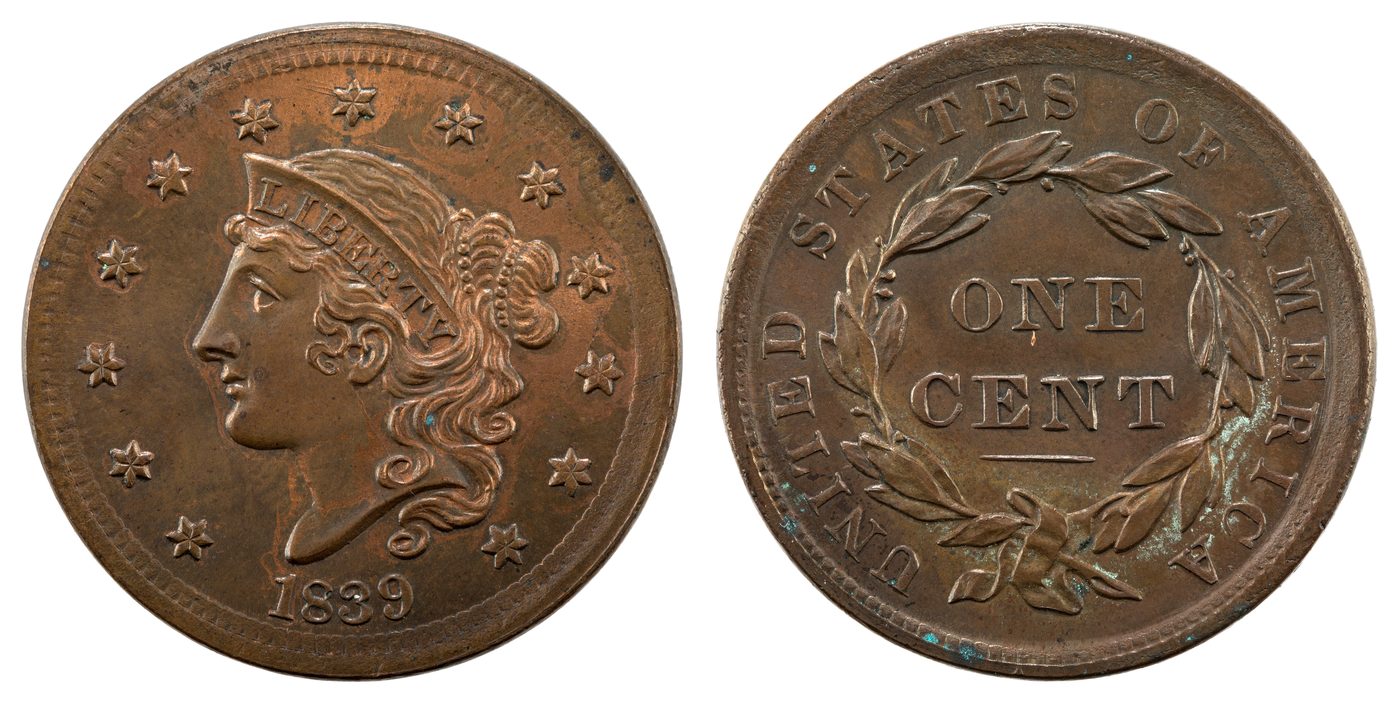
The Matron Head is one of the friendlier early coppers to start with — most dates exist in enough quantity that a worn, honest example is affordable. The interest lives at the two ends: the genuinely rare dates, and the hoard that makes the early ones strangely easy.
The 1823 is the key. Here the calendar plays a trick. No cents were actually struck in 1823; the coins that bear that date were struck in 1824, alongside the 1824s. They come two ways — a normal date and an 1823/2 overdate, where an old "2" punch still shows under the "3" because the Mint reused a die. Both are scarce, and the 1823 is widely held to be the hardest regular cent to find of its whole era. There are also private restrikes — pieces made decades later, around the 1860s, by someone outside the Mint (the dealer Joseph Mickley is the name most often floated, though it has never been proven) using an 1823 die mated to an old reverse. The restrikes are collectible in their own right; they are not Mint products, and a serious cabinet wants the distinction labeled.
The 1821 is the genuine low-mintage date. Just 389,000 were struck — the smallest output of the type — and it is tough in high grade.
Varieties reward a sharp eye. The most famous is the 1817 "15 Stars," where the obverse carries fifteen stars instead of the usual thirteen — a design slip that collectors prize. Overdates run through the series: besides the 1823/2, there are 1819/8, 1820/19, 1824/2, and 1826/5, each the fingerprint of a reused or repunched die.
Why high grade is scarce — and why some early dates aren't. Copper is unforgiving. It darkens, spots, and corrodes, so a cent that kept its original bright "red" color (the just-struck copper shine, as opposed to the brown a coin turns with age) is genuinely hard to find and commands a premium. With one big exception. Sometime after the Civil War — the story says inside a small keg, possibly under a railroad platform in Georgia — a cache of uncirculated cents dated 1816 through 1820 surfaced. It is remembered as the Randall Hoard, after John Swan Randall, who handled the coins as they reached the market in the 1860s and '70s. A good estimate puts it near 5,000 pieces. That single find is the reason mint-state cents of 1816–1820 are far more available than the date and age would suggest. Most Randall coins show a telltale look — bright red mottled with brown or black flecks; a fully pristine, untouched red survivor is the rare prize within the rare prize.