US coin · series

The 1983 Olympic Dollar: an ancient athlete, reborn to pay for a modern Games

The coin that restarted America's commemorative silver dollar after an 83-year silence — and sent ten dollars to the Olympics with every sale.

The 1983 Olympic Dollar: an ancient athlete, reborn to pay for a modern Games
United States Mint · public domain · source

In 1983 the United States struck its first commemorative silver dollar since 1900 — and put an ancient Greek discus thrower on it. Each one carried a $10 surcharge that went straight to the Los Angeles Games. It became the only modern commemorative ever sold from all three U.S. mints at once.

The coin that paid for an Olympics

For 83 years, the United States had not struck a single commemorative silver dollar. The last one — the Lafayette dollar of 1900 — was a distant memory. Then Los Angeles won the 1984 Summer Olympics, and the organizers faced a uniquely American problem: these would be the first privately financed Games of the modern era. No federal bailout, no taxpayer guarantee. They had to raise the money themselves.

Congress reached for an old idea. In 1982 it passed Public Law 97-220, authorizing a set of Olympic coins — two silver dollars and a $10 gold piece — and built a surcharge into every one. Buy the 1983 dollar and $10 of your purchase price went directly to the Games. Buy the gold coin and $50 did. Sales weren't a souvenir; they were fundraising.

This dollar was the first to appear. It followed the 1982 Washington half dollar that had revived the commemorative program after a 28-year gap — but it was the first commemorative silver dollar the Mint had issued since the Lafayette piece of 1900. By the time the Olympic coin program closed, the surcharges had delivered roughly $73.4 million, split evenly between the Los Angeles Olympic Organizing Committee that staged the Games and the U.S. Olympic Committee that trained the athletes.

A discus thrower, 2,400 years old

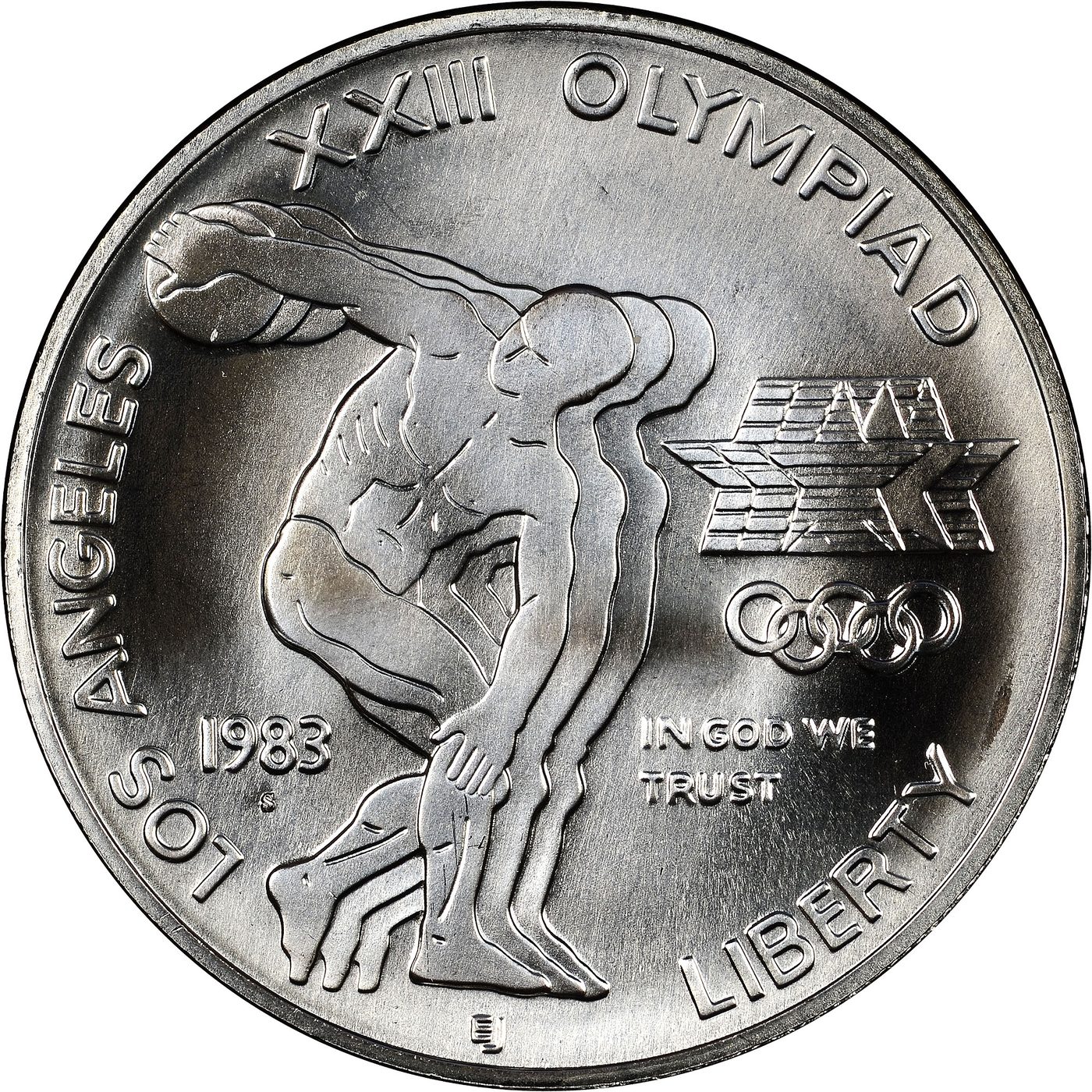
For the obverse — the heads side — Chief Engraver Elizabeth Jones did not invent a new athlete. She borrowed one. The figure is a reinterpretation of the Discobolus, the discus thrower sculpted by the Greek master Myron around the middle of the 5th century B.C. It is one of the most famous poses in all of art: the body coiled, weight loaded, the throw an instant from release.

Jones reworked that ancient tension into a modern study of motion. The athlete is rendered without a head — a deliberate echo of the way Myron's original survives only in headless Roman marble copies. Around the figure run the words LOS ANGELES XXIII OLYMPIAD, LIBERTY, IN GOD WE TRUST, and the date 1983, with her initials EJ.

The reverse turns to a different icon. It shows the head and upper body of an American eagle, designed by Jones together with John M. Mercanti — whose initials JM sit beside hers as EJ·JM. The eagle carries E PLURIBUS UNUM, UNITED STATES OF AMERICA, and ONE DOLLAR. It is a large, heavy coin: 90% silver, 26.73 grams, 38.1 mm across, with a reeded edge.

Key facts

Denomination
Silver dollar (commemorative)
Year struck
1983 (for the 1984 Los Angeles Olympics)
Obverse designer
Elizabeth Jones — discus thrower after Myron
Reverse designer
Elizabeth Jones & John M. Mercanti — American eagle
Composition
90% silver, 10% copper (0.7736 oz silver)
Weight / diameter
26.73 g / 38.1 mm, reeded edge
Mints
Philadelphia, Denver, San Francisco
Uncirculated mintage
294,543 (P) · 174,014 (D) · 174,014 (S)
Proof mintage
1,577,025 (1983-S proof)
Surcharge
$10 per coin, to the L.A. and U.S. Olympic committees
Authorizing law
Public Law 97-220 (1982)

What collectors chase

The 1983 Olympic dollar has a quirk no other modern U.S. commemorative shares: it was struck — and sold — from all three operating mints in the same year, carrying the P, D, and S mint marks (the small letter showing where a coin was made). The Mint did it on purpose. Eager to prove the revived commemorative program could move coins, it offered the Denver and San Francisco uncirculated pieces only as part of a three-coin set, never individually. That marketing decision makes the 1983–1984 Olympic dollars the only modern commemorative set ever sold this way.

It also explains the mintages. The Philadelphia coin, sold on its own, reached 294,543 uncirculated. The Denver and San Francisco coins — locked inside the set — came in lower, at 174,014 each. The collectible scarcity, in other words, was engineered by how the coins were sold, not by any shortage of silver.

Far more proofs exist — over 1.5 million 1983-S proofs were struck — so for most collectors the chase is condition, not date. These are big silver coins that were saved carefully, so ordinary examples are common and inexpensive. Top-grade pieces are a different story: flawless MS-70 examples are genuinely scarce and command real premiums. Congress authorized up to 50 million Olympic dollars across 1983 and 1984; actual demand fell far short of that ceiling, which is why the coins are plentiful and affordable today even as the finest survive in small numbers.

Questions collectors ask

Why does the 1983 Olympic dollar come with P, D, and S mint marks?

The U.S. Mint struck it at Philadelphia, Denver, and San Francisco in the same year and sold the Denver and San Francisco uncirculated coins only inside a three-coin set. It's the only modern U.S. commemorative ever offered that way, which is why all three mint marks exist for one design.

Is the 1983 Olympic dollar real silver?

Yes. It's 90% silver and 10% copper, weighs 26.73 grams, and contains about 0.7736 troy ounces of silver — the same fineness as classic pre-1965 U.S. silver dollars.

Who designed the discus thrower?

U.S. Mint Chief Engraver Elizabeth Jones designed the obverse, reinterpreting the Discobolus sculpted by the ancient Greek artist Myron around 450 B.C. Jones and John M. Mercanti designed the eagle on the reverse.

What was the $10 surcharge for?

Every silver dollar carried a $10 surcharge built into its price (the gold coin carried $50). The money was split evenly between the Los Angeles Olympic Organizing Committee and the U.S. Olympic Committee, and the program raised about $73.4 million in total.

Why are some 1983 Olympic dollars worth far more than others?

Most are common and trade close to their silver value. The premium pieces are the highest certified grades — a flawless MS-70, or a low-mintage uncirculated Denver or San Francisco coin in top condition — where survivors are genuinely scarce.

Sources