US coin · series

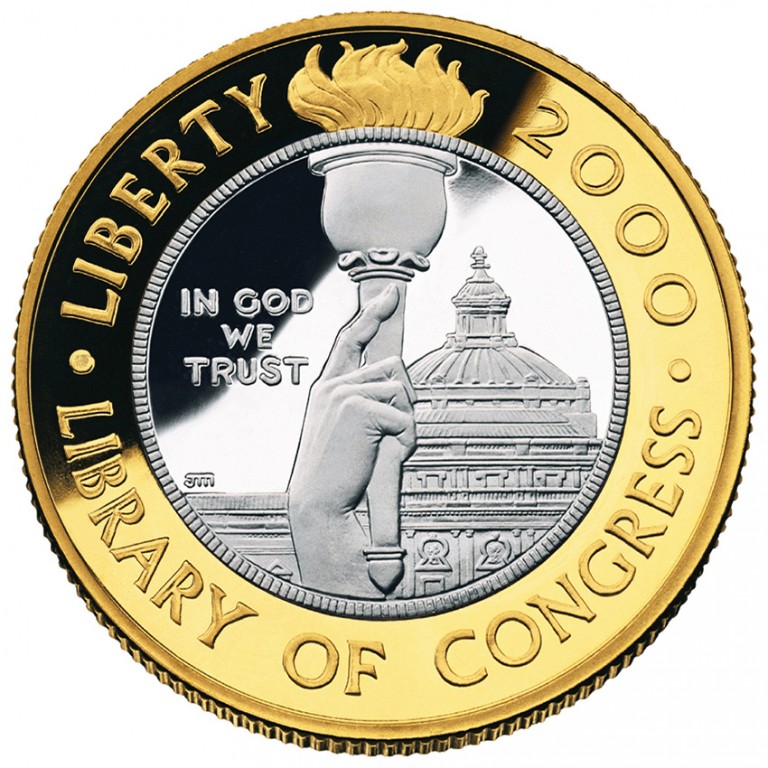
The 2000 Library of Congress $10 — the only coin the U.S. Mint ever made from two precious metals at once

A ring of gold around a core of platinum. The Mint struck it once, hit a wall, and never tried again.

The 2000 Library of Congress $10 — the only coin the U.S. Mint ever made from two precious metals at once
United States Mint · public domain · source

In 2000 the United States Mint did something it had never done before and has never done since: it locked a disc of platinum inside a ring of gold and struck them together as a single coin. It honored the Library of Congress turning 200. It nearly didn't work — and that's a large part of why collectors chase it.

The story behind the coin

The Library of Congress turned 200 in the year 2000. Congress, which the Library serves, decided to mark the bicentennial the way the country had marked anniversaries since 1982 — with commemorative coins sold to collectors, a slice of every sale flowing back to the cause.

That part was routine. What wasn't routine was the second coin.

The authorizing law — Public Law 105-268, signed by President Clinton on October 19, 1998 — gave the Mint an unusual choice. It could issue a familiar $5 gold piece, as it had for every commemorative program since the 1984 Olympics. Or it could attempt something the United States had never struck: a bimetallic coin — one body made of two different metals bonded together.

The Mint took the dare. It chose gold and platinum. The result, the $10 "Library of Congress bimetallic eagle," became the only coin of its kind in American history.

The design — Minerva's torch over the Jefferson dome

The obverse — the heads side — was designed by John Mercanti, the Mint's longtime sculptor-engraver, the same hand behind the American Silver Eagle's reverse. It shows the upraised hand of Minerva, the Roman goddess of wisdom, holding the Torch of Learning. Behind it rises the dome of the Library's Thomas Jefferson Building, the great Beaux-Arts reading room that is the Library's public face.

The reverse — the tails side — is the work of Thomas D. Rogers, Sr., another Mint sculptor-engraver. It carries the seal of the Library of Congress, wrapped in a laurel wreath.

The real artistry, though, isn't in the imagery — it's in the metal. The coin is a gold ring cradling a platinum center, the two surfaces meeting at a clean circular seam. Gold and platinum read differently to the eye: the warm yellow ring frames a cooler, whiter heart. You don't need to know a thing about coins to see that this one is built from two materials. That contrast was the whole point.

Key facts

Year struck
2000
Denomination
$10 (ten dollars)
Commemorates
Bicentennial of the Library of Congress (founded 1800)
Authorizing act
Public Law 105-268, signed October 19, 1998
Obverse designer
John Mercanti
Reverse designer
Thomas D. Rogers, Sr.
Composition
48% gold (.900 fine) outer ring, 48% platinum (.9995 fine) center, 4% alloy
Weight
16.259 g
Diameter
27.00 mm
Mint
West Point (W mint mark)
Proof mintage
27,445
Uncirculated mintage
7,261
Maximum authorized
200,000
Surcharge
$50 per coin, to the Library of Congress Trust Fund Board
Distinction
The only bimetallic coin ever struck by the U.S. Mint

What made it so hard to make

Striking one metal is simple physics: a steel die — the engraved stamp — slams into a blank disc with enormous pressure, and the metal flows into the design. Striking two metals at once is a different problem, because gold and platinum don't behave the same under pressure.

Platinum is denser and harder to deform than the gold around it. The Mint's method was to set a solid platinum core inside a gold ring, then strike both together so the metals expanded into each other and locked at the seam. When it worked, the two pieces fused into one coin. When it didn't, the bond at the seam was weak — and on some examples the platinum core actually rattles inside the gold ring, loose enough to feel.

That defect, plus slow sales, ended the experiment. The coin carried a high price for the moment — about $400 — and it launched in the same year the wildly popular State Quarters were soaking up collector attention. The Mint had been authorized to strike up to 200,000. It sold a fraction of that. Had the program sold better, more bimetallic coins might have followed. Instead the Mint struck this one and never returned to the idea.

Collecting it

There is only one date, one mint, and two finishes — so building a "set" is straightforward, but acquiring even one example is not cheap, and for good reason.

The numbers are the story. Just 7,261 uncirculated (business-strike) coins and 27,445 proof coins were sold. (A proof is a specially struck collector coin, made with polished dies and blanks for a mirror-like finish.) The uncirculated coin in particular has one of the lowest mintages of any modern U.S. commemorative — a genuinely scarce coin, not a manufactured rarity. The metal alone gives it a floor: roughly a quarter-ounce of gold and a quarter-ounce of platinum.

Two things drive grade and price beyond the metal. First, condition: high-grade survivors command strong premiums, and the rattling-core defect makes a tight, well-bonded example more desirable. Second, the story itself — being the only bimetallic coin the U.S. ever made gives this piece a place in any "firsts and onlys" collection, which is exactly the kind of distinction that keeps demand steady a generation later.

Questions collectors ask

Why is the 2000 Library of Congress $10 special?

It's the only bimetallic coin the United States Mint has ever struck — a ring of gold around a platinum core. No U.S. coin before it or since combines two precious metals in one body, which is what gives it its place in American numismatics.

What metals is it made of?

An outer ring of .900 fine gold (90% gold) and a center of .9995 fine platinum. By weight the coin is about 48% gold, 48% platinum, and 4% alloy, for a total of 16.259 grams.

Why did the U.S. Mint never make another bimetallic coin?

Two reasons. The coin was hard to make — gold and platinum have different densities and hardness, and on some examples the platinum core didn't bond tightly and rattled inside the gold ring. And it sold poorly, partly because of its roughly $400 price and partly because State Quarters dominated collector attention in 2000. The Mint never revisited the idea.

Who designed it?

John Mercanti designed the obverse — Minerva's hand raising the Torch of Learning before the Jefferson Building dome. Thomas D. Rogers, Sr. designed the reverse, the seal of the Library of Congress in a laurel wreath. Both were U.S. Mint sculptor-engravers.

How rare is it?

Scarce by mintage. Only 7,261 uncirculated coins and 27,445 proofs were sold, against a 200,000 authorized maximum. The uncirculated version has one of the lowest mintages of any modern U.S. commemorative.

Is the rattling platinum core a flaw or a feature?

A flaw. On some coins the platinum center wasn't fully locked into the gold ring during striking and moves slightly. A well-bonded, silent example is more desirable than a rattling one.

Sources