US coin · series

The 2000 Library of Congress Silver Dollar

A birthday coin for America's oldest cultural institution — sold, fittingly, on the exact day it turned 200.

The 2000 Library of Congress Silver Dollar
United States Mint · public domain · source

On April 24, 1800, Congress set aside $5,000 to buy books. Two hundred years later — to the day — the U.S. Mint began selling a silver dollar to mark what those few thousand dollars became: the largest library on Earth.

The story behind the coin

It started with a shopping list. On April 24, 1800, as the young government packed up to move from Philadelphia to the swamp that would become Washington, Congress voted $5,000 to buy reference books for its own use. That single line in a relocation bill created the Library of Congress — and made it the oldest federal cultural institution in the United States.

Two centuries later, that working collection had grown into something staggering: tens of millions of books, maps, manuscripts, films, and recordings in hundreds of languages — the largest library in the world. For its 200th birthday in 2000, Congress did what it had done for the institution's whole life: it reached for the coinage. Public Law 105-268, signed in 1998, authorized a commemorative silver dollar to honor the bicentennial.

The Mint chose the date with care. Sales opened on April 24, 2000 — exactly 200 years after that first appropriation. A coin sold on the anniversary of the thing it celebrates is a small touch, but it's the kind of touch that tells you the people behind it understood what they were marking.

The design

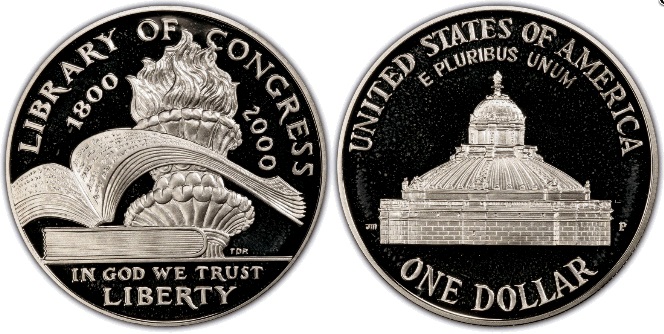
The obverse — the heads side — was designed by U.S. Mint sculptor-engraver Thomas D. Rogers. It shows two books, one closed and one open, layered over the torch of learning. It's an unusually literal piece of symbolism, and it works: the closed book is knowledge stored, the open book is knowledge read, and the torch is the old idea that learning is a flame you pass along. For a library, you could hardly ask for a tighter little argument.

The reverse — the tails side — came from John Mercanti, who would later become the Mint's 12th Chief Engraver and is best known for the heraldic eagle on the American Silver Eagle. He rendered the great dome of the Thomas Jefferson Building, the 1897 Beaux-Arts landmark that is the public face of the Library. The choice of Jefferson's name is no accident either: after the British burned the original library in 1814, the nation rebuilt it around Thomas Jefferson's personal collection of nearly 6,500 books, bought to restock the shelves.

This is a commemorative coin, not a circulating one — struck to be sold to collectors at a premium, never meant to jingle in a pocket. Every piece carries a "P" mint mark for Philadelphia, where all of them were made.

Key facts

Year struck
2000
Denomination
$1 (silver dollar)
Authorizing act
Public Law 105-268 (signed Oct. 19, 1998)
Obverse designer
Thomas D. Rogers — two books over the torch of learning
Reverse designer
John Mercanti — dome of the Jefferson Building
Composition
90% silver, 10% copper
Weight / diameter
26.73 g / 38.1 mm, reeded edge
Mint
Philadelphia (P mint mark)
Maximum authorized
500,000 coins
Proof sold
198,503
Uncirculated (BU) sold
53,264
Surcharge
Paid to the Library of Congress Trust Fund Board for public-access programs

Collecting it

The most useful number on this coin is the gap between its two finishes. The Mint sold 198,503 proofs — coins struck on polished dies for mirror fields and frosted devices — but only 53,264 uncirculated (or "BU," brilliant uncirculated) pieces. Roughly four proofs exist for every business-strike. That makes the BU dollar the harder of the two to find, the reverse of what casual buyers often assume.

Even so, neither finish is genuinely rare. The Mint was authorized to strike up to 500,000 silver dollars and sold barely 251,767 of them combined — a modest program, but not a tiny one. The real scarcity lives at the top of the grading scale, where condition is everything. A coin certified MS70 or PR70 — the perfect grade, no flaws visible under magnification — commands a sharp premium over the same coin one point lower. For modern commemoratives like this, the chase is almost always about the grade, not the date.

One more thing worth knowing for context: this dollar had a far more famous sibling. The same 2000 program produced the first bimetallic coin in U.S. history — a $10 piece with a gold ring around a platinum center — and that companion, struck in tiny numbers, is the one collectors prize most. The silver dollar is the accessible, affordable way into the bicentennial story.

Questions collectors ask

Why does the 2000 Library of Congress dollar matter?

It marks the 200th birthday of the Library of Congress, America's oldest federal cultural institution, founded by an act of Congress on April 24, 1800. The Mint began selling the coin on that exact anniversary in 2000.

Is the proof or the uncirculated version rarer?

The uncirculated (BU) version is scarcer. The Mint sold 198,503 proofs but only 53,264 uncirculated coins — about four proofs for every business strike.

Who designed the coin?

Thomas D. Rogers designed the obverse — two books over the torch of learning. John Mercanti, later the Mint's 12th Chief Engraver, designed the reverse: the dome of the Jefferson Building.

Is this the same as the gold-and-platinum Library of Congress coin?

No. The 2000 program had two coins. This is the 90% silver dollar. The companion was a $10 bimetallic piece — a gold ring around a platinum core — the first bimetallic coin the U.S. Mint ever made, and far scarcer.

What was the silver dollar's surcharge used for?

Each sale carried a surcharge that the Mint forwarded to the Library of Congress Trust Fund Board, helping fund programs that make the Library's collections accessible to the public.

Sources