US coin · series

The 1991 Korean War Memorial Dollar

A coin minted to build a memorial — seven dollars at a time.

The 1991 Korean War Memorial Dollar
US Mint (https://www.usmint.gov/coins/coin-medal-programs/commemorative-coins) · public domain · source

The forgotten war finally got its monument, and this coin helped pay for it. Every 1991 Korean War Memorial dollar carried a $7 surcharge that went straight toward the wall of faces now standing in West Potomac Park.

The story behind the coin

Korea is the war America almost forgot. It started in 1950, ended in a stalemate in 1953, and for nearly four decades the men who fought it had no national memorial. While Vietnam veterans got their black granite wall in 1982, Korea's veterans were still waiting.

This coin was part of how that changed. On October 31, 1990, Congress passed the Korean War Veterans Memorial Thirty-Eighth Anniversary Commemorative Coin Act. It authorized a single silver dollar — no more than one million of them — to mark the 38th anniversary of the war's end and to help fund a memorial in Washington.

The mechanism was simple. Every coin sold carried a surcharge — an extra charge on top of the coin's price, set at $7 — and that money flowed to the memorial fund. The U.S. Mint released the coin on May 6, 1991. Buyers weren't just collecting silver; they were buying a brick in the wall, years before the wall existed. The Korean War Veterans Memorial finally opened in West Potomac Park in July 1995.

What the coin depicts

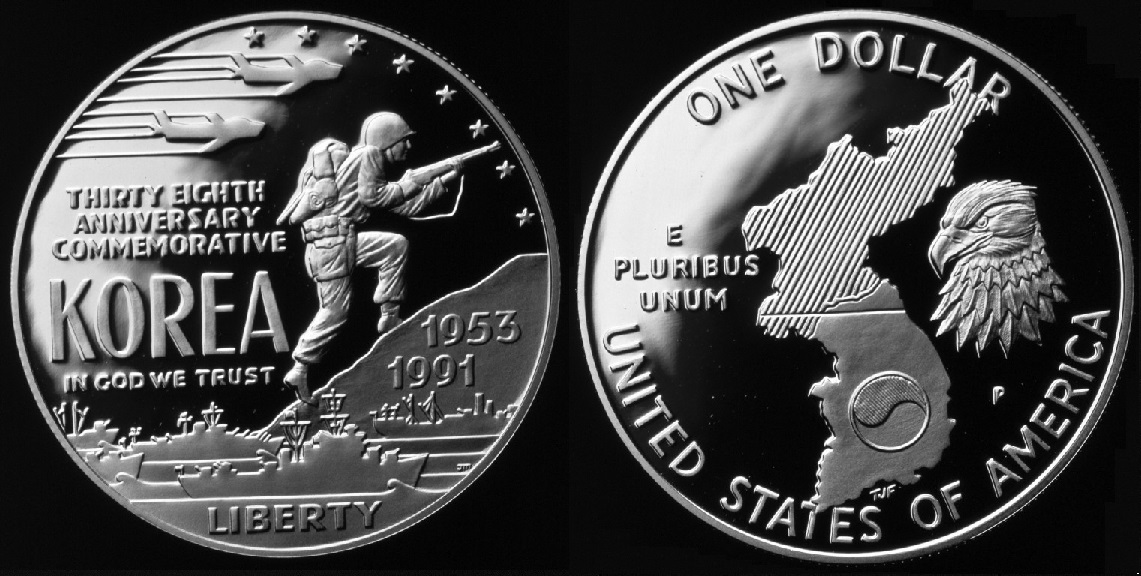
The obverse — the heads side — is a scene, not a portrait. A single soldier climbs a Korean hill, naval ships sit offshore behind him, and two F-86 Sabre jets streak overhead. It compresses the whole war into one frame: the infantryman, the fleet, the air war. Around the rim run the words "THIRTY EIGHTH ANNIVERSARY COMMEMORATIVE" and "KOREA," with the dual dates 1953 1991 set into the slope of the hill — the year the fighting stopped, and the year the coin honored it.

The reverse — the tails side — does something rare for a U.S. coin: it shows a map. The Korean peninsula appears with North Korea hatched in diagonal lines and South Korea raised as a solid surface, a quiet design choice that draws the line the war was fought over. The taegeuk, the red-and-blue symbol from the South Korean flag, sits over the south, and the head of an American bald eagle faces the peninsula from the side.

Two of the Mint's most prolific engravers split the work. John Mercanti designed the obverse — he would go on to become the U.S. Mint's Chief Engraver and is best known to collectors as the man behind the Silver Eagle's heraldic reverse. T. James Ferrell, another long-serving Mint sculptor-engraver, designed the map reverse.

Key facts

Year struck
1991
Denomination
Silver dollar (commemorative)
Obverse designer
John Mercanti
Reverse designer
T. James Ferrell
Composition
90% silver, 10% copper
Weight
26.73 g
Diameter
38.1 mm
Edge
Reeded
Uncirculated mint
Denver (1991-D)
Proof mint
Philadelphia (1991-P)
Uncirculated mintage
213,049
Proof mintage
618,488
Total mintage
831,537 (cap was 1,000,000)
Surcharge
$7 per coin — to the Korean War Veterans Memorial fund
Authorizing act
Pub. L. 101–495 (Oct. 31, 1990)
Released
May 6, 1991

Collecting it

There are only two coins to know here, and they split cleanly by mint and finish. The 1991-D is the uncirculated coin, struck at Denver. The 1991-P is the proof — a coin made with polished dies and specially prepared blanks to give a mirror-bright field and frosted devices, sold to collectors rather than spent.

Neither is rare in the usual sense. Both were sold straight to the public, and most survive in high grade because almost none ever circulated. The proof outsold the uncirculated coin nearly three to one — 618,488 against 213,049 — which is the reverse of how scarcity usually works, but it reflects how these were bought: collectors wanted the showier proof.

Even so, the program fell well short of its million-coin ceiling. Mint Director Donna Pope had warned that selling that many would be hard, and the final total of 831,537 proved her right. For collectors today, the value lives at the top of the grading scale: where an ordinary example trades for the price of its silver plus a small premium, a flawless certified proof commands a real multiple of that. The chase isn't for the date — it's for the grade, the difference between a good coin and a perfect one.

Questions collectors ask

Is the 1991 Korean War dollar real silver?

Yes. It's struck in 90% silver, 10% copper, weighs 26.73 grams, and contains about three-quarters of a troy ounce of silver. That metal value sets the floor for what any example is worth.

What's the difference between the 1991-P and 1991-D Korea dollar?

The 1991-D is the uncirculated coin from the Denver Mint; the 1991-P is the proof from Philadelphia, made with polished dies for a mirror finish. The proof was the more popular of the two, with 618,488 struck versus 213,049 uncirculated.

Why was this coin made?

Congress authorized it to mark the 38th anniversary of the Korean War's end and to raise money for the Korean War Veterans Memorial in Washington, D.C. A $7 surcharge on every coin went to the memorial fund. The memorial opened in 1995.

What do the dates 1953 and 1991 mean on the coin?

1953 is the year the Korean War armistice was signed, ending the fighting. 1991 is the year the commemorative coin was issued, on the 38th anniversary of that armistice.

Is the 1991 Korean War silver dollar valuable?

Most examples are worth their silver content plus a modest premium, because both versions survive in high grade. The money is in top-graded proofs — a perfect certified example can sell for several times the price of an ordinary one.

Sources