US coin · series

The Jefferson Wartime Nickel — when the nickel held no nickel

For three years America made its five-cent coin out of silver, and marked it so it could find every one again.

The Jefferson Wartime Nickel — when the nickel held no nickel
United States Mint (via Wikimedia Commons) · public domain · source

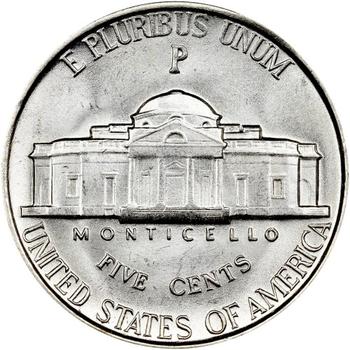
In 1942 the United States did something it had not done since 1873: it put silver into a circulating five-cent coin. Not for beauty — for war. Nickel metal was needed for armor and engines, so the Mint pulled it out of the nickel entirely and replaced it with silver and manganese, then stamped a giant mintmark over Monticello so the Treasury could one day sort these strange coins back out of circulation.

The story behind the coin

In the spring of 1942, the metal that gave the nickel its name was suddenly worth more in a factory than in your pocket. Nickel is hard, it resists heat, and it makes steel tougher — exactly what a country building aircraft engines, armor plate, and warships needs. So the United States decided its five-cent coin would have to give the metal back.

On March 27, 1942, Congress authorized a new alloy. The Mint dropped the nickel metal almost entirely and reached for an unlikely substitute: silver. The wartime coin became 56% copper, 35% silver, and 9% manganese — the first silver in a U.S. five-cent piece since the old silver half dime ended in 1873. The first coins in the new alloy were struck that autumn.

There was a practical problem hiding inside the patriotic one. These silver coins looked almost exactly like ordinary nickels, and one day the war would end and the Treasury would want to redeem the silver. How do you pull a few hundred million near-identical coins back out of a nation's coffee cans and cash drawers? The Mint's answer is the thing collectors point to first.

The design — and the mark that gives it away

The coin itself was already four years old. The obverse — the heads side — carries a left-facing portrait of Thomas Jefferson, the third U.S. president, modeled on a famous Gilbert Stuart painting. The reverse — the tails side — shows Monticello, Jefferson's Virginia home, straight on. Both sides are the work of Felix Schlag, a German-born sculptor who beat out hundreds of other entrants to win the Mint's 1938 design competition and its $1,000 prize. It remained his only adopted coin design.

What makes a wartime nickel is not the picture but the mintmark — the small letter telling you which mint struck the coin. On a normal Jefferson nickel that letter sits small and quiet beside Monticello's steps. On the war nickels the Mint blew it up into a large letter floating above Monticello's dome, impossible to miss. That oversized mark was a flag for the future: a signal to sorters that this coin held silver and should be set aside.

It came with a genuine first. Philadelphia, which had struck coins without any mintmark for 150 years, added a "P" above the dome — the first time the Philadelphia Mint's own letter ever appeared on a United States coin. For three years, then, every war nickel announced its home: P, D (Denver), or S (San Francisco), each one large and high on the reverse.

Key facts

Years struck (wartime alloy)
1942–1945
Designer
Felix Schlag (obverse Jefferson + reverse Monticello)
Wartime composition
56% copper, 35% silver, 9% manganese
Silver per coin
about 1.75 g (35% of the 5.00 g coin)
Identifying mark
Large P, D, or S above the Monticello dome
Authorized by
Act of Congress, March 27, 1942
Mints
Philadelphia (P), Denver (D), San Francisco (S)
Proofs
Struck 1942 only; proof coinage then suspended 1943–1945
Famous variety
1943/2-P overdate — the only overdate in the Jefferson series
Standard alloy resumed
1946 (copper-nickel, small/absent mintmark)

Collecting it — key dates, varieties, and why a sharp one is hard

The war nickel is one of the friendliest sets in American coins to start — every date and mint is affordable, and even a worn one carries real silver. The challenge, and the fun, is in the edges of the set.

The 1943/2-P overdate is the star. A 1942-dated die was pressed back into service and re-dated for 1943, leaving a faint "2" peeking out from under the "3." It is the only overdate in the entire Jefferson nickel series, which makes it the variety collectors hunt hardest. Sharp, high-grade examples are genuinely scarce; one PCGS MS67 with Full Steps brought $16,675 at a Heritage auction in 2008. Two more 1943-P die varieties — a doubled-die obverse and the "doubled eye" — keep variety specialists busy, and a 1945-P doubled-die reverse rounds out the famous list.

Then there is the matter of strike. Look at the base of Monticello: those little steps are notoriously soft, because tired dies and a stubborn alloy often left them mushy. A coin where five (or six) steps stand crisp and unbroken earns the "Full Steps" designation — and on some war-nickel dates a true Full Steps coin in high grade is far rarer than the raw mintage would suggest. That single detail separates a common date from a condition rarity.

One last historical footnote that collectors love: the war nickels are the only Jefferson nickels you can melt for their metal, and during and after the war huge numbers were hoarded and pulled from circulation precisely for the silver inside. The ones that survived in pristine, never-spent condition are the ones worth chasing.

Questions collectors ask

How do I tell a war nickel from a regular Jefferson nickel?

Look at the reverse, just above Monticello's dome. War nickels (1942–1945) carry a large mintmark — P, D, or S — high over the building. Regular Jefferson nickels either have a small mintmark beside the steps or, for many Philadelphia years, none at all. The big letter over the dome is the tell.

Why does a nickel from this period contain silver instead of nickel?

Nickel metal was a strategic material in World War II, needed for armor plate, aircraft engines, and ships. Congress authorized a substitute alloy on March 27, 1942 — 56% copper, 35% silver, and 9% manganese — so the coin gave its nickel back to the war effort. The standard copper-nickel composition returned in 1946.

What does the P mintmark mean on a 1942 nickel?

The P stands for the Philadelphia Mint. The war nickels were the first U.S. coins ever to carry Philadelphia's own mintmark — for 150 years before that, Philadelphia coins had no letter at all. The large P over Monticello also signaled that the coin held silver.

Which wartime nickel is the most valuable?

The 1943/2-P overdate is the headline rarity — the only overdate in the Jefferson series, where a faint 2 shows beneath the 3. Beyond that, value is driven by grade and strike: a coin with crisp, unbroken steps at the base of Monticello (a 'Full Steps' coin) in high mint state can be worth many multiples of an ordinary example.

Are common war nickels worth more than five cents?

Yes, even worn ones — each holds about 1.75 grams of silver, so the metal alone is worth well above face value. The real money, though, is in scarce varieties like the 1943/2-P and in pristine, fully-struck examples.

How much silver is in each war nickel?

Each coin weighs 5.00 grams and is 35% silver, so roughly 1.75 grams of silver per coin. That's why so many were hoarded and melted, and why surviving high-grade pieces are scarcer than the mintage figures imply.

Sources