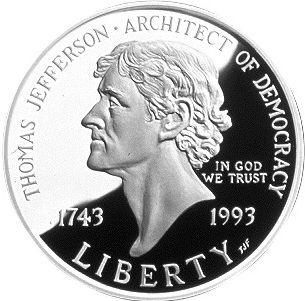
The story behind the coin
Thomas Jefferson wrote the Declaration of Independence, doubled the size of the country, and founded a university. He also did something most Americans forget: he helped invent the dollar. As the first Secretary of State, Jefferson pushed for a decimal money system — dollars split into tenths and hundredths — instead of the clumsy British pounds, shillings, and pence. The change in your pocket today traces back to his argument.
So when his 250th birthday came around — Jefferson was born April 13, 1743 — Congress decided the founder of American coinage deserved a coin of his own. The result is the dual date you'll see on it: 1743–1993, birth year and anniversary side by side.
Congress authorized the coin through the Jefferson Commemorative Coin Act of 1993 (Public Law 103-186). It set a hard ceiling of 600,000 coins and attached a $10 surcharge to every one sold. That money wasn't a tax — it was the point. The first 500,000 coins funded an endowment for Monticello, Jefferson's mountaintop home, and his educational programs. Everything sold beyond that went to Poplar Forest, the octagonal retreat he designed for himself in the Virginia woods. A coin honoring Jefferson literally paid to keep Jefferson's houses standing.
Here's the quiet drama: most commemorative coins fall far short of their authorized limit and quietly fade. This one sold out. All 600,000 were struck and bought — a genuinely rare outcome that tells you how much affection still surrounds the man on the coin.