US coin · series

The 2007-W Jamestown $5 Gold Coin

A half eagle for the colony that nearly starved to death — then became America.

The 2007-W Jamestown $5 Gold Coin
U.S. Mint (usmint.gov) — coin design is a U.S. Government work · public domain · source

In 1607, 104 English settlers landed on a swampy island in Virginia and clung to it through famine, disease, and a brutal winter. Four centuries later, the U.S. Mint struck a small gold coin to mark the spot where America began.

The story behind the coin

In May 1607, three small ships dropped anchor in a Virginia river and put 104 English settlers ashore on a marshy peninsula. They called it Jamestown, after their king. It was the first permanent English settlement in North America — and for its first few years, "permanent" was a wildly optimistic word.

The colony nearly died. Disease, brackish water, and hunger killed settlers by the dozen. The winter of 1609–10, remembered as the "starving time," was the worst: of roughly 300 people crowded into the fort, only about 60 lived to see spring. That Jamestown survived at all owed much to one stubborn soldier — Captain John Smith — whose hard rule that "he that will not work shall not eat" kept the colony alive, and whose fraught dealings with the powerful chief Powhatan shaped its early years.

Four hundred years later, Congress decided that beginning deserved a coin. The Jamestown 400th Anniversary Commemorative Coin Act of 2004 — Public Law 108-289, signed August 6, 2004 — authorized two commemoratives for the anniversary: a silver dollar and this $5 gold piece. They were struck and sold only during 2007, the anniversary year itself.

The design

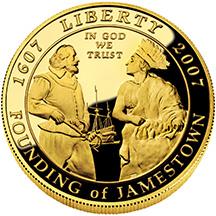
The coin tells the Jamestown story across its two faces. The obverse — the heads side — was designed by U.S. Mint sculptor-engraver John Mercanti, the artist behind the long-running American Silver Eagle reverse. It shows Captain John Smith meeting an American Indian who carries a bag of corn — a quiet nod to the trade and tension that defined those first years, since corn from the Powhatan people repeatedly kept the starving colonists alive. The dates "1607-2007" frame the scene.

The reverse — the tails side — came from Susan Gamble, working through the Mint's Artistic Infusion Program, which brings in outside artists to refresh American coin design. It depicts the Jamestown Memorial Church, the brick church that still stands on the historic site today as the colony's most enduring landmark.

Every Jamestown half eagle was struck at the West Point Mint and carries its "W" mint mark — the small letter on a coin that tells you which facility made it. It is a tiny coin for such a big story: just over eight grams of gold, a little under nine-tenths of an inch across.

Key facts

Year struck
2007
Denomination
$5 (half eagle)
Mint / mint mark
West Point — W
Obverse designer
John Mercanti (Capt. John Smith and an American Indian)
Reverse designer
Susan Gamble (Jamestown Memorial Church)
Composition
90% gold, 10% alloy
Weight
8.359 g
Diameter
0.850 in (21.6 mm)
Edge
Reeded
Authorizing law
Public Law 108-289 (Aug 6, 2004)
Maximum mintage authorized
100,000 (all options combined)
Proof mintage
46,365
Uncirculated mintage
18,348
Total mintage
64,713
Surcharge
$35 per coin, to Jamestown legacy organizations

Collecting it

This is a modern commemorative, so the collecting story is different from a circulating coin's. There was no "key date" that escaped into pocket change — every Jamestown half eagle was sold directly by the Mint, in a box, during 2007. What makes it interesting is how few were actually bought.

Congress authorized up to 100,000 across both finishes. The Mint sold 64,713 — 46,365 proofs (the mirror-finish collector version, struck with polished dies on polished blanks) and just 18,348 uncirculated pieces (the matte business-strike finish). The uncirculated coin is the scarcer of the two by a wide margin, which collectors notice when comparing the two finishes.

Because these coins went straight from the Mint into careful hands, top grades are common — most survive in pristine condition. The premiums collectors chase therefore tend to sit at the very top of the grading scale (a flawless proof graded PF70, for example), where small differences in surface quality separate one coin from the next. Underneath that, the coin carries its weight in gold: roughly a quarter-ounce of fine gold gives every example a real bullion floor that rises and falls with the gold price.

Each coin also carried a $35 surcharge above its cost — money directed by law to organizations preserving the Jamestown legacy, including the Jamestown-Yorktown Foundation, the Association for the Preservation of Virginia Antiquities, and the Secretary of the Interior. In other words, buying one helped fund the very history it celebrates.

Questions collectors ask

How many 2007 Jamestown $5 gold coins were made?

64,713 in total — 46,365 proof coins and 18,348 uncirculated coins — against a maximum authorization of 100,000. The uncirculated version is the scarcer of the two.

Who designed the Jamestown gold coin?

The obverse, showing Captain John Smith meeting an American Indian carrying corn, was designed by U.S. Mint sculptor-engraver John Mercanti. The reverse, depicting the Jamestown Memorial Church, was designed by Susan Gamble through the Mint's Artistic Infusion Program.

How much gold is in the coin?

It is 90% gold, 10% alloy, weighing 8.359 grams in total — roughly a quarter ounce of pure gold. That gives the coin a real bullion value beneath its collector premium.

What does the 'W' mint mark mean?

Every Jamestown half eagle was struck at the West Point Mint in New York, which marks its coins with a 'W.' No other mint produced this issue.

Why was the coin made?

To mark the 400th anniversary of the founding of Jamestown in 1607 — the first permanent English settlement in North America. Congress authorized it in 2004, and the coins were sold only during the 2007 anniversary year.

Sources