US coin · series

The 1946 Iowa Centennial Half Dollar

A statehood coin sold for $2.50, gone in weeks, and run so honestly it became the textbook example.

The 1946 Iowa Centennial Half Dollar
United States Mint · public domain · source

By 1946, Congress had nearly killed off the commemorative coin — too many states had gamed the program for profit. Then Iowa proved it could be done right: one coin, one year, one price, sold by Iowans to Iowans, and sold out almost overnight.

The coin that behaved

By the mid-1940s, the U.S. commemorative half dollar had a bad reputation — and it had earned it. Through the 1930s, sponsors had milked their coin programs: ordering the same design from several mints across several years to manufacture "varieties," then holding back coins to drive up prices. A 1937 congressional hearing aired the abuses, and dozens of proposed commemorative bills were quietly killed. The genre was in disgrace.

Then Iowa showed how it was supposed to work.

In 1946 the state turned 100, and Congress authorized a single half dollar to mark it. A commemorative — a coin struck to honor a person, place, or event rather than to spend — lived or died by how its sponsor sold it. Iowa's sponsor, the Iowa Centennial Committee, did everything the cynics didn't: one design, one year, one mint, and a price set low enough that ordinary people could actually buy one. The coins sold out fast. No leftover hoard held back for ransom, no manufactured rarities. It became the clean example the others should have followed.

What it shows — and the eagle's hidden count

The obverse — the heads side — carries the Iowa state seal: a heraldic eagle with a banner in its beak reading "OUR LIBERTIES WE PRIZE AND OUR RIGHTS WE WILL MAINTAIN." Look above the eagle and you'll find 29 stars. That's not decoration. Iowa was the 29th state admitted to the Union, and the designer counted them out exactly.

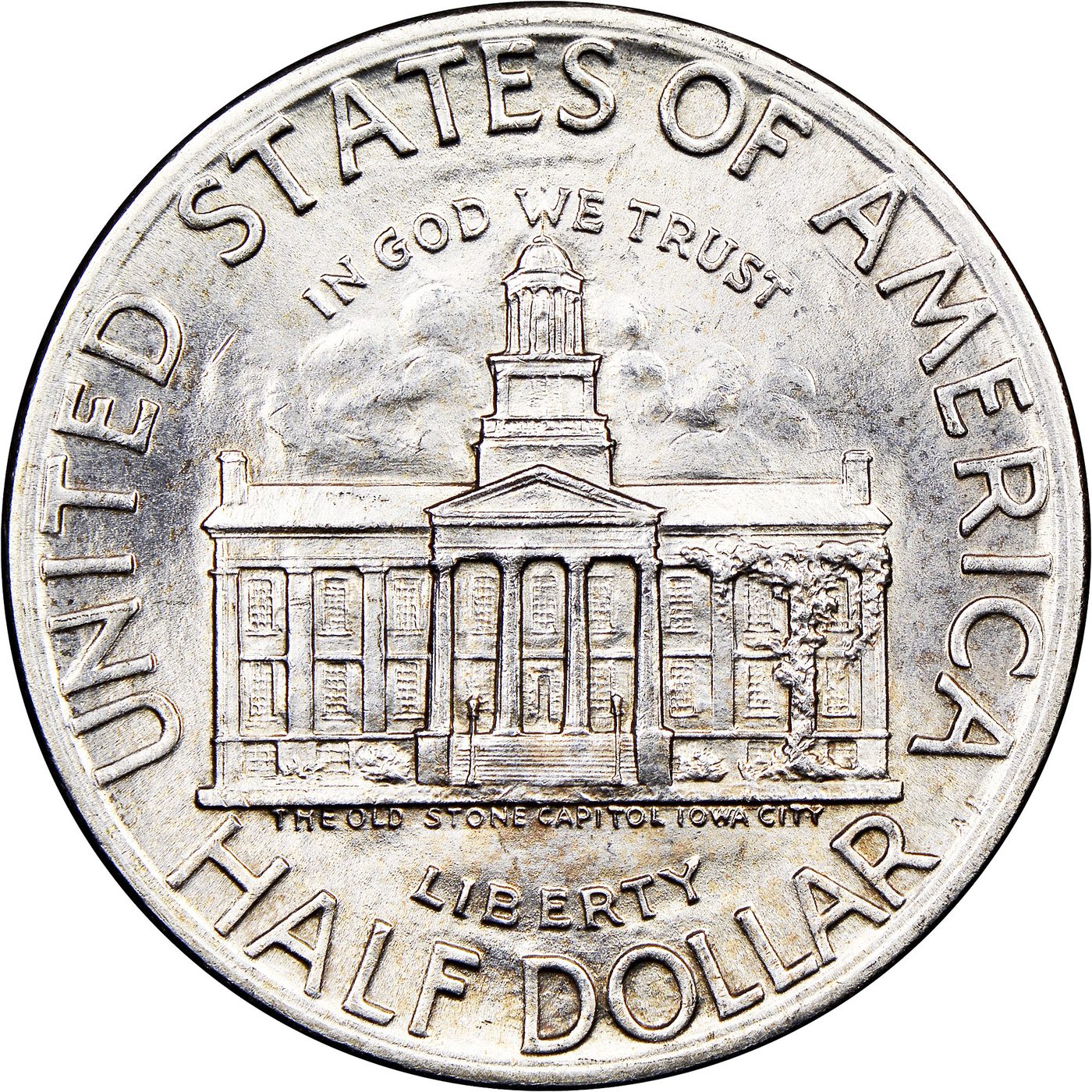
The reverse — the tails side — pulls back to show the Old Stone Capitol at Iowa City, the limestone statehouse where Iowa governed in its territorial and early-statehood years. The building rises beneath an arc of clouds and the motto "IN GOD WE TRUST."

The designer was Adam Pietz (1873–1961), a German-born sculptor and medalist who served as assistant chief engraver at the Philadelphia Mint from 1927 to 1946. He spent a career on medals and dies, but the Iowa half dollar was the only circulating-format coin design of his that the Mint ever struck — a single, late, well-made coin to cap a long medallic career. Mint director Nellie Tayloe Ross, the first woman to run the Mint, chose him for the job.

Key facts

Years struck
1946 (one year only)
Event honored
Centennial of Iowa statehood (1846–1946)
Designer
Adam Pietz
Mint
Philadelphia (no mint mark)
Mintage
100,057 struck (100,000 authorized; 57 reserved for assay)
Composition
90% silver, 10% copper
Weight
12.5 g (0.36169 oz silver)
Diameter
30.61 mm; reeded edge
Original price
$2.50 to Iowans, $3 out of state
Authorizing act
Approved August 7, 1946

Collecting it

There's a happy paradox here for newcomers: the Iowa half dollar is both genuinely historic and easy to own. Because Iowans saved their coins as keepsakes rather than spending them, the survivors came down to us in unusually good shape. Most certified examples grade at least MS-65 — "Mint State 65," a high spot on the 70-point grading scale where a coin shows full original luster and only minor flaws. That makes a beautiful Iowa one of the most affordable ways into the classic commemorative series.

The scarcity lives at the very top. The jump from a clean MS-67 to a flawless MS-68+ is steep — PCGS, one of the two major grading services, has certified only a handful at MS-68+ and none finer. So while a nice Iowa is common, a perfect one is a chase. Toning is the other wildcard: examples with deep red-green-gold-violet color over strong mint frost can sell for many multiples of a plain white coin.

One more wrinkle the sponsor built in: of the coins struck, 500 were set aside to be sold in 1996 and another 500 reserved for 2046. The 1996 batch was offered at $500 each in special holders — a half-century time capsule from the committee that ran the program.

Questions collectors ask

Which side is the eagle and which is the building?

The obverse (heads) carries the Iowa state seal — a heraldic eagle with a banner and 29 stars above it. The reverse (tails) shows the Old Stone Capitol building in Iowa City. Sources occasionally swap the labels, but the eagle/state-seal side is the obverse.

Why are there 29 stars on the coin?

Iowa was the 29th state admitted to the Union, in 1846. Designer Adam Pietz placed exactly 29 stars above the eagle to mark that.

How much did it cost when it came out, and why is the price different for Iowans?

The Iowa Centennial Committee sold them for $2.50 to Iowa residents and $3 to out-of-state buyers. The committee wanted any Iowan who wanted a coin to be able to afford one, so it kept the in-state price low.

Is the Iowa half dollar rare?

Not in absolute terms — about 100,000 were struck and most were carefully saved, so it's one of the more common classic silver commemoratives. The rarity is in top condition: pristine, high-grade, or beautifully toned examples are scarce and command large premiums.

Why was only one year struck?

By design. After 1930s sponsors had abused multi-year, multi-mint commemorative programs to create artificial rarities, Iowa's was run cleanly — a single 1946 issue from one mint, sold openly at a fair price. That restraint is part of why the coin is so well regarded.

Sources