US coin · series

The Fugio Cent: America's First Coin

A sundial, a warning to mind your business, and a coinage scandal at the birth of a nation.

The Fugio Cent: America's First Coin
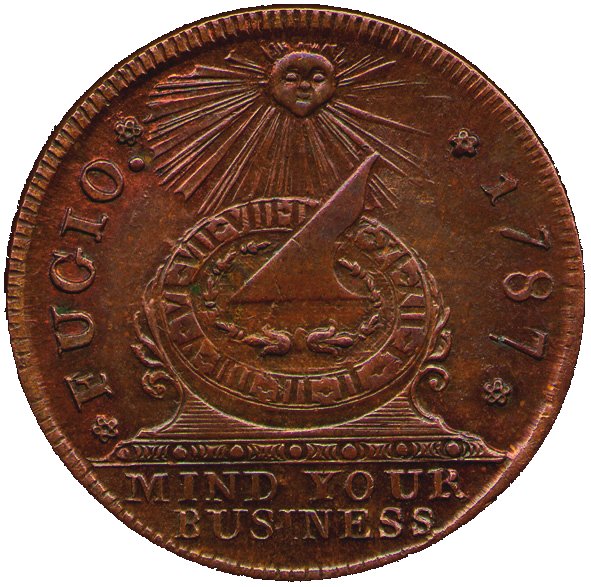
Unknown, purportedly Benjamin Franklin (design). Source: coins.nd.edu, via Wikimedia Commons · public domain · source

In 1787, before there was a U.S. Mint, before there was a Constitution, the new nation struck its first coin. It carried a sundial, a Latin word for fleeing time, and three blunt English words: "Mind Your Business." Then the man hired to make it took the copper and ran.

The story behind the coin

The United States had a government before it had money of its own. Under the Articles of Confederation — the loose pact that held the thirteen states together before the Constitution — the country ran on a chaos of foreign silver, state coppers, and worn British coins. So on April 21, 1787, the Congress of the Confederation did something it had never done: it authorized a coin in the name of the United States. That coin is the Fugio cent, and it is the first coin the nation ever officially put its name on.

Congress did not run a mint. It hired one. The contract went to James Jarvis, a Connecticut businessman, who was to deliver roughly 300 tons of copper coinage. Jarvis got the job the old-fashioned way — collectors and historians cite a $10,000 bribe paid to William Duer, the head of the Board of Treasury that awarded it. The dies were cut by Abel Buell, a New Haven engraver of real talent and a colorful past: years earlier he had been convicted of counterfeiting and branded for it. The man who engraved America's first coin had once been punished for faking the colony's money.

It went badly. Jarvis diverted the federal copper to a more profitable side business — striking Connecticut state coppers — and never delivered the cents he had promised. By September 1788 the government had cancelled his contract for non-performance, and Jarvis had fled to Europe to dodge his creditors. The first coin of the United States was born of a bribe, struck by a former counterfeiter, and abandoned by the contractor who made it. And yet it survived — because of a keg in a bank basement (more on that below).

The design — Franklin's sundial

The Fugio cent's design did not start in 1787. It started with Benjamin Franklin. The motifs trace directly to the 1776 Continental Currency dollar, a pattern coin Franklin is credited with designing, and the Fugio reused them eleven years later.

The obverse — the "heads" side — shows a sundial under a beaming sun, the date 1787, and the single Latin word FUGIO, meaning "I flee" or "I fly." Read it together and the meaning lands: the sun and the sundial mark the hours, and time is fleeing. Beneath the dial sits the famous English line, MIND YOUR BUSINESS. To eighteenth-century eyes this was a double pun — both "attend to your work" and "watch your money." Franklin, the apostle of thrift who wrote "a penny saved is a penny earned," put a tiny sermon on the country's first cent. (The Franklin attribution is the long-standing scholarly view, anchored by the numismatist Eric Newman; Buell engraved the actual 1787 dies.)

The reverse — the "tails" side — carries thirteen linked rings, one for each state, encircling the words WE ARE ONE and UNITED STATES. Thirteen separate links forming one chain: a plea for a fragile union to hold together. The coin is struck in copper and weighs roughly 10 grams. It is plain, it is dense with meaning, and every word on it is a message about time, money, or unity — the three things the young republic was most anxious about.

Key facts

Year struck
1787 (New Haven restrikes c. 1859)
Authorized
April 21, 1787, by the Congress of the Confederation
Status
First coin authorized by the United States
Design source
Benjamin Franklin (attributed); dies engraved by Abel Buell
Contractor
James Jarvis, New Haven, Connecticut
Composition
Copper, approx. 10 g
Obverse
Sundial, sun, FUGIO, MIND YOUR BUSINESS, 1787
Reverse
13 linked rings, WE ARE ONE, UNITED STATES
Major varieties
STATES UNITED / UNITED STATES, club rays, pointed rays, cinquefoils, FUCIO error, AMERICAN CONGRESS reverse

Collecting the Fugio cent

Here is the surprise that makes the Fugio cent so collectible: a coin from 1787 is genuinely available in mint condition, and you can thank one bank for it. Sometime in 1788, the Bank of New York acquired a keg of fresh Fugio cents and stored it in the basement. It sat largely forgotten — rediscovered in 1856, then again in 1926. When the American Numismatic Society examined the surviving group in 1948, 1,641 coins remained; the bank kept 819 of them. This is the Bank of New York Hoard, and it is why a collector today can own an uncirculated example of the first U.S. coin — something almost unheard of for an eighteenth-century issue. Hoard coins often show glossy chocolate-brown surfaces with traces of original orange copper luster.

The series is a playground of varieties because the dies were cut by hand. The biggest split is the reverse legend: most read STATES UNITED, a smaller group reads UNITED STATES, and the rays of the sundial come in "pointed" and blunt "club" forms. The "cinquefoils" (small five-petaled ornaments) versus other border ornaments separate further die pairings. Specialists track them by the Newman die-variety numbers — the standard reference for the series — and a few are genuinely scarce, including the FUCIO misspelling die and the rare AMERICAN CONGRESS reverse, which trades the linked rings for a different legend.

One more wrinkle the catalog won't let you skip: the New Haven "restrikes." Around 1859, Horatio N. Rust struck Fugio-style pieces in copper, brass, silver, and even gold (two gold examples are known). Collectors love them, but the name misleads on two counts — they were made from new dies, not the originals, so they are not true restrikes, and they were not actually struck in New Haven. They are their own collectible, distinct from a genuine 1787 piece. For high grades, the scarcity is real for everything outside the hoard: original 1787 cents that didn't sit safe in a bank keg circulated as hard money, and choice Mint State examples of the scarcer die varieties are tightly held.

Questions collectors ask

Is the Fugio cent really the first U.S. coin?

Yes — it is the first coin officially authorized and issued in the name of the United States. Congress authorized it on April 21, 1787, five years before the U.S. Mint was founded in Philadelphia. The Mint's own first coins came later, in the 1790s.

Did Benjamin Franklin design the Fugio cent?

By long-standing scholarly attribution, yes — the design comes from Franklin. The sundial, the FUGIO motto, and 'Mind Your Business' first appeared on the 1776 Continental Currency dollar credited to him, and the Fugio cent reused them. The 1787 dies themselves were engraved by Abel Buell of New Haven.

What does 'Mind Your Business' mean on the coin?

It is an eighteenth-century double meaning: attend to your work, and watch over your money. Paired with the sundial and the word FUGIO ('I flee'), the message is that time is fleeting, so be diligent and thrifty — very much in Franklin's spirit.

Why can I buy a 1787 coin in mint condition?

Because of the Bank of New York Hoard. The bank stored a keg of new Fugio cents around 1788 and largely forgot it. When the surviving coins were examined in 1948, 1,641 remained. That hoard is the reason uncirculated examples of America's first coin still exist for collectors today.

What is a New Haven restrike?

Pieces struck around 1859 by Horatio N. Rust in copper, brass, silver, and gold. The name is a double misnomer: they were made from new dies rather than the originals, so they are not true restrikes, and they were not actually struck in New Haven. They are collected separately from genuine 1787 cents.

What are the most valuable Fugio varieties?

Beyond top-grade examples, the scarcer die varieties command premiums — notably the FUCIO misspelling, the AMERICAN CONGRESS reverse, and the less-common UNITED STATES legend (most read STATES UNITED). Specialists track all of them by Newman die-variety numbers.

Sources