US coin · series

The 1990 Eisenhower Centennial Dollar

Two profiles of Ike, one coin — and a surcharge that went straight to the national debt.

The 1990 Eisenhower Centennial Dollar
Windrain (Wikimedia Commons), own work · CC0 · source

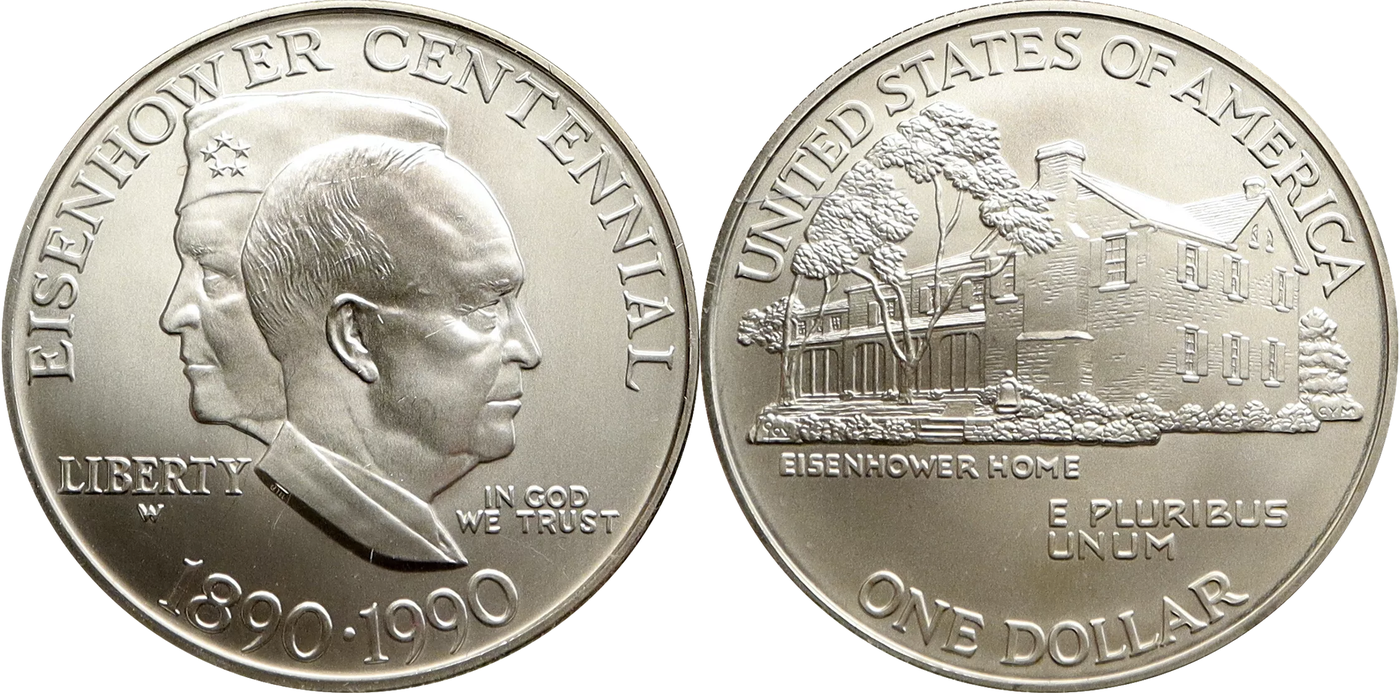
In 1990 the Mint put two men named Eisenhower on the same silver dollar — the young general and the older president, facing apart. Then it did something it has done almost nowhere else: it sent the coin's surcharge to pay down the federal debt.

The story behind the coin

Dwight D. Eisenhower was born in 1890. A hundred years later, Congress wanted a coin for the centennial — and for Ike, that meant a choice. Which Eisenhower? The five-star general who planned the D-Day invasion, or the two-term president who steered America through the calm, anxious 1950s?

The answer was both. Congress authorized the coin through the Dwight David Eisenhower Commemorative Coin Act of 1988 (Public Law 100-467), signed by President Reagan on October 3, 1988. The Mint struck and released the dollar in early 1990, the centennial year — the dates "1890–1990" run right across the coin's face.

Here is the part that makes this dollar genuinely unusual. Modern US commemoratives carry a surcharge — a few dollars added to the price, set aside by law for a cause: a museum, a memorial, an Olympic team. The Eisenhower dollar's surcharge went somewhere else entirely. By act of Congress, the money was directed toward reducing the national debt of the United States. It is one of the very few US commemoratives ever aimed at the Treasury itself rather than a sponsoring organization — a fittingly Eisenhower gesture, given how much the fiscally cautious president worried about what the country owed.

The design

The obverse — the heads side — is the reason people remember this coin. Mint sculptor John Mercanti set two profiles of Eisenhower back to back: the general facing left, the president facing right, overlapping in a single portrait. Mercanti is the same artist who designed the eagle on the American Silver Eagle, the most-collected bullion coin in the world. Here he gave Ike two faces in one frame — a quiet way of saying a single man held two great roles.

Turn the coin over and the war and the White House both fall away. The reverse, designed by Marcel Jovine, shows a farmhouse: the Eisenhower home at Gettysburg, Pennsylvania, the only house Dwight and Mamie Eisenhower ever owned, where they retired after the presidency. After a life spent in army quarters and the Executive Mansion, the place Ike chose to come home to was a Civil War battlefield town. The reverse reads simply "EISENHOWER HOME."

The coin is a traditional silver dollar in every physical sense — 90% silver, the same heft and width as the classic Morgan and Peace dollars that came before it.

Key facts

Year struck
1990
Commemorates
100th anniversary of Eisenhower's birth (1890–1990)
Authorizing act
Public Law 100-467 (Eisenhower Commemorative Coin Act of 1988)
Obverse designer
John Mercanti — dual general/president portrait
Reverse designer
Marcel Jovine — Eisenhower's Gettysburg home
Composition
90% silver, 10% copper
Weight / diameter
26.73 g / 38.1 mm, reeded edge
1990-P Proof (Philadelphia)
241,669 struck
1990-W Uncirculated (West Point)
1,144,461 struck
Maximum authorized
Up to 4,000,000 silver dollars
Surcharge
Directed to reducing the US national debt

Collecting it

Two coins were sold under this program, and the split tells you something about how people buy commemoratives. The proof — a mirror-finish coin struck twice from polished dies, made for collectors — carries the "P" mint mark of Philadelphia and a mintage of 241,669. The uncirculated, business-strike version was made at West Point and wears a "W"; far more were sold, 1,144,461. The uncirculated outsold the proof nearly five to one. That makes the 1990-P proof the scarcer of the pair.

The program was authorized for up to four million coins. It sold roughly 1.39 million — about a third of the ceiling. Sales started fast, with more than a million orders inside three months, then cooled. Neither version is rare in absolute terms, but as a low-cost way to own a full-size 90% silver dollar designed by the man behind the Silver Eagle, the coin has a steady following. Condition matters, as always: the value lives at the very top of the grading scale, where a coin shows essentially no contact marks under magnification.

A footnote worth knowing: the West Point Mint had long struck gold and stored bullion, but the 1990 Eisenhower uncirculated dollar is often cited as among the first regular silver coins West Point produced — a small first for a facility better known as a vault.

Questions collectors ask

Why are there two portraits of Eisenhower on the coin?

Mint sculptor John Mercanti placed two profiles back to back — Eisenhower as a five-star general facing left, and as president facing right. It captures the two roles that defined his life on a single obverse.

What's the difference between the 1990-P and 1990-W Eisenhower dollars?

The 1990-P is the proof version, struck at Philadelphia with a mirror finish for collectors (241,669 made) — the scarcer of the two. The 1990-W is the uncirculated business strike from West Point (1,144,461 made).

Is the 1990 Eisenhower dollar real silver?

Yes. It is 90% silver and 10% copper, weighs 26.73 grams, and measures 38.1 mm — the same standard as the classic Morgan and Peace dollars.

What was the surcharge on the coin used for?

Unusually, the surcharge was directed by Congress toward reducing the US national debt, rather than to a museum, memorial, or sponsoring organization as most commemorative surcharges are.

What does the building on the reverse represent?

It is the Eisenhower home at Gettysburg, Pennsylvania — the only house Dwight and Mamie Eisenhower ever owned, where they retired after the presidency.

Sources