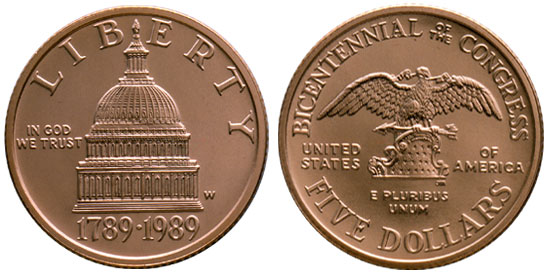
The story behind the coin
On a spring day in 1789, the first Congress of the United States finally got down to business in New York City. Two hundred years later, the institution it founded decided to celebrate — and it reached for gold.
The Bicentennial of the United States Congress Commemorative Coin Act, signed as Public Law 100-673, authorized three coins for the anniversary: a copper-nickel half dollar, a silver dollar, and this $5 gold half eagle. ("Half eagle" is the old name for the $5 gold denomination, a holdover from the 1800s when a $10 gold coin was an "eagle.") The first piece was struck on June 14, 1989, at a ceremony outside the Capitol itself.
There was a practical motive folded into the patriotism. Congress sold these coins above their face and metal value, and the extra money — the surcharge — was earmarked. Half of the first $40 million in surcharges was directed to the Capitol Preservation Fund, the account that pays to maintain and restore the Capitol building. The rest went to reducing the national debt. So buyers of a coin showing the Capitol dome were, in a small way, helping to keep that dome standing.