US coin · series

The 2001 Capitol Visitor Center Silver Dollar

A commemorative coin that helped pay for a building dug three stories under the U.S. Capitol.

The 2001 Capitol Visitor Center Silver Dollar
U.S. Mint (www.usmint.gov) · public domain · source

In 1998 a gunman shot his way past Capitol security and killed two police officers. Three years later, the U.S. Mint sold a silver dollar to help bury a visitor center under the building — and the coin's $10 surcharge went straight into the concrete.

The story behind the coin

For decades, anyone could walk up the steps of the U.S. Capitol and into the building. Then, on July 24, 1998, a gunman pushed through a security checkpoint and opened fire, killing two Capitol Police officers. The idea of a controlled, secure entrance — kicked around Washington since the 1960s — suddenly had urgency.

Congress answered partly with money, and partly with a coin. The United States Capitol Visitor Center Commemorative Coins Act of 1999 (Public Law 106-126) authorized three commemorative coins: a clad half dollar, this silver dollar, and a five-dollar gold piece. Every coin carried a surcharge — an extra fee added on top of the metal-and-minting cost — and that surcharge was earmarked for the Capitol Preservation Fund to help build the new center.

The result was one of the most literal coins the Mint has ever made. You bought the dollar; ten dollars of your purchase went into a hole in the ground beneath the East Front of the Capitol. The center that money helped fund — 580,000 square feet on three underground levels — finally opened in December 2008, years late and far over budget, reshaped along the way by the attacks of September 11, 2001.

The design

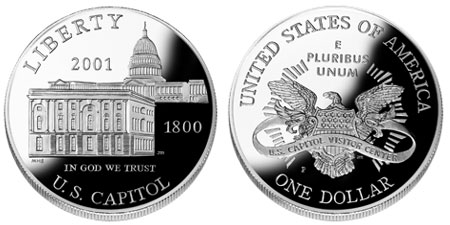
The obverse — the heads side — does something clever: it shows the Capitol twice. In the foreground stands the modest building of 1800, when Congress first met there. Behind it rises the great domed Capitol we know today. One coin, two centuries, the institution growing in stone. It carries the dates 2001 and 1800 together, with LIBERTY, IN GOD WE TRUST, and U.S. CAPITOL.

That obverse was the work of Marika Somogyi, and her own story is hard to top. Born in Budapest in 1933, she survived the Holocaust hidden in a Catholic convent, then fled Hungary with her husband during the failed 1956 revolution and built a new life as a sculptor in California. She had already designed a U.S. commemorative dollar in 1991; the Capitol coin was her second.

The reverse — the tails side — is an eagle, a contemporary take on a classic American motif that catalogs trace to the reverse of the old Liberty Head Double Eagle. It was modeled by John Mercanti, a Mint sculptor-engraver who would go on to become the twelfth Chief Engraver of the United States Mint. The eagle carries a banner reading U.S. CAPITOL VISITOR CENTER, alongside UNITED STATES OF AMERICA, E PLURIBUS UNUM, and the denomination, ONE DOLLAR.

Key facts

Year struck
2001 (one year only)
Mint
Philadelphia (P mint mark)
Obverse designer
Marika Somogyi
Reverse designer
John Mercanti
Composition
90% silver, 10% copper
Weight
26.730 g (0.8594 troy oz)
Diameter
38.10 mm
Edge
Reeded
Proof mintage
143,793
Uncirculated mintage
35,380
Maximum authorized
500,000
Surcharge
$10 to the Capitol Preservation Fund
Released
February 28, 2001

Collecting it

This is a modern commemorative, sold to the public in 2001 in proof and uncirculated finishes. A proof is a specially struck collector coin — polished dies, mirror fields, frosted devices — while the uncirculated (or "Burnished") version has a softer, satin-like look. It was never meant to spend; it was meant to be saved.

The number that matters most is how few were made against how many were allowed. Congress capped the silver dollar at 500,000 coins. The Mint struck 143,793 proofs and only 35,380 uncirculated pieces — together barely a third of the ceiling, and the uncirculated coin in particular is genuinely scarce by modern-commemorative standards. As with the whole 1982-onward commemorative series, the low-mintage coin is the one collectors chase.

Because every one was struck at Philadelphia and sold direct from the Mint, condition is the whole game. These coins came home in capsules, so high grades are common — which means the gem and near-perfect pieces are where the interest concentrates. There are no date-or-mint varieties to hunt here; this is a single-year, single-mint coin. The story does the heavy lifting.

Questions collectors ask

What does the 2001 Capitol Visitor Center silver dollar commemorate?

It marks the building of the U.S. Capitol Visitor Center, the secure underground entrance dug beneath the Capitol's East Front. The obverse pairs the original 1800 Capitol with the modern domed building. A $10 surcharge on each coin went to the Capitol Preservation Fund to help pay for construction.

How many were made?

The U.S. Mint struck 143,793 proof coins and 35,380 uncirculated coins — about 179,000 in total, well under the 500,000 maximum Congress authorized. The uncirculated version is the scarcer of the two.

Who designed it?

The obverse was designed by Marika Somogyi, a Hungarian-born American sculptor who survived the Holocaust and fled Hungary in 1956. The reverse eagle was modeled by John Mercanti, who later became the twelfth Chief Engraver of the United States Mint.

What is it made of?

It is a 90% silver, 10% copper coin weighing 26.730 grams (0.8594 troy ounces of pure silver), 38.10 mm across, with a reeded edge — the standard format for U.S. silver dollar commemoratives.

Is it rare?

Not rare in the absolute sense — well over 100,000 were made — but the uncirculated coin's mintage of 35,380 is low for a modern commemorative, which gives it more collector interest than the more common proof. Value tracks the grade and finish closely.

Sources