US coin · series

The Coin That Helped Save the Building It Honors

1994 U.S. Capitol Bicentennial Silver Dollar

The Coin That Helped Save the Building It Honors
United States Mint (credit: usmint.gov) · public domain · source

In 1793, George Washington laid the cornerstone of the United States Capitol himself. Two hundred years later, the Mint struck a silver dollar to celebrate it — and quietly funneled fifteen dollars from every sale back into preserving the very building on the coin.

Two centuries from a cornerstone

On September 18, 1793, George Washington put on a Masonic apron, walked to a muddy hill on the Potomac, and laid the cornerstone of the United States Capitol with his own hands. The building that rose from that stone would take decades to finish, burn in the War of 1812, and grow a great cast-iron dome during the Civil War. Two hundred years after that first stone, Congress decided the anniversary deserved a coin.

The result was the U.S. Capitol Bicentennial silver dollar of 1994. Congress authorized it under Public Law 103-186 and capped the program at 500,000 coins. Sales ran from May 1, 1994, with striking set to stop after April 30, 1995 — a short, deliberate window, the way modern U.S. commemoratives work.

Here's the part collectors love. Every coin carried a $15 surcharge on top of its price, and that money went straight into the Capitol Preservation Fund, overseen by the U.S. Capitol Preservation Commission. So a coin honoring the Capitol's 200th birthday also paid, dollar by dollar, to keep the real building standing. The story on the coin and the money behind it pointed at the same place.

What the coin shows

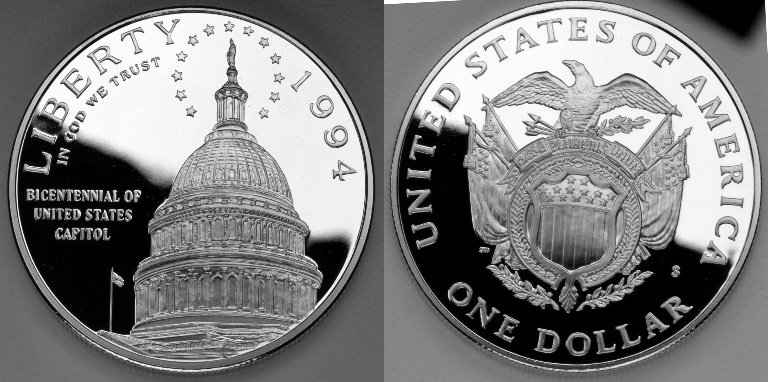
The obverse — the heads side — was designed by U.S. Mint engraver William C. Cousins. It frames the Capitol's great dome, with the bronze Statue of Freedom that stands atop it, ringed by 13 stars for the original states. It is a portrait of the dome alone, not the sprawling wings of the building — the silhouette every American recognizes.

The reverse — the tails side — is the work of John Mercanti, who would later become the Mint's Chief Engraver. He rendered the Arms of Congress: the national shield wrapped in laurel, an eagle above it clutching arrows and an olive branch, flanked by two U.S. flags. Mercanti drew it from a stained-glass window that hangs near the grand staircases between the House and Senate — a heraldic emblem most visitors walk past without noticing, lifted onto a coin.

The piece is a classic silver dollar in metal and heft: 90% silver, 10% copper, weighing 26.73 grams across a 38.1 mm face, with a reeded (grooved) edge. The Mint struck it two ways. Uncirculated coins came from Denver with a "D" mint mark — the small letter showing which Mint made the coin. Proof coins — struck twice on polished dies for a mirror finish — came from San Francisco with an "S."

Key facts

Year struck
1994
Denomination
Silver dollar (commemorative)
Commemorates
Bicentennial of the U.S. Capitol (cornerstone laid 1793)
Obverse designer
William C. Cousins (Capitol dome & Statue of Freedom)
Reverse designer
John Mercanti (Arms of Congress)
Composition
90% silver, 10% copper
Weight / Diameter
26.73 g / 38.1 mm, reeded edge
Uncirculated (Denver)
68,332 struck — 'D' mint mark
Proof (San Francisco)
279,579 struck — 'S' mint mark
Authorized maximum
500,000 coins (Public Law 103-186)
Surcharge
$15 per coin → Capitol Preservation Fund
Sales window
May 1, 1994 – April 30, 1995

Collecting the Capitol dollar

This is a coin a beginner can actually own. Neither version is a rarity. Of the 500,000 the Mint was allowed to strike, only about 348,000 across both finishes ever sold — well short of the cap, which was typical for the crowded commemorative market of the mid-1990s. That undersell means the coin trades close to the value of its silver plus a modest collector premium, not at headline auction prices.

So the chase here isn't about finding the coin — it's about finding a flawless one. The two finishes split cleanly. The Denver uncirculated piece (68,332 made) is the scarcer of the two and the one mint-state collectors hunt in the top grades. The San Francisco proof (279,579 made) is the more common, prized instead for the depth of its mirror fields and frosted devices — what graders call "deep cameo" contrast. In both cases the question a grade answers is the same: how close to perfect did this one survive, untouched in its original Mint packaging?

For a newcomer, the appeal is rare among U.S. coins — you can hold a real silver dollar, struck for a genuine national anniversary, with a verifiable story attached, without spending a fortune to do it.

Questions collectors ask

What does the 1994 Capitol silver dollar commemorate?

It marks 200 years since the cornerstone of the United States Capitol was laid in 1793 — by George Washington himself, on September 18 of that year. Congress authorized the coin under Public Law 103-186 to mark the bicentennial.

Who designed the coin?

Two Mint engravers split the work. William C. Cousins designed the obverse — the Capitol dome topped by the Statue of Freedom, ringed by 13 stars. John Mercanti, later the Mint's Chief Engraver, designed the reverse: the Arms of Congress, drawn from a stained-glass window inside the building.

What's the difference between the 'D' and 'S' coins?

The mint mark tells you which Mint struck the coin and in which finish. Denver ('D') made 68,332 uncirculated coins; San Francisco ('S') made 279,579 proofs — struck on polished dies for a mirror finish. The Denver uncirculated coin is the scarcer of the two.

Is the 1994 Capitol dollar rare or valuable?

It isn't rare. Total sales of roughly 348,000 fell short of the 500,000 the Mint was allowed to strike, so the coin generally trades near its silver value plus a small collector premium. The premium climbs only for examples certified in the very highest grades.

Where did the surcharge money go?

Every coin carried a $15 surcharge that was deposited into the Capitol Preservation Fund, overseen by the U.S. Capitol Preservation Commission — money used to help maintain and preserve the Capitol building itself.

Sources