US coin · series

The Alabama Centennial Half Dollar — the coin that broke two rules

First US coin designed by a woman. First to show a living person. And a tiny mark that turned one coin into two.

The Alabama Centennial Half Dollar — the coin that broke two rules
Bobby131313 (photography), via Wikimedia Commons · public domain · source

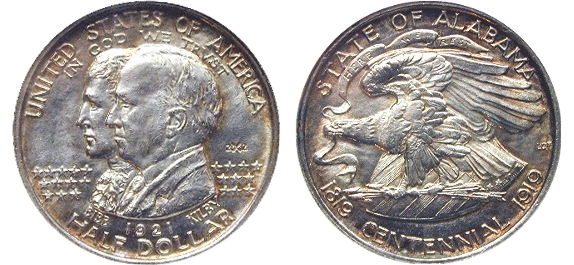
In 1921 the Mint did two things it had never done before, both on the same fifty-cent piece. It let a woman design a US coin, and it put a living man's face on American money. Then it quietly stamped a few thousand of them with a tiny "2x2" — and a single coin became two prizes.

The story behind the coin

Alabama turned a hundred years old in 1919, and the state wanted a souvenir worth keeping. The plan was a coin — a half dollar the state could sell above face value, with the profit going to mark the centennial.

Congressman Lilius Bratton Rainey carried the bill. It started as a commemorative quarter, got amended to a half dollar along the way, and became law on May 10, 1920, when President Woodrow Wilson signed it. The state's centennial commission would buy the coins from the Mint at face value, then sell them to the public for a dollar each — the gap was the fundraiser.

The coins arrived late, but they arrived in style. President Warren G. Harding came to Birmingham on October 26, 1921, and the half dollars went on sale to the crowd that day. The coin you can hold today was, for a few thousand buyers, a literal memento of the day a sitting president came to town.

The design — and the two rules it broke

The Mint handed the work to Laura Gardin Fraser, and with that she became the first woman to design a coin for the United States — and, by most accounts, the first to design a circulating-style coin for any country. Her husband, sculptor James Earle Fraser (the man behind the Buffalo nickel), sat on the federal Commission of Fine Arts that vetted coin designs, and he recommended her for the job.

The obverse — the "heads" side — carries two overlapping portraits, what numismatists call jugate busts. In front is Thomas E. Kilby, Alabama's governor in 1919; behind him, William Wyatt Bibb, the state's very first governor back in 1819. Twenty-two stars ring the figures, because Alabama was the 22nd state to join the Union.

Putting Kilby there broke the second rule. He was alive — and no living person had ever appeared on a circulating-style US coin before. An 1866 law was read by many to forbid exactly that, and the choice drew grumbling at the time. Kilby went on the coin anyway. The reverse — the "tails" side — adapts the Alabama state seal: an eagle on a shield, gripping a ribbon that reads HERE WE REST, the state's motto of that era.

Key facts

Year struck
1921 (Philadelphia, no mint mark)
Denomination
Half dollar (50 cents)
Designer
Laura Gardin Fraser
Authorized by
Act of May 10, 1920
Composition
90% silver, 10% copper
Weight / diameter
12.5 g · 30.6 mm · reeded edge
Silver content
≈0.3617 troy oz
Original sale price
$1.00 (centennial fundraiser)
First-of-its-kind
First US coin designed by a woman; first to depict a living person
Plain variety
64,038 struck; ~5,000 melted unsold; ~59,000 net
Famous variety
'2x2' — catalog figure 6,006 struck (disputed; see below)

Collecting it — the 2x2 trick

Here's the clever part. Sales of these fundraiser coins often stalled, so James Earle Fraser suggested a fix: stamp a small mark on some of the coins, and collectors who wanted a "complete" set would have to buy both kinds. The mark chosen was a sunken "2x2" in the right field, above the stars — the two 2's for the 22nd state, the X standing in for the diagonal St. Andrew's cross from Alabama's flag. (It is not a multiplication sign, even though it reads like one.)

It worked. The 2x2 became the scarcer, more sought-after coin, and it still carries a premium over the plain version today — typically running noticeably higher in collector grades. The plain variety is the more available of the two: 64,038 were struck, around 5,000 went back to the Mint unsold and were melted, leaving roughly 59,000 in collectors' hands.

The 2x2 mintage is where the honesty has to come in. The long-standing catalog figure is 6,006 struck (six held back for the annual Assay Commission). But numismatists don't fully agree — published research has put the real 2x2 figure anywhere from about 5,000 to 15,000-plus, each side making a fair case. Treat 6,006 as the traditional number, not a settled one. Either way, this is a genuinely scarce coin, and a sharply struck, high-grade example of the 2x2 is a real prize.

Questions collectors ask

What does the '2x2' on the Alabama half dollar mean?

It marks Alabama as the 22nd state. The two 2's give the number; the X stands for the St. Andrew's cross on Alabama's flag. It is not a multiplication sign. The mark was added on purpose to create a second variety so collectors would buy both.

Why is the Alabama Centennial half dollar historically important?

Two firsts on one coin. It was the first US coin designed by a woman, Laura Gardin Fraser, and the first US coin to show a living person — Governor Thomas E. Kilby, who was in office when the coin was made.

Who are the two people on the coin?

The front man is Thomas E. Kilby, Alabama's governor in 1919. Behind him is William Wyatt Bibb, the state's first governor in 1819. They appear as overlapping (jugate) portraits.

How many were made, and is the 2x2 rarer?

The plain version: 64,038 struck, about 5,000 melted unsold, roughly 59,000 net. The 2x2 is much scarcer — the traditional catalog figure is 6,006, though researchers dispute the exact number. The 2x2 commands a premium, especially in high grades.

What does 'HERE WE REST' mean on the coin?

It was Alabama's state motto at the time, taken from the state seal of that era. It appears on the reverse on a ribbon held by the eagle.

Where was it minted and in what years?

Only at the Philadelphia Mint, and only in 1921. It carries no mint mark.

Sources