US coin · series

The Washington Quarter: The Coin That Quietly Lost Its Silver

In 1965 the most ordinary coin in America was reinvented overnight — and the change is still visible on the edge.

The Washington Quarter: The Coin That Quietly Lost Its Silver
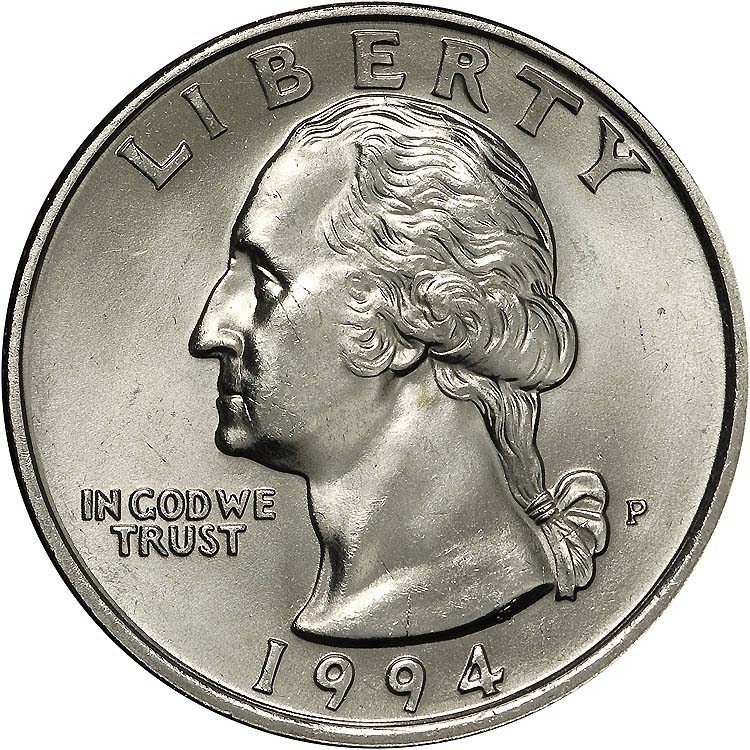
Photo credit: Numismatic Guaranty Corporation (NGC Coin Explorer); coin design by John Flanagan. US Government work, public domain · public domain · source

Stand a quarter on its side and look at the rim. That thin orange-copper stripe is the fingerprint of a national emergency: in 1965 the United States ran out of cheap silver and had to rebuild its small change from the inside out. The Washington quarter is where the swap happened — and it kept George Washington's face the whole time, so almost nobody noticed.

The story behind the coin

By the mid-1960s the United States had a slow-motion panic on its hands. The price of silver was climbing, and the metal inside a 90% silver quarter was creeping toward — and would soon pass — the 25 cents stamped on its face. When a coin is worth more melted than spent, people stop spending it. Americans began pulling silver dimes, quarters, and half dollars out of circulation by the bagful and stashing them. The country was running short of the coins it needed to make change.

So Congress acted. The Coinage Act of 1965, signed into law by President Lyndon B. Johnson on July 23, 1965, pulled silver out of the dime and the quarter entirely. The Washington quarter — already America's everyday 25-cent piece since 1932 — became a "clad" coin: a pure copper core wrapped in a copper-nickel skin that looks like silver but costs a fraction as much to make. The face of the coin stayed exactly the same. The body underneath was swapped out completely.

This is the quarter in your pocket today, and collectors draw the line right at 1965. Everything from that year forward — the clad Washington quarter — is treated as a distinct type from the 90% silver quarters of 1932–1964 that wear the same George Washington portrait. Same face, different metal, different era.

The Mint was nervous that people would now hoard the new coins, just to keep a souvenir of the changeover. So for three years — coins dated 1965, 1966, and 1967 — it stripped the mint marks off entirely. A mint mark is the little letter that says which factory struck the coin: D for Denver, S for San Francisco, no letter for Philadelphia. The thinking was that featureless coins would seem less worth collecting. The marks returned in 1968 — and this time they moved, from the back of the coin to the front, just to the right of Washington's neck, where they have stayed ever since.

The design and who made it

The quarter's design was already old by 1965 — and it almost wasn't this design at all.

The portrait was created in 1931 for the 200th anniversary of George Washington's birth. The obverse — the heads side — shows Washington in left-facing profile, modeled on the famous 1786 bust by the French sculptor Jean-Antoine Houdon, who had sculpted Washington from life at Mount Vernon. The reverse — the tails side — carries a heraldic eagle with wings spread, perched on a bundle of arrows over two crossed olive branches: war and peace, the old American pairing.

Both sides are the work of the sculptor John Flanagan. But the Mint's own art jury had wanted someone else. A competition was held, and the Commission of Fine Arts twice recommended the sculptor Laura Gardin Fraser — one of the most accomplished medalists of her day — as the winner. Treasury Secretary Andrew W. Mellon overruled them and chose Flanagan's model instead. Fraser's design was set aside and never struck on the circulating quarter. (It was not forgotten: the Mint finally used her Washington portrait on a 1999 commemorative gold coin, and again on the obverse of the American Women quarters beginning in 2022 — roughly ninety years late.)

Flanagan's eagle reverse rode the quarter through the whole silver era and straight into the clad years, appearing every year from 1932 to 1998 — with one famous, deliberate interruption.

For the nation's 200th birthday, the Mint suspended the eagle and held a national design contest for a one-time Bicentennial reverse. The winner was Jack L. Ahr, whose design shows a Revolutionary War colonial drummer beside a victory torch ringed by thirteen stars, one for each original colony. Every Bicentennial quarter carries the double date "1776–1976" instead of a single year — which is why there is no such thing as a 1975-dated Washington quarter. None were made. The Mint jumped straight from 1974 to the dual-dated coins, struck across 1975 and 1976, then put Flanagan's eagle back in 1977 as if nothing had happened.

Key facts

Type
Washington quarter, copper-nickel clad
Years struck
1965–1998 (the clad type before the 50 State Quarters of 1999)
Obverse designer
John Flanagan — George Washington, after Houdon's 1786 bust
Reverse designer
John Flanagan — heraldic eagle (1965–1974, 1977–1998)
Bicentennial reverse
Jack L. Ahr — colonial drummer, dual-dated 1776–1976
Composition
Outer layers 75% copper / 25% nickel bonded to a pure copper core (overall ~91.67% copper, 8.33% nickel)
Weight
5.67 g (down from 6.25 g for the silver quarter)
Diameter
24.3 mm
Edge
Reeded
Mints
Philadelphia (P), Denver (D), San Francisco (S, collector coins)
Bicentennial silver
40% silver versions struck at San Francisco for collector sets only

Collecting the clad Washington quarter

For a coin people throw in a cup holder without a second look, the clad Washington quarter rewards a careful eye in a few specific places.

The single most valuable thing to look for is the 1965 silver transitional error. During the 1964-to-1965 changeover, a handful of leftover 90% silver quarter blanks got mixed into bins of the new clad blanks and were struck with 1965 dies. The giveaway is weight: a normal clad quarter weighs 5.67 grams, while a silver one weighs about 6.25 grams, with a solid silver edge instead of the copper stripe. These are genuine rarities — confirmed, certified examples have sold for many thousands of dollars. (A word of caution: the internet is full of "$80,000 quarter" headlines about ordinary 1965 coins. The real transitional errors are scarce and must be authenticated by PCGS or NGC; a regular 1965 quarter from change is worth 25 cents.)

The most surprising sleeper is hiding in plain sight: the 1982 and 1983 quarters. In those two years, federal budget cuts led the Mint to cancel its annual Uncirculated Mint Sets — the little sealed cards that were, for decades, how collectors squirreled away brand-new coins in pristine condition. With no sets issued, and a deep recession pushing people to spend rather than save, very few 1982 and 1983 quarters were ever set aside in mint condition. The result is one of the few times the price guides flag modern coins as legitimately scarce in top grades. Worn ones are still just quarters; a truly uncirculated, well-struck 1982 or 1983 quarter is genuinely hard to find and carries a real premium.

The 1965–1967 Special Mint Set (SMS) coins are a smaller story. With proof and uncirculated sets suspended during the coin shortage, the Mint sold a single combined "Special Mint Set" each year — coins struck at San Francisco from polished dies with a sharper-than-normal finish, but generally not the mirror-deep quality of true proofs. The standout among them is the rare 1966 SMS quarter with a deep cameo, mirror-like surface, prized when found in the very highest grades.

For everything else, the math is simple and brutal: billions of these quarters were made to be spent. They were bag-handled, dumped into rolls, and scratched before they ever cooled. A flawless, fully struck example with crisp detail in Washington's hair and the eagle's feathers survived against long odds — and that scarcity at the very top of the grading scale is exactly what turns a 25-cent coin into something a collector will pay for. The proof coins struck for collectors at San Francisco (the S issues, from 1968 on) are the easiest way to own one in flawless condition.

Questions collectors ask

When did quarters stop being silver?

1964 was the last year for 90% silver Washington quarters made for circulation. The Coinage Act of 1965 replaced the silver with a copper-nickel clad sandwich, and clad quarters have circulated ever since. The quickest tell is the edge: a clad quarter shows a thin copper stripe, a silver one does not.

Why does my 1965, 1966, or 1967 quarter have no mint mark?

That was deliberate. The Mint left mint marks off all quarters from 1965 through 1967 to discourage people from hoarding specific dates and mints during the coin shortage. Mint marks returned in 1968 — and moved to the front of the coin, beside Washington's neck. A missing mark on those three years is normal, not an error.

Is there a 1975 Washington quarter?

No 1975-dated Washington quarter exists. For the Bicentennial, the Mint dropped single-year dates and struck only coins reading '1776–1976,' produced across 1975 and 1976. So there is no 1975 quarter — and the dual-dated Bicentennial coin is the only Washington quarter that does not show a single year.

Who designed the drummer-boy quarter, and is it valuable?

The Bicentennial reverse — a colonial drummer with a victory torch and thirteen stars — was designed by Jack L. Ahr, who won a national contest. Ordinary copper-nickel 1776–1976 quarters from circulation are worth face value; they were made by the hundreds of millions. The premium versions are the 40% silver coins struck at San Francisco for collector sets, and any quarter in pristine, high-grade condition.

Why are 1982 and 1983 quarters worth saving?

The Mint canceled its annual Uncirculated Mint Sets in both years to cut costs, so almost no one preserved fresh examples — and a recession pushed people to spend rather than save. That makes 1982 and 1983 quarters genuinely scarce in true mint condition, one of the few modern dates the price guides recognize as such. Worn ones are still just quarters; uncirculated ones carry a real premium.

What is the 1965 silver quarter error?

During the switch to clad, a few leftover 90% silver blanks were struck with 1965 dies by mistake. A genuine one weighs about 6.25 grams instead of 5.67 and has a solid silver edge. They are rare and valuable — but must be authenticated by PCGS or NGC. A normal 1965 quarter from change is worth 25 cents, despite the viral headlines.

Sources