Designer
John R. Sinnock
The Mint engraver whose two initials touched off a Cold War rumor — and who designed the dime still in your pocket.
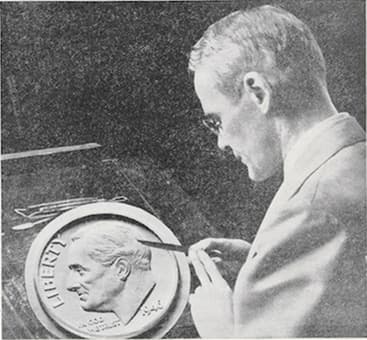
Two tiny letters near Roosevelt's neck — "JS" — once convinced thousands of Americans that a Soviet agent had slipped Joseph Stalin's mark onto the dime. The truth was quieter and stranger: they belonged to a sculptor from a New Mexico railroad town who spent thirty years inside the U.S. Mint, and whose work is still jingling in every pocket in America.
Who he was
John Ray Sinnock was born in 1888 in Raton, New Mexico — a railroad town near the Colorado line, about as far from the marble studios of the art world as a boy with a gift for sculpting could be. He found his way east to Philadelphia, the home of the United States Mint, and enrolled at the Pennsylvania Museum School of Industrial Art. He was good enough to win the school's A. W. Mifflin award, which sent him to study abroad.
In 1917, the Mint's veteran Chief Engraver, George T. Morgan — the man behind the famous Morgan silver dollar — hired Sinnock as his assistant engraver and medalist. It was the apprenticeship that shaped everything after. One of Sinnock's first jobs was the reverse — the tails side — of the 1918 Illinois Centennial half dollar, while Morgan handled the obverse, the heads side. The student was learning from the master, one coin at a time.
When Morgan died in 1925, Sinnock stepped into his chair. He became the eighth Chief Engraver of the United States Mint, the official in charge of how the nation's money looked. He would hold the post for the next 22 years, until his own death in 1947. Along the way he kept teaching, spending a decade as an art instructor — the Mint man who still graded students' clay.
The craft
Sinnock was a medalist first — a sculptor of low-relief portraits meant to read clearly at the size of a coin. That discipline shows in his work: clean profiles, calm surfaces, lettering that sits comfortably rather than shouting. He designed the modern Purple Heart's sculpted form and the medal Congress awarded Thomas Edison, and he cut the Mint's annual Assay Commission medals for years. The portrait was his instrument.
His signature habit was to reuse his own hand. The Liberty Bell that anchors the Franklin half dollar's reverse was not invented for it — Sinnock had already modeled a Liberty Bell two decades earlier, for the 1926 Sesquicentennial half dollar marking 150 years of American independence. His Franklin portrait, likewise, grew out of a 1933 medal he had sculpted, which in turn leaned on the famous Houdon bust of Franklin from life. Sinnock built new coins out of work he trusted.
That working method sits at the center of the one real controversy of his career. When the Roosevelt dime appeared, the sculptor Selma Burke — who had modeled President Roosevelt from life in 1944 for a relief plaque in Washington — argued that Sinnock's dime portrait was drawn from her work without credit. Sinnock answered that his profile was his own, "a composite of two studies that he made from life in 1933 and 1934." Here is the honest verdict, and collectors should hear it plainly: the historical record does not settle it. Burke's supporters, including a Roosevelt son and the FDR Presidential Library, have leaned toward her claim; the Mint's official record names Sinnock. Decades on, no one can prove it either way. The dispute is real; the answer is lost.
A career in coins
- 1888Born in Raton, New Mexico, on July 8.
- 1913Earns his art-instruction degree at the Pennsylvania Museum School of Industrial Art in Philadelphia.
- 1917Hired by Chief Engraver George T. Morgan as assistant engraver and medalist at the Philadelphia Mint.
- 1918Designs the reverse of the Illinois Centennial half dollar — his first coin work, under Morgan.
- 1925Succeeds Morgan as the 8th Chief Engraver of the United States Mint.
- 1926Designs the Sesquicentennial half dollar (with its Liberty Bell reverse) and the gold quarter eagle for the 150th anniversary of independence.
- 1946The Roosevelt dime — his design — is struck and released on January 30, Roosevelt's birthday.
- 1947Dies on May 14 in Staten Island, New York, having completed the Franklin half dollar's obverse but not its reverse.
- 1948The Franklin half dollar is released after his death; successor Gilroy Roberts finishes the Liberty Bell reverse.
Key facts
- Born
- July 8, 1888 — Raton, New Mexico
- Died
- May 14, 1947 — Staten Island, New York
- Nationality
- American
- Role
- 8th Chief Engraver, U.S. Mint (1925–1947)
- Trained at
- Pennsylvania Museum School of Industrial Art
- Mentor
- George T. Morgan (designer of the Morgan dollar)
- Signature coins
- Roosevelt dime (1946); Franklin half dollar (1948)
- Earlier work
- 1926 Sesquicentennial half dollar & gold $2.50; 1918 Illinois Centennial half (reverse)
- Notable medal
- The modern Purple Heart (sculpted form)
- Signature mark
- The initials 'JS' on the Roosevelt dime obverse
Questions collectors ask
What does the 'JS' on the Roosevelt dime stand for?
John Sinnock — the designer's initials, placed near the cutoff of Roosevelt's neck on the obverse, the heads side. It is simply how he signed his work.
Was 'JS' really put there for Joseph Stalin?
No. After the dime appeared in 1946 — at the height of postwar fear of communism — a rumor spread that the 'JS' stood for Soviet leader Joseph Stalin, supposedly slipped in by a sympathizer at the Mint. The Treasury Department issued formal denials. No evidence ever supported the claim, and the initials remain on the dime today. It is a piece of folklore, not history.
Why was Roosevelt chosen for the dime specifically?
Roosevelt had been paralyzed by polio in 1921 and strongly backed the March of Dimes, the campaign that asked Americans to mail in dimes to fight the disease. Honoring him on the ten-cent coin tied the man to the cause. The dime also had a practical advantage: the Mercury dime it replaced had run more than 25 years, so the design could be changed without an act of Congress.
Did Sinnock design the whole Franklin half dollar?
He designed the Benjamin Franklin portrait on the obverse, basing it on a 1933 medal of his own. He died in 1947 before the coin was issued, and his successor Gilroy Roberts finished the Liberty Bell reverse — adding the small eagle beside the bell to satisfy an old law requiring an eagle on silver coins above the dime.
Did Sinnock copy Selma Burke's portrait for the dime?
It is genuinely disputed. Sculptor Selma Burke, who modeled Roosevelt from life for a 1944 plaque, said her work was used without credit. Sinnock said his profile came from his own studies of 1933 and 1934. The Mint credits Sinnock; Burke's supporters disagree. The surviving record does not resolve it either way — a real unanswered question, not a settled fact.
Sources
- John R. Sinnock — Wikipedia
- Roosevelt dime — Wikipedia
- Franklin half dollar — Wikipedia
- The Roosevelt Dime — Stolen Design or Communist Plot? — CoinWeek
- What's the 'JS' on the Roosevelt Dime Mean? — PCGS
- Why Such A Small Eagle on the Franklin Half Dollar? — PCGS
- John R. Sinnock — Chief Coin Engraver and Designer — USA Coin Book
- United States Sesquicentennial coinage — Wikipedia
colcur earns a commission when you buy on eBay through our links — it never changes your price. Every listing opens on eBay USA; other marketplaces are not indexed yet.