Designer
William Barber
The Mint's fifth Chief Engraver — author of the Trade Dollar, and of a cabinet of magnificent coins the country decided not to make.
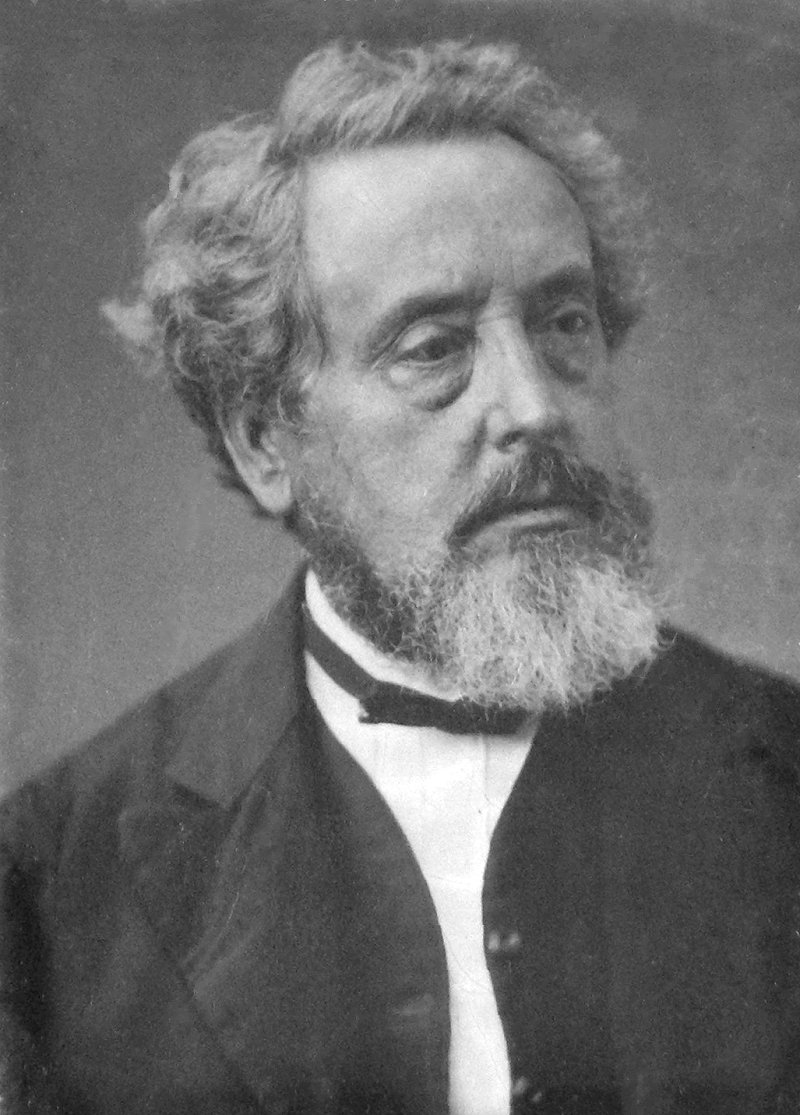
William Barber engraved one coin the whole world handled — the silver Trade Dollar that sailed to China by the ton — and a series of dazzling experiments the United States ordered up, admired, and then refused to mint. His decade as Chief Engraver is a story of one quiet success surrounded by a vault full of beautiful might-have-beens.
A London silversmith who ended up engraving America's money
William Barber learned his trade the old way: at his father's elbow. Born in London on May 2, 1807, he was taught engraving by his father, John Barber, and spent his early career cutting dies and decorating silver tableware — the painstaking, miniature work of putting fine detail onto hard metal.
In September 1852 he emigrated to the United States and settled in Boston, where he worked in the same line for about a decade. His skill eventually reached James B. Longacre — the man who had designed the Indian Head cent and the Liberty Head double eagle, and who was then Engraver of the Mint (the official who cuts the master dies a nation's coins are struck from). Around 1865 Longacre hired Barber as his assistant in Philadelphia.
When Longacre died in early 1869, the top job was open. On January 20, 1869, President Andrew Johnson appointed Barber the fifth Chief Engraver of the United States Mint. He would hold the post for ten years, until his death — and almost immediately he brought in his own son, Charles E. Barber, to work beside him. That choice would shape the rest of his career.
The one coin the world actually used — and the ones it didn't
Here is the strange shape of Barber's legacy: his most important coin was meant to leave the country, and most of his most beautiful coins never left the Mint.
The coin that left was the Trade Dollar. After Congress authorized it in the Coinage Act of 1873, the Mint adopted Barber's design — a seated Liberty offering an olive branch, facing left toward the sea, with an eagle on the reverse. It was a deliberate piece of commercial diplomacy. American silver interests wanted to break into the markets of China and the Far East, where merchants trusted the big, heavy Mexican silver dollar. So Barber's coin was built to beat that rival on weight: 420 grains of .900-fine silver, slightly heavier than a standard U.S. silver dollar. Millions crossed the Pacific. Chinese merchants stamped them with small chopmarks — punches that vouched for the silver — and a chopmarked Trade Dollar is, in effect, a coin wearing the signatures of the men who trusted it.
The coins that didn't leave the Mint are the patterns — pattern meaning a trial coin, struck to test a design or an idea that may never go into production. The Mint kept ordering grand ones from Barber, and the country kept saying no:
- The $50 Half Union of 1877 — a gold piece worth fifty dollars, the largest U.S. coin ever seriously proposed, adapting Longacre's Liberty Head. Only a tiny number of trial pieces were struck; two gold examples survive, both in the Smithsonian. It remains one of the most famous patterns the Mint ever made.
- The goloid metric dollars (from 1878) — coins in "goloid," a patented gold-silver-copper alloy, with their metal recipe spelled out in grams right on the coin. The idea was to put America on a metric, internationally compatible money standard. The alloy had a fatal flaw: it looked just like ordinary 90% silver, so no one could tell real from fake without a chemistry set.
- The metric double eagle, or quintuple stella (1879) — a $20 gold pattern whose Liberty descends from Longacre's double eagle, ringed with its metric formula in grams and the unusual Latin motto DEO EST GLORIA ("To God is the glory"). Only about five are known, and it is one of the supreme rarities of the U.S. pattern series.
Barber's style was clean, careful, and conservative — a die-sinker's precision more than a sculptor's drama. Auction cataloguers have been candid about it: one Heritage lot flatly calls his goloid metric dollar a "rather bland design." That is a fair read of the man. His gift was technical control of the die, not the bold relief later associated with the great American coin sculptors.
His decade also had a human grain of conflict running through it. In 1876, Mint Director Henry Linderman hired a young English engraver, George T. Morgan, as an assistant — without consulting his own Chief Engraver, and with Morgan reporting straight to Linderman. The two Barbers, father and son, were cold to the newcomer; William wanted Charles to succeed him, and saw Morgan as a threat to that plan. Accounts say Barber told Morgan there was no office space for him, leaving Morgan to do much of his work from a rooming house until Linderman ordered room be made. In late 1877 Linderman set Barber and Morgan against each other in a design contest for a new silver dollar. Morgan's entry won — and became the Morgan dollar, the most collected U.S. silver dollar of all. The friction eased only when Linderman retired in 1878.
A career in coins, medals, and patterns
- 1807Born in London on May 2; trained in engraving by his father, John Barber.
- 1852Emigrates to the United States in September; works as a silver and die engraver in Boston for about a decade.
- c. 1865Hired as assistant engraver at the Philadelphia Mint by Chief Engraver James B. Longacre.
- 1869Appointed fifth Chief Engraver of the U.S. Mint on January 20 by President Andrew Johnson; brings in son Charles E. Barber as an assistant.
- 1873His Trade Dollar design is adopted under the Coinage Act of 1873 and struck for export to the Far East.
- 1875Designs the short-lived twenty-cent piece, abandoned for circulation almost at once because it looked too much like the quarter.
- 1876Director Henry Linderman hires George T. Morgan over Barber's head, opening years of rivalry at the engraving department.
- 1877Engraves the $50 Half Union gold pattern; loses the silver-dollar design contest to Morgan.
- 1878Engraves the goloid metric dollar patterns, part of a push for a metric, internationally compatible coinage.
- 1879Dies in Philadelphia on August 31, aged 72, after falling ill on a seaside vacation.
Key facts
- Born
- May 2, 1807 — London, England
- Died
- August 31, 1879 — Philadelphia, Pennsylvania
- Nationality
- English-born; emigrated to the U.S. in 1852
- Role
- Fifth Chief Engraver, U.S. Mint (1869–1879)
- Trained by
- His father, John Barber, in London
- Best-known coin
- U.S. Trade Dollar (design adopted 1873)
- Famous patterns
- $50 Half Union (1877); goloid metric dollar (1878); quintuple stella / metric double eagle (1879)
- Succeeded by
- His son, Charles E. Barber, sixth Chief Engraver
In his colleagues' words
No words of William Barber's own seem to survive in the record. What survives is how the people he worked with remembered him. At a memorial meeting on September 2, 1879 — two days after he died — his Mint colleagues described him as:
"an affable, active, pain-staking, and meritorious officer, skilful in one of the most difficult of all arts."
(Memorial tribute recorded after Barber's death; quoted in his Wikipedia biography. We have not located a primary statement made by Barber himself; if you want a Barber quotation on the page, it should be sourced before publishing.)
Questions collectors ask
Was William Barber related to Charles Barber of the Barber dime?
Yes — Charles E. Barber was his son. William hired Charles as an assistant in 1869, and after William died in 1879 Charles became the sixth Chief Engraver, going on to design the Barber dime, quarter, and half dollar. The two are often confused; the Trade Dollar is the father's work, the Barber coinage of the 1890s is the son's.
Which circulating U.S. coins did William Barber design?
His major circulating design is the Trade Dollar, adopted in 1873. He also designed the twenty-cent piece of 1875, which was pulled almost immediately because it looked too much like the quarter. Much of his remaining output was patterns and medals rather than everyday coinage.
What is the $50 Half Union, and can you own one?
It is a fifty-dollar gold pattern Barber engraved in 1877 — the largest denomination the U.S. ever seriously considered. It never went into production. Two gold examples are known, both held by the Smithsonian, so a genuine one is effectively impossible to own.
Why did Barber design so many coins that were never minted?
The 1870s were a decade of experiments — a Far East trade coin, a metric coinage to match Europe, a giant gold piece. Congress and the Mint kept commissioning trial designs, then rejecting the underlying idea. As Chief Engraver, Barber executed those experiments, which is why his name sits on a remarkable run of beautiful coins that never circulated.
Who really designed the Morgan dollar — Barber or Morgan?
George T. Morgan, not Barber. In an 1877 design contest set by the Mint Director, Morgan's entry beat Barber's and became the Morgan dollar. Barber had wanted his own son to inherit the engraving department, which is part of why the two men were rivals.
Sources
- Wikipedia — William Barber (engraver)
- Wikipedia — Trade dollar (United States coin)
- Wikipedia — Half union ($50 gold pattern)
- Wikipedia — Stella (United States coin)
- Wikipedia — Twenty-cent piece (United States)
- Numista — 1879 Metric Double Eagle / Quintuple Stella ($20 pattern)
- Heritage Auctions — 1879 Goloid Metric Dollar, Judd-1628 (lot description)
- Currency Wiki (Fandom) — George T. Morgan (Linderman hiring, Mint rivalry)
- CoinCollecting.com — Chief Engraver of the U.S. Mint: William Barber
- USA Coin Book — William Barber, designer of the U.S. Trade Dollar