Designer
Pompeo Coppini
The Italian immigrant who carved Texas into bronze, stone — and silver.
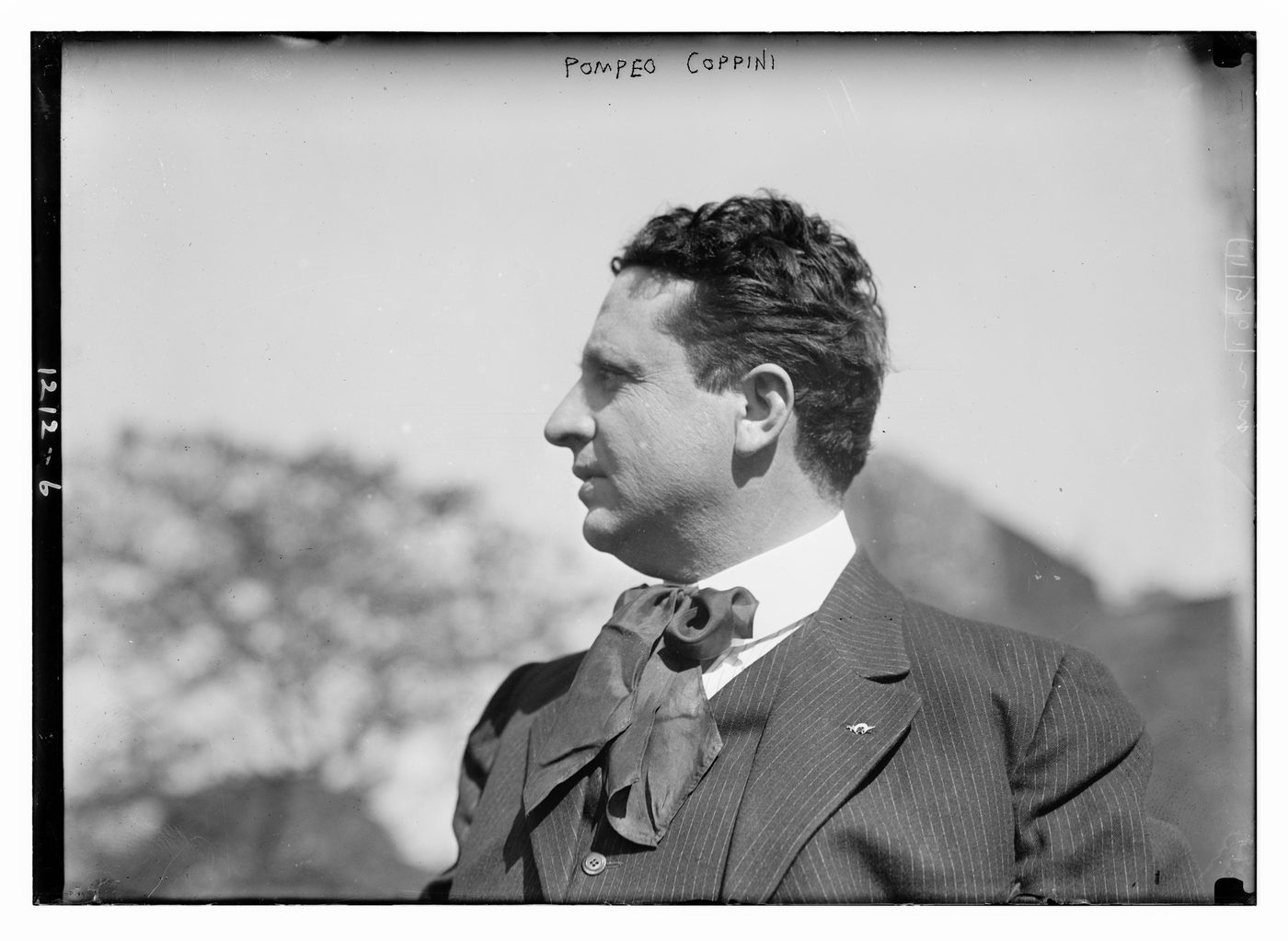
He arrived in New York in 1896 with a trunk of clothes and forty dollars, speaking no English. Four decades later he had sculpted the Alamo's great memorial — and designed the coin that paid for Texas's hundredth-birthday museum.
Who he was
Pompeo Luigi Coppini landed in New York in March 1896 with forty dollars and a trunk of clothes, and no English at all. His first American work was modeling wax figures for a museum. Twenty years later he was the most sought-after monument sculptor in Texas — and a generation after that, his work would anchor the Alamo itself.
He was born in 1870 in Moglia, a small town in northern Italy, and grew up in Florence. There he trained at the city's fine-arts academy under the sculptor Augusto Rivalta, graduating with highest honors in 1889. That academic, classical schooling — the human figure rendered with anatomical precision and heroic feeling — stayed with him for the rest of his life. He never made peace with modern abstraction.
Texas found him almost by accident. In 1901 another sculptor, Frank Teich, was hunting for skilled help, and Coppini moved south to take the work. He became an American citizen in 1902 and made San Antonio his home base. Over the next half-century he filled the state with bronze and stone, and Texas claimed him as its own.
The craft
Coppini was a monument man. His instinct was always toward the grand public statement — the soldier, the founder, the hero cast larger than life, with feeling written into every muscle. The obverse and reverse of a coin (the heads and tails sides) demanded the same instinct shrunk to fifty cents of silver.
His best-known monuments tell you exactly what he was after. The Littlefield Memorial Fountain at the University of Texas, a sprawling bronze tableau, took him eight years (1920–1928). The grave monument for Sam Houston, the founding general of the Texas Republic, stands at Huntsville. His masterpiece is the Alamo Cenotaph in San Antonio — The Spirit of Sacrifice — a sixty-foot marble shaft carrying the carved figures of the Alamo's defenders, finished in 1937–1939.
That same classical drama is what got his coin into trouble. When he designed the Texas Centennial half dollar in 1934, he packed it full: a winged goddess, the Alamo, six flags, and two portrait heads. The federal Commission of Fine Arts — the body that reviews US coin and monument designs — called it too crowded. Their sculptor member, Lee Lawrie, pushed Coppini to simplify. After back-and-forth, a compromise was approved on 25 June 1934. The episode is pure Coppini: a heroic sculptor's eye trying to fit an entire history onto a coin.
Key facts
- Full name
- Pompeo Luigi Coppini
- Born
- 19 May 1870 — Moglia, Mantua, Italy
- Died
- 26 September 1957 — San Antonio, Texas
- Nationality
- Italian-born; naturalized US citizen, 1902
- Training
- Accademia di Belle Arti, Florence (under Augusto Rivalta), 1889
- Coin design
- Texas Centennial half dollar (1934–1938)
- Signature monuments
- Alamo Cenotaph, San Antonio; Littlefield Fountain, UT Austin; Sam Houston grave, Huntsville
- Academy founded
- Coppini Academy of Fine Arts, San Antonio (founded 1945)
- Autobiography
- From Dawn to Sunset (1949)
Questions collectors ask
Who designed the Texas Centennial half dollar?
Pompeo Coppini, an Italian-born sculptor who had become the leading monument artist in Texas. He was best known for large public statues — including the Alamo Cenotaph in San Antonio — and the Texas Centennial half dollar (struck 1934–1938) was his one foray into coin design.
Was Pompeo Coppini a US Mint engraver?
No. He was an independent monument sculptor, not a staff engraver at the Mint. He created the models for the Texas half dollar as a commissioned designer; the Medallic Art Company reduced his work to coining hubs and the Philadelphia Mint struck the coins.
Why was Coppini's coin design changed before it was approved?
His first models were judged too complicated by the US Commission of Fine Arts, the body that reviews federal coin designs. Its sculptor member, Lee Lawrie, asked Coppini to simplify the crowded composition. A revised design was approved on 25 June 1934.
What is Coppini most famous for outside of coins?
The Alamo Cenotaph in San Antonio — a sixty-foot marble memorial to the defenders of the Alamo, titled The Spirit of Sacrifice, which he worked on from 1937 to 1939. It remains one of the most recognized monuments in Texas.
Where was Pompeo Coppini from?
He was born in Moglia, in the Mantua region of northern Italy, in 1870, and trained in Florence. He emigrated to the United States in 1896 and settled in Texas in 1901, becoming a US citizen in 1902.