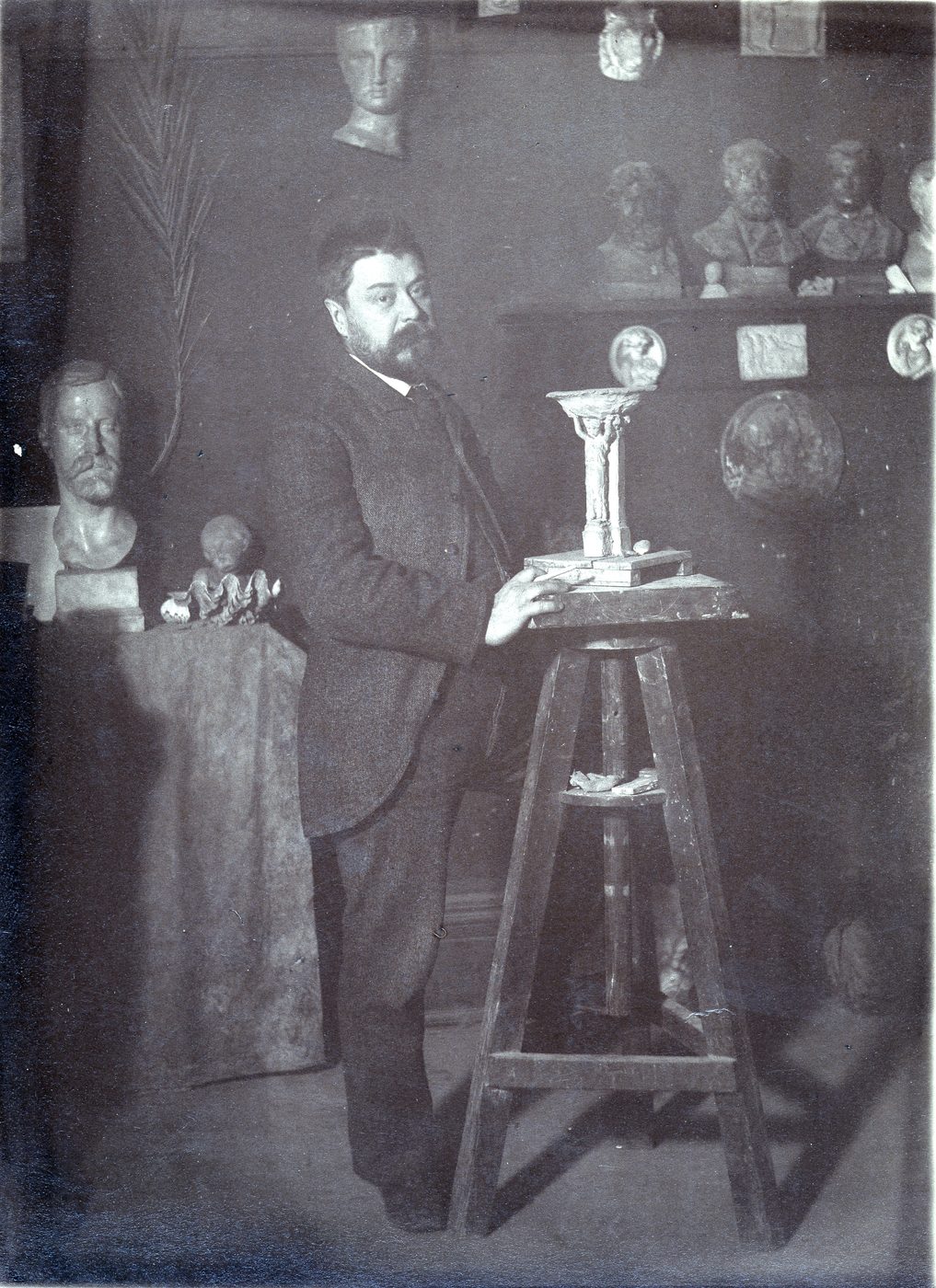
Warner's gift was the portrait in low relief — the bas-relief, a sculpted image that rises only slightly from a flat background, the way a face rises from the surface of a coin. He is often credited with helping popularize the form in America. His portrait medallions and busts are quiet, dignified, alive in a way that flat profiles rarely are.
His most ambitious portraits came from a trip through the Northwest. Warner met Native American leaders and modeled a series of medallions of individual chiefs — real people, studied from life, at a moment when most American art was content to render "the Indian" as a type. It is the same instinct that made his coin work: catch the specific human face, not the symbol.
That instinct collided with the practical world of the United States Mint in 1892. The World's Columbian Exposition in Chicago — the great fair marking 400 years since Columbus crossed the Atlantic — needed a souvenir coin to raise money. The Mint's own chief engraver, Charles E. Barber, drew first, basing Columbus on a Renaissance painting. The art world savaged the result; one paper said it looked less like Columbus than "a long-haired professor." The fair's organizers needed a rescue.
Warner — by then serving as the exposition's director of decorations — supplied it. He proposed a Columbus in profile (drawn from the fair's own badges) for the front, and for the back a caravel, evoking Columbus's flagship the Santa María, sailing above the two hemispheres of the globe, with 1492 below. The fair's artists approved it. In September 1892 the Mint agreed to use Warner's concept for both sides.
Here is the twist that makes Warner a kind of ghost. By Mint rule, only Mint engravers could cut the working dies. Barber adapted Warner's obverse — shrinking it to fit the legends — and signed it with his "B." Barber's assistant George T. Morgan reworked the ship and tucked his "M" into the rigging. So the coin the public bought, and that catalogs still credit to Barber and Morgan, was Warner's idea wearing two other men's initials. The result, the Columbian half dollar, became the first commemorative coin the United States ever struck — and the first U.S. coin to portray a real historical person.
Warner did not have long to enjoy it. In 1895 he won the kind of commission a sculptor dreams of: three sets of bronze doors for the new Library of Congress in Washington. He had finished one pair — the figures "Tradition," with its panels of Memory and Imagination — when, on August 14, 1896, he died after a bicycle accident in New York's Central Park. He was 52. The sculptor Herbert Adams completed the remaining doors.