Designer
Benjamin Franklin
The printer, scientist, and statesman who gave America's first coin its blunt advice: Mind Your Business.
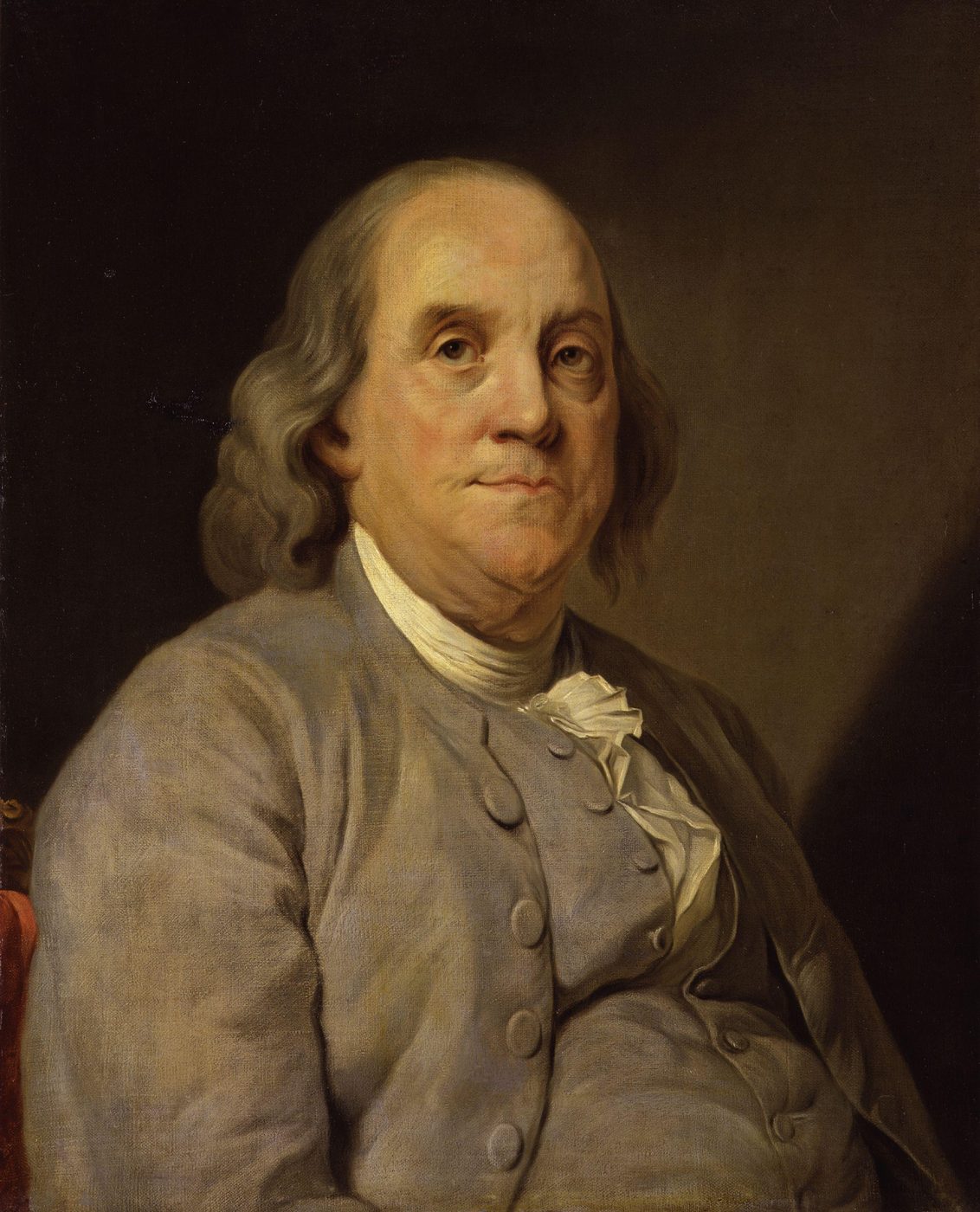
Benjamin Franklin never trained as an artist or an engraver. Yet he is the man credited with designing the first coin the United States ever issued — and with stamping on it a piece of advice that still makes people smile two centuries later: "Mind Your Business."
Who he was
Most of the men whose work appears on American coins were sculptors and engravers by trade. Benjamin Franklin was neither. He was a printer — and arguably the most famous private citizen in the world when he turned his hand to designing money.
He was born in Boston in 1706, the fifteenth of seventeen children. At twelve he was apprenticed to his older brother's print shop, and printing became the craft that made everything else possible. By 1729 he owned the Pennsylvania Gazette in Philadelphia. From 1732 he wrote Poor Richard's Almanack, packing it with the thrifty proverbs that became his trademark — "a penny saved is two pence clear." (The version everyone quotes, "a penny saved is a penny earned," he never actually wrote.)
Printing pulled Franklin into the world of money early. Colonial governments needed paper currency, and currency needed a printer who could make it hard to fake. Franklin became that printer. He devised a now-famous trick — pressing real leaves into the printing plates, so that the unrepeatable veins of an actual leaf became a counterfeiter's nightmare. This is the thread that matters for collectors: long before there was a United States, Franklin was already in the business of designing what money should look like.
The rest of his life reads like a syllabus. He proved lightning was electricity. He founded a library, a fire company, a hospital, and the academy that became the University of Pennsylvania. He is the only Founding Father to sign all four documents that built the country — the Declaration of Independence, the 1778 alliance with France, the 1783 Treaty of Paris that ended the Revolutionary War, and the Constitution. He died in Philadelphia in 1790. The coin he is remembered for in numismatics had been struck just three years before.
The craft: a motto, not a portrait
Franklin's signature on a coin isn't a style of carving. It's a style of thinking — a habit of turning a moral lesson into a picture and a few sharp words.
During the Revolution, the Continental Congress put Franklin in charge of designing its paper money. In February 1776 he produced a set of fractional currency notes — small-denomination bills — and on them he placed a device that would outlive him: a sun shining down on a sundial, the Latin word FUGIO ("I fly"), and beneath it the plain English instruction MIND YOUR BUSINESS. Read together it is a rebus, a picture-puzzle: time flies, so mind your business. In Franklin's century "mind your business" meant tend to your work and your affairs — the briskest possible sermon on industry, not the modern brush-off it sounds like today.
That same year the design jumped from paper to metal. The 1776 Continental Currency dollar — a pattern coin, meaning a trial piece that was never released for everyday use — carried Franklin's sundial and motto on one face. On the other it carried his other great idea: thirteen rings, each a colony, locked into an unbroken chain around the words WE ARE ONE and AMERICAN CONGRESS. One man's argument for union, reduced to a picture a farmer could read in a second.
A point of honesty about the craft. The numismatist Eric P. Newman, whose research underpins almost everything known about these pieces, showed that the concepts and mottos were Franklin's — the engraving of the actual currency devices was done by a craftsman named Elisha Gallaudet. Franklin was the author, not the hand. That is exactly how he worked: the printer who hired the engraving, the thinker who supplied the meaning.
The Fugio cent: America's first coin
On April 21, 1787, the Congress of the Confederation — the government running the country before the Constitution — authorized an official copper coin. A resolution that July spelled out the design, and it was Franklin's, lifted almost line for line from his 1776 work: the sun and sundial, FUGIO, MIND YOUR BUSINESS, and on the reverse the thirteen linked rings around WE ARE ONE and UNITED STATES. Collectors call it the Fugio cent — also the "Franklin cent" or the "Mind Your Business cent." It is regarded as the first coin officially issued by the United States.
Then the project ran straight into a swindle. Congress hired a contractor named James Jarvis, who held a controlling stake in a Connecticut mint at New Haven, and authorized the Treasury to acquire a vast quantity of copper — on the order of 300 tons. Jarvis, it was alleged, had secured the deal with a bribe to the Treasury official William Duer. Whatever greased it, Jarvis then did the unthinkable: instead of striking federal Fugio cents, he used much of the government's copper to mint lighter-weight Connecticut state coppers, which were more profitable. By the time Congress understood what had happened, Jarvis had fled to Europe. The government won a judgment against him that he never paid.
So the first coin of the United States was also the subject of its first coinage scandal. The numbers tell the story of a contract that collapsed: Jarvis was ultimately credited with delivering only 398,577 cents — a tiny fraction of what 300 tons of copper should have produced. (That figure comes from the weight actually delivered, 8,968 pounds, reckoned at the contract rate.) The Founders' tidy little coin about minding your business was nearly sunk by a contractor who didn't mind his.
What survives is genuinely scarce — and a remarkable number of the finest examples trace to a single lucky cache, the Bank of New York Hoard, a keg of Fugio cents found in the bank's vault and not fully examined until the twentieth century. Franklin would have appreciated the irony: thousands of his "mind your business" coins, forgotten in a banker's basement.
Key facts
- Born
- January 17, 1706 — Boston, Massachusetts
- Died
- April 17, 1790 — Philadelphia, Pennsylvania
- Nationality
- American
- Trade
- Printer, publisher, scientist, statesman, diplomat
- Coin work
- Credited with designing the 1787 Fugio cent — the first official U.S. coin
- Signature motto
- "Mind Your Business" (with FUGIO and the sundial)
- Other famous device
- "We Are One" — thirteen linked rings, also on the 1776 Continental dollar
- Attribution basis
- Demonstrated by numismatist Eric P. Newman; Mint records list the designer as "unknown, reputedly Franklin"
Career timeline
- 1706Born in Boston, fifteenth of seventeen children.
- 1718Apprenticed at twelve to his brother's print shop — the start of a printing career.
- 1729Takes over the Pennsylvania Gazette in Philadelphia.
- 1732Begins Poor Richard's Almanack and its thrift proverbs.
- 1754Publishes the 'JOIN, or DIE' cartoon — an early plea for colonial union, the same idea his 'We Are One' rings would later carry.
- 1776Designs Continental paper currency for Congress, including the February fractional notes with the FUGIO sundial and 'Mind Your Business' device; signs the Declaration of Independence.
- 1776His design appears on the Continental Currency dollar — a pattern coin, never circulated.
- 1783Negotiates the Treaty of Paris, ending the Revolutionary War.
- 1787Congress authorizes the Fugio cent on Franklin's design; signs the U.S. Constitution.
- 1790Dies in Philadelphia, three years after the first U.S. coin bore his motto.
In his own words
A penny saved is two pence clear.
The actual line from Poor Richard's Almanack (1737) — the thrift-minded sensibility that runs straight through to "Mind Your Business" on the Fugio cent. The popular paraphrase, "a penny saved is a penny earned," is not something Franklin ever wrote.
Questions collectors ask
Did Benjamin Franklin really design the Fugio cent?
He is credited with it, and the credit is well founded — but it's an attribution, not a signed mint record. The numismatist Eric P. Newman traced the coin's design and mottos back to Franklin's own 1776 Continental currency designs. Official references usually phrase it as 'designer unknown, reputedly Benjamin Franklin.' What's documented is that the design is Franklin's idea; the engraving of the earlier currency device was done by a craftsman, Elisha Gallaudet.
What does 'Mind Your Business' mean on the coin?
In the 18th century it meant 'tend to your own work and affairs' — a call to industry, not the modern 'leave me alone.' Paired with the sundial and the Latin FUGIO ('I fly'), the whole obverse reads as a picture-puzzle: time flies, so get to work. It's pure Franklin, the same spirit as his almanac proverbs.
Was the Fugio cent really the first United States coin?
Yes — it's regarded as the first coin officially issued by the United States, authorized by the Congress of the Confederation in 1787, before the Constitution took effect. (Franklin's 1776 Continental dollar came earlier but was a pattern piece that never circulated.)
Why are so few Fugio cents around if 300 tons of copper were authorized?
Because the contract was a fiasco. The contractor, James Jarvis, diverted much of the federal copper into more profitable Connecticut state coins and then fled to Europe. He was credited with delivering only 398,577 cents — a sliver of what the copper should have made — which is why the Fugio cent is genuinely scarce today.
What does 'We Are One' refer to?
It's Franklin's argument for union, made in metal. Thirteen rings — one per colony — interlock into an unbroken chain around the words 'We Are One' and 'United States.' It echoes the message of his 1754 'JOIN, or DIE' cartoon: stay together or fail apart.
Sources
- Wikipedia — Fugio cent
- Wikipedia — Continental Currency dollar coin
- Smithsonian Institution — 1 Fugio Cent, United States, 1787
- PCGS — Fugio Cents: The First Regular-Issue United States Coin
- CoinWeek — Fugio Coppers Are Not One-Cent Coins
- University of Notre Dame — Continental Currency, February 17, 1776
- OUPblog — Benjamin Franklin Says 'WE ARE ONE'
- Encyclopaedia Britannica — Benjamin Franklin
- FEE — The Hidden Message on Ben Franklin's Fugio Cent