US coin · series

The U.S. Gold Coin With a Word Hidden in Morse Code

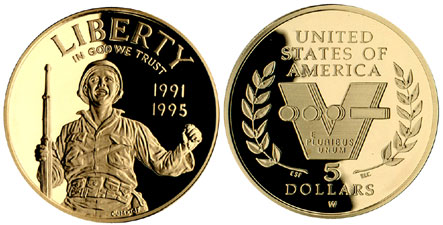
A 1993 half eagle, dated 1991-1995, for a war that ended in 1945.

The U.S. Gold Coin With a Word Hidden in Morse Code
United States Mint (www.usmint.gov) · public domain · source

Look closely at the back of this little gold coin and you'll find four marks no other U.S. coin carries: three dots and a dash. It's Morse code. It spells V — for Victory.

The story behind the coin

By the early 1990s, the soldiers who fought World War II were entering their seventies. The men who stormed Normandy and raised the flag on Iwo Jima were growing old, and the country still had no national memorial to what they'd done. Congress decided to mark the war's 50th anniversary with money — coins whose sales could help pay for a monument on the Mall in Washington.

So in 1993, the U.S. Mint released a set of three commemorative coins: a copper-nickel half dollar, a silver dollar, and the small gold piece on this page — a half eagle, the old name for a five-dollar gold coin. It was struck at West Point, the Mint's fortress-like facility in New York, which marks its coins with a tiny W (the mint mark — the letter that tells you which Mint building struck a coin).

Here's the first oddity. The coin says 1991–1995, but it was struck and sold in 1993. The dual date isn't a mistake. It frames the whole anniversary span — from the program's authorization through the 50th anniversary of the war's end in 1945 — rather than the single year it left the press. It's a coin dated for a war it commemorates, not for the day it was made.

What it depicts

The obverse — the heads side — shows an American serviceman in the instant of triumph: rifle in one hand, the other fist thrown up in the air. No general, no president. Just an ordinary soldier at the moment the shooting stopped. It was designed by Charles J. Madsen.

Turn it over and the reverse carries a heavy, blocky letter V — for Victory — wrapped in laurel. That much is conventional. What isn't conventional sits right on top of the V: four small marks, three dots and a dash. In Morse code, that's the letter V. Edward Southworth Fisher designed it, and as far as collectors have catalogued, it makes this the only United States coin to carry Morse code on its face.

The choice was loaded with meaning. During the war, the BBC opened its broadcasts to occupied Europe with the four-beat Morse rhythm for V — dot-dot-dot-dash — the same rhythm as the opening of Beethoven's Fifth Symphony. It became the sound of resistance. Stamping it onto a victory coin was a quiet nod to anyone who'd huddled around a radio in the dark.

Key facts

Denomination
$5 gold half eagle
Program
World War II 50th Anniversary commemoratives (Public Law 102-414)
Dated / struck
Dated 1991–1995; struck and released 1993
Mint
West Point (W mint mark)
Obverse designer
Charles J. Madsen — serviceman raising rifle and fist
Reverse designer
Edward Southworth Fisher — block 'V' with Morse code
Composition
90% gold, 3.6% silver, 6.4% copper
Weight / diameter
8.359 g; 21.59 mm; reeded edge
Gold content
approx. 0.242 troy oz of gold
Proof mintage
67,026
Uncirculated mintage
23,672

Collecting it

This is a modern commemorative, which means two things at once. It was never meant to circulate — it was sold straight from the Mint to collectors in boxed sets — so almost every survivor is in pristine shape. But it's also genuinely scarce by the numbers. The Mint reported just 23,672 uncirculated pieces and 67,026 proof pieces, far below the kind of figures circulating coins reach.

A quick vocabulary note, because it matters here. A proof is a specially made presentation coin, struck with polished dies on a polished blank to give mirror-bright fields and frosted devices — the showcase version. The uncirculated (or "Burnished") strike is the everyday-finish collector version. For this coin the uncirculated is the rarer of the two, since fewer people bought it.

Because the coin is roughly a quarter ounce of gold, its floor value tracks the gold price — it will rarely trade far below its metal. The premium above that comes from condition and the slab grade. Collectors chasing the very top grades — a flawless MS70 or PR70 (a perfect coin under magnification) — pay sharply more, because perfection survives in only a fraction of an already small mintage.

Questions collectors ask

Why is this coin dated 1991-1995 if it was made in 1993?

The dual date frames the 50th-anniversary span of America's World War II era rather than the year the coin was struck. All three coins in the 1993 program — half dollar, silver dollar, and this $5 gold piece — carry the same 1991-1995 dual date, even though they were all struck and sold in 1993.

Is it true this coin has Morse code on it?

Yes. The reverse places the Morse code for the letter V — three dots and a dash — directly over the block 'V' for Victory. Among catalogued U.S. coins, it is the only one to carry Morse code. The four-beat rhythm was famous in wartime as the 'V for Victory' signal broadcast into occupied Europe.

What does the W mint mark mean?

It means the coin was struck at the United States Mint at West Point, New York. The mint mark is the small letter on a coin that identifies which Mint facility produced it.

How much gold is in it?

The coin weighs 8.359 grams and is 90% gold, which works out to roughly 0.242 troy ounce of actual gold. The rest is silver and copper, added to harden the alloy.

What were the coin's sales meant to pay for?

Surcharges built into the program's prices were earmarked to help fund a national World War II memorial in Washington. The program ran a decade before the National World War II Memorial was finally dedicated on the Mall in 2004.

Sources