US coin · series

The World War I Centennial Silver Dollar

A coin minted in 2018 to finish a memorial America had owed its Great War veterans for a hundred years.

The World War I Centennial Silver Dollar
Wikimedia Commons user "Windrain" (own work, CC0 Public Domain Dedication) · CC0 · source

By 2018, every American who fought in World War I was gone — and the capital still had no national memorial to them. This silver dollar was Congress's way of fixing that: a coin whose every sale chipped in $10 toward the monument that should have been built generations earlier.

The story behind the coin

Washington, D.C. has a memorial for almost every war America has fought. For one century, it had nothing national for the first World War — the one that killed more than 116,000 Americans in barely nineteen months of fighting. The veterans of 1917–18 came home, grew old, and died, and still the capital had no place to honor them.

This coin was built to change that. In 2014, Congress passed the World War I American Veterans Centennial Commemorative Coin Act (Public Law 113-212), signed into law that December. It authorized a single silver dollar, struck in 2018, to mark a hundred years since America entered the Great War — and, crucially, to help pay for the National World War I Memorial rising in Pershing Park, just blocks from the White House.

Here is how that worked. On top of the coin's price, every buyer paid a $10 surcharge — money routed to the United States Foundation for the Commemoration of the World Wars to help fund the memorial. Commemorative coins like this one don't circulate; they exist to be sold to collectors, and the surcharge turns each sale into a small donation. A penny saved by buyers became a monument finally built.

The timing was deliberate. America joined the war in 1917 and fought hard through 1918; the coin pairs both dates — 1918 and 2018 — exactly a century apart.

The design

The two designs came from a juried competition, not from a single Mint artist working alone. The winner was LeRoy Transfield, a sculptor from Orem, Utah, whose entries beat out a field of submitted designs judged by members of the Citizens Coinage Advisory Committee and the U.S. Commission of Fine Arts. Transfield's drawings were then turned into coin sculpture by Don Everhart, at the time one of the Mint's senior sculptor-engravers (he has since retired).

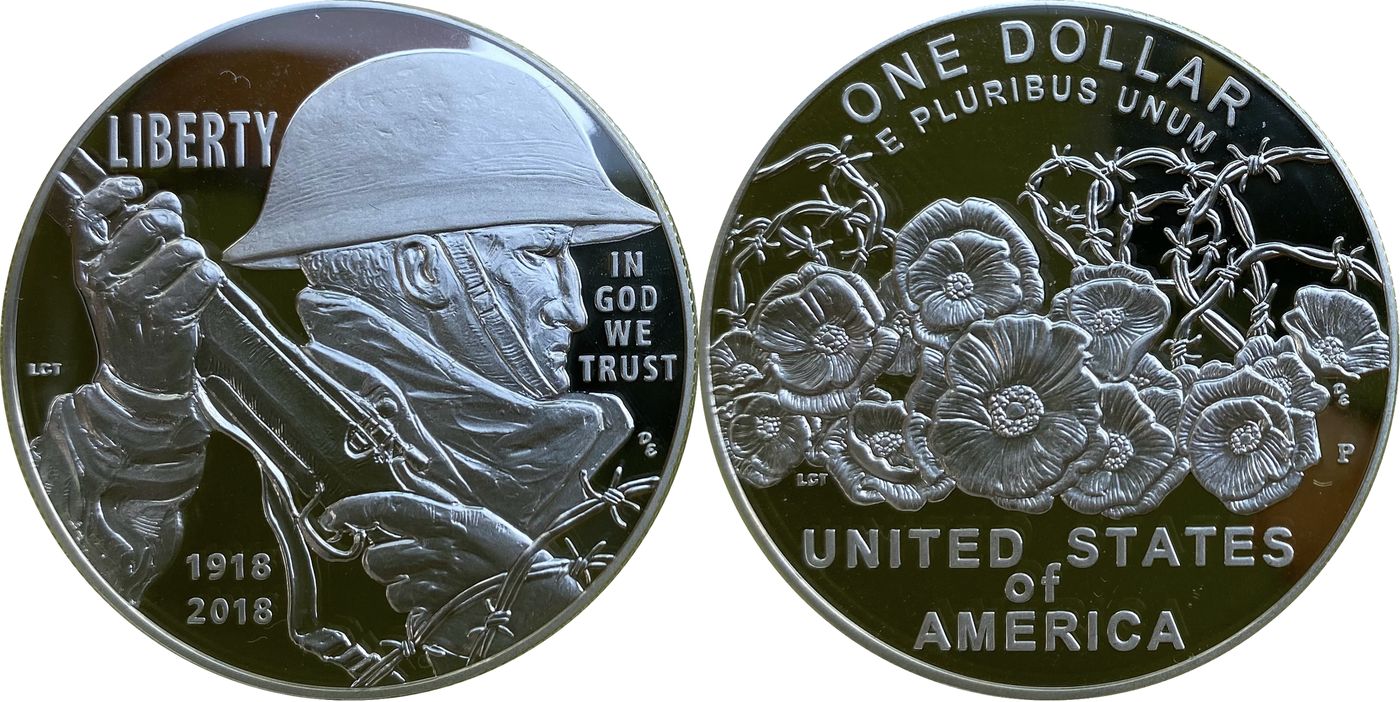
The obverse — the heads side — is called "Soldier's Charge." It shows a doughboy mid-advance, gripping his rifle, rendered almost like carved stone, with barbed wire curling into the lower corner. It is not a triumphant pose. It is a man going forward into the wire, which is exactly what the Western Front asked of him.

The reverse — the tails side — is "Poppies in the Wire." Abstract poppies tangle through strands of barbed wire. The poppy had become the flower of remembrance after the war, immortalized in the poem In Flanders Fields; setting it against the wire that defined trench warfare is the whole story of the conflict in one image — beauty growing out of devastation.

Transfield reportedly kept the lines spare on purpose, having learned that busy, detailed artwork loses its punch when squeezed onto a small coin in low relief — the shallow, sculpted height of the design above the coin's flat field.

The coin was struck only at Philadelphia, carrying that mint's P mint mark — the small letter that tells you which U.S. Mint facility made a coin. It came two ways: a proof, struck on polished dies to mirror-like fields with frosted devices, and an uncirculated business-style finish.

Key facts

Year struck
2018 (one year only)
Denomination
$1 (commemorative — does not circulate)
Authorizing act
World War I American Veterans Centennial Commemorative Coin Act — Public Law 113-212 (Dec 16, 2014)
Designer
LeRoy Transfield (designs)
Sculptor
Don Everhart (U.S. Mint)
Obverse / Reverse
"Soldier's Charge" / "Poppies in the Wire"
Mint
Philadelphia (P)
Composition
90% silver, 10% copper
Weight / Diameter
26.730 g / 38.10 mm, reeded edge
Maximum authorized
350,000 coins
Reported sales
Proof 127,848 + Uncirculated 22,340 (~150,000 total)
Surcharge
$10 per coin to help fund the National WWI Memorial, Washington, D.C.

Collecting it

This is a one-year coin, and the numbers tell a clear story. Congress authorized up to 350,000, but buyers took only around 150,000 — roughly 127,848 proofs and 22,340 uncirculated, by reported figures. The proof outsold the uncirculated by close to six to one, and there's a reason: the Mint bundled proof dollars with a set of companion medals, which pushed proof demand and left the plain uncirculated coin the scarcer of the two finishes.

About those medals. The Mint paired the silver dollar with five companion silver medals, one for each U.S. service that fought the war — Army, Navy, Marine Corps, Air Service, and Coast Guard. Each medal was sold only in a set with a proof dollar, for $99.95. A collector who wanted all five branches had to buy five separate sets. The medals are not coins and carry no face value, but they're part of this program's story and part of what made the proof so popular.

For grading: because these were sold straight from the Mint and never jingled in a pocket, surviving examples grade very high. Top-grade pieces — MS70 for uncirculated, PF70 (or PR70) for proof, the perfect end of the 70-point scale — are common rather than rare. With this issue, scarcity lives in the low total mintage and the smaller uncirculated run, not in chasing a flawless grade.

Questions collectors ask

Why does the coin show both 1918 and 2018?

It's a centennial coin. The United States fought World War I in 1917–1918; the dollar was struck in 2018, a hundred years on. Pairing the two dates is the whole point — it marks the anniversary.

Can I spend a World War I Centennial silver dollar?

Technically it's legal tender for one dollar, but no one does — it's a commemorative made of 90% silver and was sold to collectors well above face value, with a $10 surcharge on top to fund the National WWI Memorial. Its silver content alone is worth far more than a dollar.

What do the designs mean?

The obverse, "Soldier's Charge," shows an American soldier advancing into barbed wire. The reverse, "Poppies in the Wire," tangles the remembrance poppy through the barbed wire of the trenches — the flower of mourning growing out of the battlefield.

What were the companion medals?

The Mint offered five silver medals, one per service branch (Army, Navy, Marine Corps, Air Service, Coast Guard), each sold only paired with a proof dollar in a $99.95 set. They are medals, not coins, and have no face value.

Is the uncirculated or the proof rarer?

The uncirculated. Reported sales were about 22,340 uncirculated versus 127,848 proof — the proof was buoyed by the popular medal sets, leaving the plain uncirculated finish the scarcer of the two.

Sources