US coin · series

The 1994 World Cup $5 Gold Coin

The summer America hosted the world's game — and put soccer's trophy on a gold coin.

The 1994 World Cup $5 Gold Coin
United States Mint (source: usmint.gov commemorative-coins program) · public domain · source

In 1994 the United States hosted soccer's World Cup for the first time — and drew the largest crowds the tournament has ever seen. To mark it, the U.S. Mint struck a gold coin carrying the one object every nation in the field was chasing: the trophy itself.

The summer the world's game came to America

For one month in 1994, soccer owned the United States. The country that supposedly didn't care about the sport hosted the FIFA World Cup — and packed its stadiums. The 52 matches across nine cities drew 3,587,538 fans, an average of nearly 69,000 a game. That total is still the highest in World Cup history, set before the field even grew from 24 teams to 32.

It was a gamble that paid off. FIFA had handed the tournament to a nation with no top-flight professional league and a reputation for shrugging at the game the rest of the planet calls football. The crowds settled the argument. Out of that summer came Major League Soccer, launched two years later as a condition of the U.S. hosting.

The U.S. Mint marked the moment the way Congress had taught it to mark big national occasions — with a set of commemorative coins. The 1994 World Cup program ran three pieces: a copper-nickel clad half dollar, a silver dollar, and the gold coin on this page. The gold one was the prize of the set.

What the coin shows

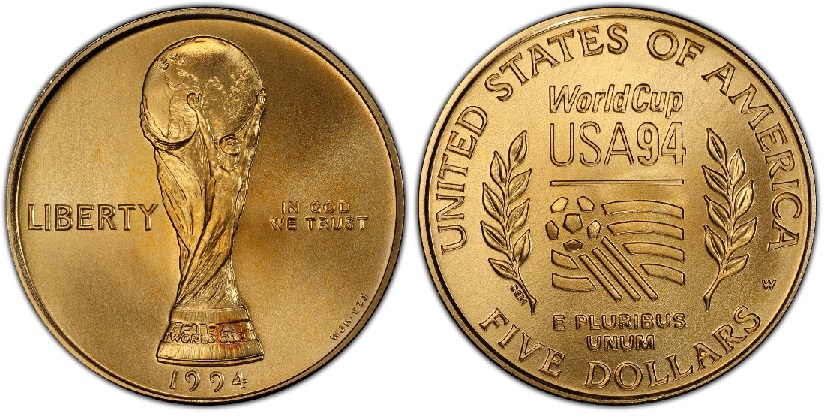
The obverse — the heads side — is the hook. It carries the FIFA World Cup Trophy, the gold statuette of two figures holding up the earth that every team in the tournament was playing to lift. Putting it on a U.S. gold coin was a neat piece of wit: the trophy is itself made of gold, so the coin is, in the catalog phrase of the day, "the trophy preserved in gold." Around it run LIBERTY, IN GOD WE TRUST, and the date, 1994. The trophy design is the work of U.S. Mint artist William J. Krawczewicz.

The reverse — the tails side — turns to the host. It centers the official "World Cup USA 94" logo flanked by laurel branches, with UNITED STATES OF AMERICA, E PLURIBUS UNUM, and the denomination, FIVE DOLLARS. That side was designed by Dean McMullen.

The coin is a gold half eagle — the historic name for a U.S. $5 gold piece. It is small and dense: 21.6 mm across, 90% gold and 10% copper, weighing 8.359 grams, with a reeded (grooved) edge. Every example carries the W mint mark of the West Point Mint, where the gold coins were struck. The $5 face value is purely legal-tender symbolism; the coin was always worth its gold and its story, never its denomination.

Key facts

Denomination
$5 gold half eagle
Year struck
1994
Mint
West Point (W mint mark)
Composition
90% gold, 10% copper
Weight
8.359 g
Diameter
21.6 mm
Obverse designer
William J. Krawczewicz (FIFA World Cup Trophy)
Reverse designer
Dean McMullen (World Cup USA 94 logo)
Authorizing law
Public Law 102-281 (May 13, 1992)
Authorized maximum
750,000 (program ceiling)
Proof struck
89,614 (1994-W)
Uncirculated struck
22,447 (1994-W)
Surcharge
$35 per gold coin, to the 1994 World Cup organizers and U.S. soccer

Collecting it

The coin comes in two flavors, both struck at West Point in 1994. The proof — struck twice from polished dies to give mirror fields and frosted devices — was the popular choice, with 89,614 sold. The uncirculated, or business-strike, version is far scarcer: just 22,447 were sold. For a collector chasing the rarer of the pair, the uncirculated is the one to know.

Set those numbers against the program's authorized ceiling of 750,000 gold coins and a pattern of the era jumps out. The early-1990s saw the U.S. Mint flood the calendar with commemorative programs, and buyers tired of them. Sponsors routinely won permission to strike far more than the market wanted, and the World Cup gold sold barely a seventh of its allowance. Low sales then mean modest survivors now — fewer than 113,000 of these coins exist in total across both finishes.

Because nearly every example was bought by a collector and tucked away, most survive in high grade. Value tracks two things: the coin's gold content, which sets a floor, and its grade, where the top of the population scale — flawless proofs and the scarce uncirculated pieces in pristine condition — commands the premium. Each coin shipped from the Mint in a capsule with a certificate; the original packaging still matters to many buyers.

Questions collectors ask

What is on the 1994 World Cup $5 gold coin?

The obverse shows the FIFA World Cup Trophy — the gold statuette teams play to lift — designed by U.S. Mint artist William J. Krawczewicz. The reverse carries the official 'World Cup USA 94' logo with laurel branches, designed by Dean McMullen. It was struck in 1994 to mark the United States hosting soccer's World Cup.

How many 1994 World Cup $5 gold coins were made?

Two versions were struck at West Point: 89,614 proofs and 22,447 uncirculated coins, about 112,000 in total. Congress had authorized up to 750,000, so the program sold only a fraction of its ceiling — common for the over-supplied commemorative programs of the early 1990s.

Which is rarer, the proof or the uncirculated?

The uncirculated (business strike). Only 22,447 were sold, versus 89,614 proofs. Both carry the W mint mark of West Point.

Is the 1994 World Cup gold coin real gold?

Yes. It is a $5 gold half eagle, 90% gold and 10% copper, weighing 8.359 grams. The $5 face value is symbolic — the coin's worth comes from its gold content and its collector demand.

Why does the coin exist?

Public Law 102-281 (1992) authorized commemorative coins for the 1994 World Cup, the first held in the United States. A $35 surcharge on each gold coin went to the tournament's organizers, with a share directed to U.S. soccer through the United States Soccer Federation Foundation.

Sources