US coin · series

The Coin That Built a Memorial Washington Wouldn't Pay For

A 1994 silver dollar for the women who served — and the only national memorial to all of them.

The Coin That Built a Memorial Washington Wouldn't Pay For
United States Mint (U.S. government work) · public domain · source

In 1986, Congress approved a memorial to every American woman who ever wore a uniform — then gave it no money to build one. This silver dollar was part of how the gap got closed: a coin that put ten dollars from every sale toward a monument at the gates of Arlington.

The story behind the coin

Women had served the United States in uniform since the Revolution — as nurses, clerks, pilots, spies, and soldiers — and for two centuries the capital had not a single national memorial to say so. In 1986 Congress finally authorized one. But it attached a catch that would define everything that followed: no federal construction money. The memorial had to be paid for by the public it honored.

That job fell to retired Air Force Brigadier General Wilma Vaught and the foundation she led. By the time ground was broken in 1995, they had raised only about $6.5 million of a budget that would climb past $21 million — and had to borrow against a bank line of credit just to keep building.

This is where the coin comes in. In December 1993, Congress passed Public Law 103-186, authorizing a 1994 silver dollar whose sale would help close the gap. It was one of three coins in that year's U.S. Veterans Program, struck alongside dollars for the Vietnam Veterans Memorial and for American Prisoners of War. Each sale of the women's coin sent a surcharge — ten dollars — straight to the memorial foundation. The coin raised roughly $2.7 million toward the building. On October 18, 1997, the Women in Military Service for America Memorial was dedicated at the western end of Memorial Avenue, the ceremonial gateway to Arlington National Cemetery. It remains the only major national memorial honoring all U.S. servicewomen, from the Revolution to today.

The design

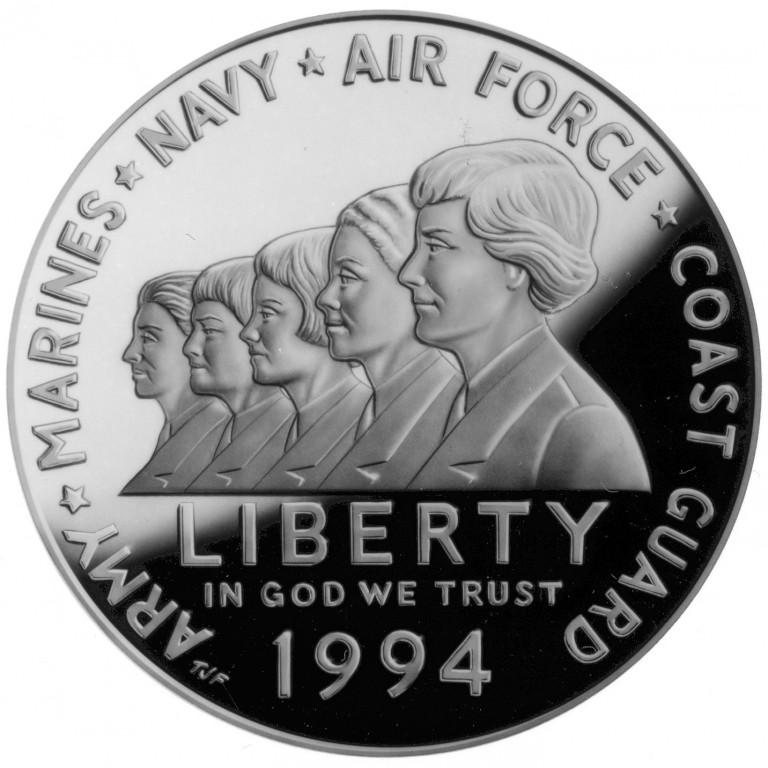
The obverse — the heads side — was designed by U.S. Mint sculptor-engraver T. James Ferrell. It shows a row of women's profiles, layered one behind the next, each representing one of the five branches of the armed forces. The names ring the rim like a roll call: ARMY, MARINES, NAVY, AIR FORCE, COAST GUARD. It is a deliberately plain image — no allegory, no goddess of Liberty, just faces — and that plainness is the point.

The reverse — the tails side — is by Mint sculptor-engraver Thomas D. Rogers Sr., and it does something most commemoratives don't: it shows the very thing the coin was paying for. The design is the approved architectural rendering of the memorial itself — the curved retaining wall set into the hillside below Arlington, with its arc of glass tablets. Buy the coin, and you held a small picture of the monument your purchase helped raise.

The coin is a standard commemorative silver dollar: 26.73 grams of 90% silver and 10% copper, 38.1 millimeters across, with a reeded (grooved) edge. It was struck in two finishes at two different mints — a detail that matters to collectors, below.

Key facts

Year struck
1994
Denomination
Silver dollar (commemorative, $1 face)
Obverse designer
T. James Ferrell
Reverse designer
Thomas D. Rogers Sr.
Composition
90% silver, 10% copper
Weight / diameter
26.73 g / 38.1 mm, reeded edge
Proof mintage (1994-P)
241,278
Uncirculated mintage (1994-W)
69,860
Authorized maximum
500,000 (not reached)
Surcharge
$10 per coin to the Women in Military Service for America Memorial Foundation
Authorizing law
Public Law 103-186 (signed Dec. 14, 1993)

Collecting it

Here is the quiet fact that makes this coin interesting: it didn't sell out. Congress authorized up to 500,000 dollars; in the end the Mint struck about 311,000 across both versions. The cause was worthy and the design dignified, but the 1994 Veterans Program flooded the market with three silver dollars at once, and buyers spread themselves thin.

That under-selling is exactly why the coin rewards a closer look. The two versions are far from equal. The proof — the mirror-finish collector strike from the Philadelphia Mint, carrying a "P" mint mark — accounts for 241,278 of the total. The uncirculated, or business-strike, version came from the West Point Mint with a "W" mint mark, and only 69,860 were made. (A mint mark is the small letter showing which facility struck a coin.) That makes the 1994-W the genuinely scarce one: among the lower-mintage modern commemorative dollars, and the half of this pairing collectors actually have to hunt for.

For grading, the gap between a good coin and a great one is narrow on a modern silver dollar — most survive in high grade because they were sold to collectors, not spent. The premium lives at the top of the scale, where a flawless strike and untouched fields separate a common slab from a conditional rarity. The 1994-W in top uncirculated grades is the one to watch.

Questions collectors ask

What is the 1994 Women in Military silver dollar worth?

It carries a little over three-quarters of a troy ounce of silver, so it always has a bullion floor that moves with the silver price. Above that, value depends on the version and grade: the low-mintage 1994-W uncirculated coin and top-graded examples command more than the more common 1994-P proof. Check current population and price data for the exact grade you hold.

Which version is rarer, the 1994-P or the 1994-W?

The 1994-W. The West Point uncirculated coin had a mintage of just 69,860, versus 241,278 for the 1994-P proof from Philadelphia. The W is the scarce half of the pair.

What do the P and W mint marks mean?

They show which U.S. Mint facility struck the coin. P is Philadelphia, which made the proofs (the polished, mirror-finish collector version). W is West Point, which made the uncirculated business strikes.

What did the coin pay for?

A $10 surcharge from each coin went to the Women in Military Service for America Memorial Foundation. The coin raised roughly $2.7 million toward the memorial at the gateway to Arlington National Cemetery, which was dedicated on October 18, 1997 — the only major national memorial honoring all U.S. servicewomen.

Why didn't the coin sell out?

It was one of three silver dollars in the 1994 U.S. Veterans Program, released alongside the Vietnam Veterans and Prisoners of War dollars. Three coins competing for the same buyers at once meant none reached its authorized cap; about 311,000 of an allowed 500,000 were struck.

Sources