US coin · series

The 1992 White House Dollar

A coin for the house — minted to rebuild the endowment that keeps its rooms whole.

The 1992 White House Dollar
United States Mint · public domain · source

In 1792, workers laid a single cornerstone for a building with no name yet. Two centuries later, the Mint struck a silver dollar for it — and capped the run so low that it sold out.

The story behind the coin

On October 13, 1792, a stone went into the ground at the edge of a swampy new capital. There was no president living in Washington yet, no marble portico, not even a finished set of walls — just a foundation for a house the country had decided it needed. Two hundred years later, the United States Mint marked that moment with a silver dollar.

Congress authorized it through the 1992 White House Commemorative Coin Act (Public Law 102-281). The point was not just to celebrate — it was to raise money. Every coin carried a surcharge on top of its price, and that surcharge flowed to the White House Endowment Fund, set up to provide a permanent source of support for the building's collection of fine art and historic furnishings and for the upkeep of its public rooms. The program ultimately delivered roughly $5 million to that fund.

Here is the twist collectors still talk about. The Mint was allowed to strike no more than 500,000 of these dollars, total — the lowest cap of any modern commemorative silver dollar to that point. Demand met the ceiling. The coins sold out. A program designed to quietly fund furniture restoration became one of the era's small surprises.

The design

The two sides of this coin tell one story from two angles: the building, then the man who drew it.

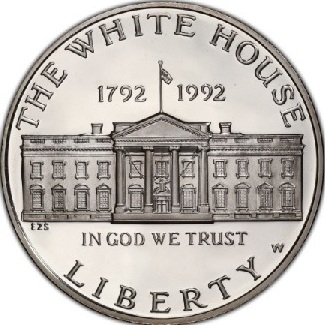
The obverse — the heads side — shows the North Portico of the White House, the columned entrance most Americans picture when they picture the house at all. The dates 1792 and 1992 sit on either side, anchoring the two-century span. It was designed by Edgar Z. Steever IV, a Mint sculptor-engraver.

The reverse — the tails side — turns to James Hoban, the Irish-born architect who won the 1792 competition to design the building. Hoban appears in a bust, set before the main entrance he conceived, with his name spelled out below. That side is the work of Chester Y. Martin. Putting the architect on the coin, rather than a president or an eagle, is the quiet argument of the whole piece: this is a tribute to the house as a work of design, and to the person who imagined it.

Key facts

Denomination
One dollar (silver commemorative)
Year struck
1992
Commemorates
200th anniversary of the White House cornerstone (laid Oct 13, 1792)
Authorizing act
1992 White House Commemorative Coin Act (Public Law 102-281)
Obverse designer
Edgar Z. Steever IV — North Portico of the White House
Reverse designer
Chester Y. Martin — architect James Hoban
Composition
90% silver, 10% copper
Weight
26.73 g
Diameter
38.1 mm (1.5 in)
Edge
Reeded
Maximum authorized
500,000 coins (all finishes) — sold out
Uncirculated (Denver)
123,803 struck — 'D' mint mark
Proof (West Point)
375,849 struck — 'W' mint mark
Surcharge beneficiary
White House Endowment Fund (~$5 million raised)

Collecting it

Two coins came out of this program, and the difference is in the finish and the mint mark. The Denver Mint struck the uncirculated version, carrying a "D" — the smaller run at 123,803 pieces. West Point struck the proof, carrying a "W" — a proof being a specially made coin with mirror-like fields and frosted devices, struck from polished dies for collectors rather than for change. The proof run was larger, at 375,849.

That combined total — just under 500,000 — is the whole story of the issue's scarcity. The cap was set low, and buyers took nearly all of it. Neither version is rare in an absolute sense; both are common enough that you can find them. The interest lies at the top of the grading scale. Because these were collector coins handled carefully from day one, a great many survive in high grades, so the premiums concentrate on the very best examples — flawless proofs and the highest-graded uncirculated pieces.

For a newcomer, the practical read is simple. A circulated-looking or lightly handled example trades close to its silver content. The value worth chasing sits in pristine, top-graded coins, where the small original mintage starts to matter.

Questions collectors ask

What does the 1992 White House dollar commemorate?

It marks 200 years since the laying of the White House cornerstone on October 13, 1792. Congress authorized it through the 1992 White House Commemorative Coin Act, with proceeds going to the White House Endowment Fund.

Who is the man on the back of the coin?

James Hoban, the Irish-born architect who won the 1792 competition to design the White House. The reverse shows his bust before the main entrance he designed — a tribute to the building's creator rather than a president.

What is the difference between the 1992-D and 1992-W?

The 'D' coin is the uncirculated version struck at the Denver Mint (123,803 pieces). The 'W' coin is the proof struck at West Point (375,849 pieces) — a mirror-finish coin made for collectors.

Why is this commemorative considered scarce?

Its maximum authorized mintage was 500,000 coins across all finishes — the lowest cap of any modern commemorative silver dollar at the time — and the program sold out. Combined sales came to just under that ceiling.

Is the 1992 White House dollar valuable?

Most examples trade near their silver value. The premiums concentrate on the highest-graded coins, where the small original mintage and the flawless condition together drive the price.

How much silver is in it?

The coin is 90% silver and 10% copper, weighs 26.73 grams, and measures 38.1 mm across — the classic U.S. silver dollar standard.

Sources