US coin · series

The Walking Liberty Half Dollar

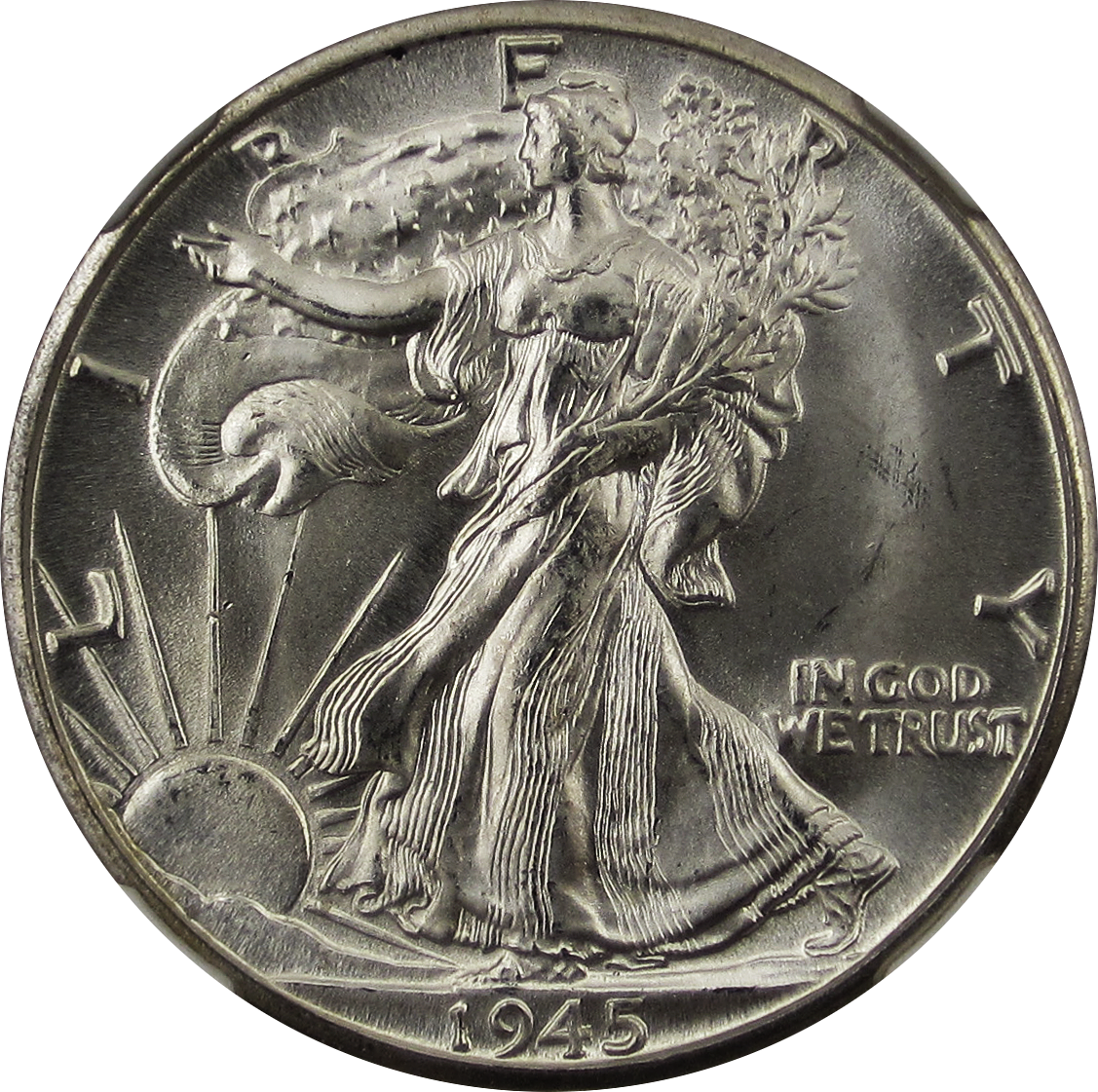
Liberty strides toward the sunrise — the coin many collectors call the most beautiful America ever struck.

The Walking Liberty Half Dollar
Photograph by Brandon Grossardt; coin design by Adolph A. Weinman (1916). Public domain, no attribution required · public domain · source

In 1916, the U.S. Mint threw out a design that had run for a quarter-century and replaced it with a half dollar so lovely that, seventy years later, it was brought back from the dead to carry the nation's silver bullion. The Walking Liberty is that coin.

The story behind the coin

By 1915, American pocket change was, frankly, dull. The dime, quarter, and half dollar all wore the same stern profile — the work of Mint Chief Engraver Charles Barber — and they had worn it since 1892. The law allowed a coin design to be replaced after 25 years, and Mint Director Robert W. Woolley wanted them gone.

So the Mint did something it rarely did: it went outside its own engraving department. The Commission of Fine Arts invited three respected sculptors to compete. The half dollar and the dime both went to Adolph A. Weinman — a German-born sculptor trained under Augustus Saint-Gaudens, the artist behind the celebrated $20 gold piece. (The third sculptor, Hermon MacNeil, won the quarter.) On February 28, 1916, Weinman learned his sketches had won.

The result was part of what collectors now call the Renaissance of American Coinage — a brief, dazzling stretch when the country decided its money should look like art. The Walking Liberty entered circulation in January 1917 and stayed there for three decades, riding through the Great War, the Roaring Twenties, the Depression, and the Second World War in the pockets of ordinary Americans.

The design — and who made it

The obverse — the heads side — is the reason people fall for this coin. Liberty walks toward the rising sun, the American flag draped over her shoulder, her free hand carrying branches of laurel and oak. Treasury Secretary William McAdoo read those branches as "symbolical of civil and military glory." She is mid-stride, full-length, sunlit — not a frozen profile but a figure in motion. Weinman drew on the classical Greek Nike, the winged Victory, and it shows.

The reverse — the tails side — answers with power instead of grace: a bald eagle perched on a mountain crag, wings half-open, a young pine sprouting from the rock beside it. Weinman described the bird as "fearless in spirit, and conscious of his power."

A quiet legend clings to the coin. Weinman is said to have modeled Liberty's face on Elsie Stevens, the wife of the poet Wallace Stevens, whose bust he had sculpted in 1913. Her daughter claimed it was true in 1966 — but no Mint record confirms it, and Weinman never said so himself. Treat it as a lovely story, not a documented fact.

One design quirk matters to collectors. On the 1916 coins and some early 1917s, the mint mark — the small letter (D for Denver, S for San Francisco) showing where a coin was struck — sat on the obverse, just below "IN GOD WE TRUST." Mint Director Friedrich von Engelken thought it looked like a flaw in the die (the engraved steel stamp that strikes the coin), so on February 14, 1917 he ordered it moved to the reverse, beneath the branch. That is why 1917 exists with the mark in two different places.

Key facts

Years struck
1916–1947
Designer
Adolph A. Weinman (obverse and reverse)
Composition
90% silver, 10% copper
Weight
12.50 g; 30.6 mm diameter
Silver content
0.36169 troy oz
Mints
Philadelphia (no mark), Denver (D), San Francisco (S)
Lowest mintage
1921-D — 208,000 struck
Replaced by
Franklin half dollar, 1948
Famous afterlife
Obverse revived for the American Silver Eagle, 1986

Collecting it — key dates, varieties, and why high grades are scarce

The Walking Liberty rewards patience. A complete date-and-mintmark set runs 65 coins, and most are common silver — but a handful are genuinely hard, and a few are downright rare.

The 1921 trio is the prize. America slid into a sharp recession after World War I, and the Mint struck very few half dollars that year. The 1921 Philadelphia (246,120), the 1921-S (548,120), and above all the 1921-D — just 208,000 struck — are the keys to the set. To put that in perspective, the 1921-D had a lower mintage than the famous 1909-S VDB Lincoln cent. Finding one in high grade, with the design crisply struck, is harder still.

The first-year and early issues fight you too. The 1916-S (508,000) and the early "mint mark on obverse" coins are tough, and the 1938-D (491,120) is the scarcest of the later dates.

Strike is the real challenge. Weinman's design has its highest point — Liberty's left hand and head — directly opposite the eagle's breast on the back. Striking both fully meant pushing a lot of metal into deep recesses, and the Mint often didn't. The result: many surviving Walkers are weakly struck, soft on Liberty's hand and the eagle's feathers even when barely worn. A coin that is both high-grade and fully struck — what collectors prize as "full head" or sharp central detail — is far scarcer than the mintage numbers alone suggest. That gap between "uncirculated" and "fully struck" is where the real money lives.

The series also includes proof coins — specially polished presentation strikes — made at Philadelphia from 1936 through 1942 in small numbers, which sit at the top of many collections.

Questions collectors ask

Who designed the Walking Liberty half dollar?

Adolph A. Weinman, a German-born American sculptor who trained under Augustus Saint-Gaudens. He designed both sides — Liberty walking toward the sun on the front, and a perched eagle on the back — and also designed the Mercury dime the same year, in 1916.

What is the rarest Walking Liberty half dollar?

By mintage, the 1921-D is the key date, with just 208,000 struck — the lowest of any regular issue in the series. The 1921, 1921-S, and 1916-S are the other major rarities. Beyond mintage, fully struck high-grade examples of almost any date are scarce, because the design was difficult to strike completely.

How much silver is in a Walking Liberty half dollar?

Each coin is 90% silver and 10% copper, weighs 12.50 grams, and contains about 0.36169 troy ounces of silver. That silver content is why circulated common-date Walkers trade close to their metal value.

Why is the same design on the Silver Eagle?

In 1986 the U.S. Mint chose Weinman's Liberty for the obverse of its new American Silver Eagle bullion coin. Sculptor John Mercanti adapted the design for the larger one-ounce coin. It has appeared on the Silver Eagle ever since — which is why a 1916 design is still being minted today.

Why did the mint mark move from the front to the back?

On the 1916 and some early 1917 coins, the mint mark sat on the obverse below the motto. Mint Director Friedrich von Engelken thought it looked like a defect in the die, so on February 14, 1917 he ordered it moved to the reverse. That's why 1917 coins exist with the mark in either spot.

Sources