US coin · series

The 1986 Statue of Liberty Half Dollar

A 100th-birthday coin for Lady Liberty — and the price of admission to her rescue.

The 1986 Statue of Liberty Half Dollar
U.S. Mint (U.S. Department of the Treasury), via usmint.gov commemorative coin program · public domain · source

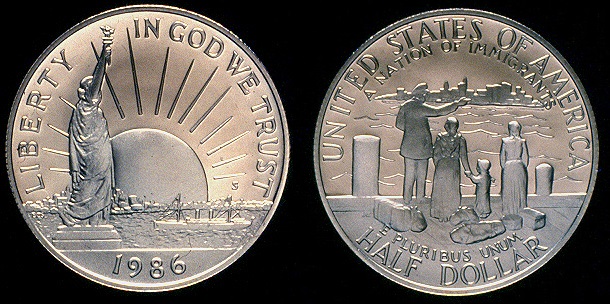
In 1986 the Statue of Liberty turned 100, and she was falling apart. This little half dollar — the first commemorative half ever struck in plain copper-nickel, not silver — came with a $2 surcharge that went straight to fixing her up and reopening Ellis Island.

The story behind the coin

By the early 1980s, the most famous statue in America was rusting. A century of salt air, wind, and a hundred million visitors had eaten into Lady Liberty's iron skeleton. Across the harbor, Ellis Island — the gateway that processed more than twelve million immigrants between 1892 and 1954 — sat abandoned and crumbling.

The fix would cost hundreds of millions of dollars, and the government wasn't paying. A private commission, chaired by Chrysler boss Lee Iacocca and formed in 1982, had to raise it. One of their tools was a coin.

In 1985, Congress passed the Statue of Liberty–Ellis Island Commemorative Coin Act. President Reagan signed it on July 9, 1985 (Public Law 99-61). It authorized a three-coin set — a half dollar, a silver dollar, and a five-dollar gold piece — timed for the statue's centennial. Every coin carried a built-in donation. The half dollar's surcharge was $2; buy one, and two dollars went to the Statue of Liberty–Ellis Island Foundation. The coins went on sale beginning in late 1985, with the celebrations cresting over the July 4, 1986 "Liberty Weekend." It became the most successful commemorative program in U.S. Mint history, raising tens of millions for the restoration.

The design

The half dollar tells the immigrant's story from both sides of the journey. The obverse — the heads side — by Mint engraver Edgar Z. Steever IV shows the Statue of Liberty as she looked in 1913, with an immigrant steamship arriving in New York Harbor behind her. It's the view from the deck: the first sight of America.

The reverse — the tails side — by Sheryl J. Winter completes the scene. An immigrant family stands at Ellis Island, looking across the water at the Manhattan skyline. The arrival has become the beginning of a life. For its imagery, collectors often call it the "Immigrant" half dollar.

The piece marked a quiet milestone. It was the first U.S. commemorative half dollar ever struck in copper-nickel clad — the same plain alloy as a circulating quarter — rather than the 90% silver used for every commemorative half before it. The age of the silver commemorative half was over.

Key facts

Denomination
Half dollar (50 cents)
Year struck
1986
Occasion
Centennial of the Statue of Liberty (dedicated 1886)
Obverse designer
Edgar Z. Steever IV
Reverse designer
Sheryl J. Winter
Composition
Copper-nickel clad (about 91.67% copper, 8.33% nickel)
Weight
11.34 g
Diameter
30.61 mm
Mint marks
D (Denver, uncirculated) · S (San Francisco, proof)
Uncirculated mintage (1986-D)
928,008
Proof mintage (1986-S)
6,925,627
Surcharge per coin
$2 — to the Statue of Liberty–Ellis Island Foundation
Authorizing law
Public Law 99-61, signed July 9, 1985
First of its kind
First U.S. commemorative half dollar in copper-nickel clad

Collecting it

This is not a rare coin, and that's the point. Nearly 7 million proofs (the S-mint, mirror-finish coins struck in San Francisco) and almost a million uncirculated business strikes (the D-mint, struck in Denver) poured out of the Mint. They were sold to the public by the millions, so survivors are everywhere and affordable. For most dates, the coin itself trades close to its melt-and-issue value.

What separates one from another is condition. Because so many were handled, mailed, and set on shelves, top-grade examples — the few that escaped a single scuff or hairline — are the ones that command a premium. For the uncirculated 1986-D, the chase is for the highest mint-state grades; for the 1986-S proof, it's for a flawless, deep-cameo strike (frosted devices against mirror fields). The story is the same across the whole series: the design is common, but a truly pristine one is not.

Questions collectors ask

Why was the 1986 Statue of Liberty half dollar made?

To mark the statue's 100th birthday — she was dedicated in 1886 — and to raise money to restore her and reopen Ellis Island. A $2 surcharge from each half dollar went to the Statue of Liberty–Ellis Island Foundation.

Is the 1986 Statue of Liberty half dollar silver?

No. It is copper-nickel clad, the same alloy as a circulating quarter. It was the first U.S. commemorative half dollar struck in clad rather than 90% silver.

What's the difference between the 1986-D and 1986-S?

The D was struck at Denver as an uncirculated coin; the S was struck at San Francisco as a proof, with mirror-like fields. Far more proofs were made — nearly 7 million versus about 928,000 uncirculated.

Why is it called the Immigrant half dollar?

Its imagery: the obverse shows an immigrant ship arriving past the statue, and the reverse shows an immigrant family looking at the New York skyline from Ellis Island.

Is the 1986 Statue of Liberty half dollar valuable?

Most examples are common and trade near issue value. The premium pieces are the top-graded survivors — a flawless deep-cameo proof, or a near-perfect uncirculated coin.

Sources