US coin · series

The 2016-W Standing Liberty Quarter — a 1916 design reborn in gold

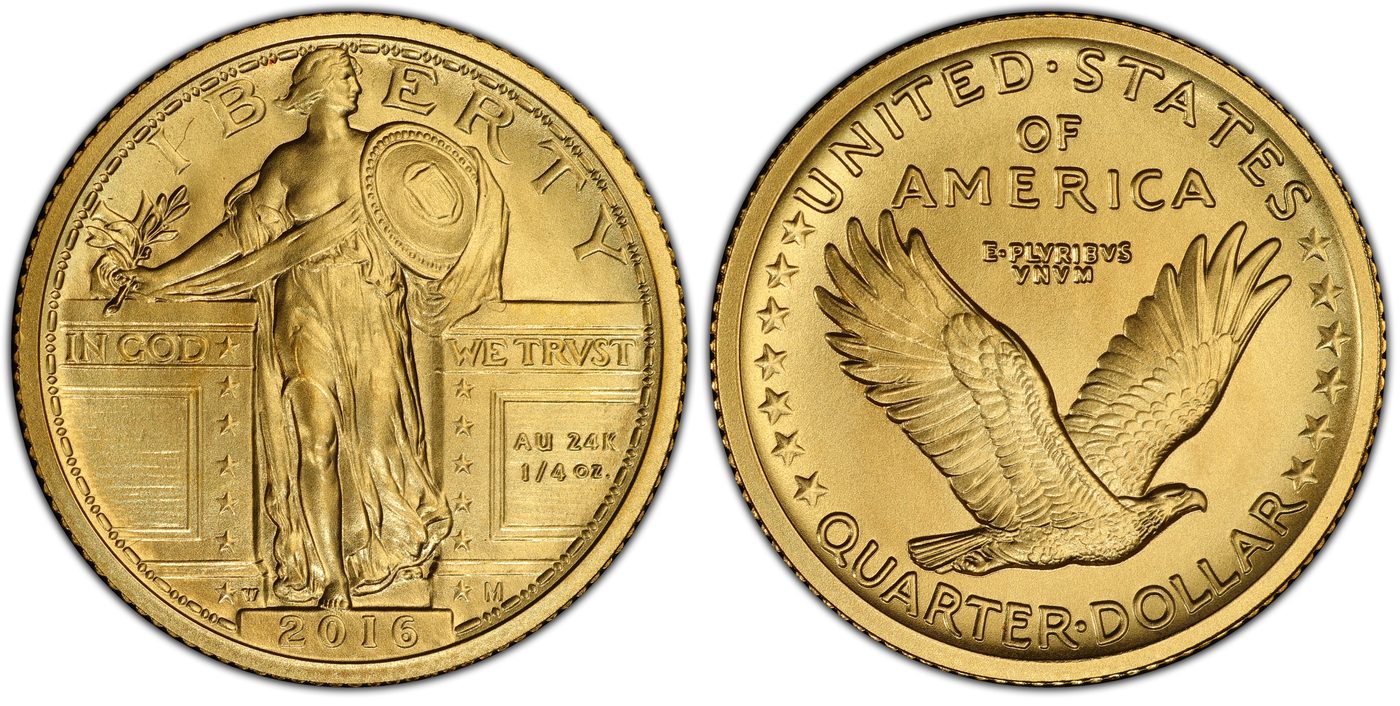
One hundred years after she first strode through the gate, Liberty came back — this time in a quarter-ounce of pure gold.

The 2016-W Standing Liberty Quarter — a 1916 design reborn in gold
Professional Coin Grading Service (PCGS) — credit: https://www.pcgs.com/coinfacts/coin/2016-w-10c-100th-anniversary/597222 · public domain · source

In 2016 the U.S. Mint did something it almost never does: it took a coin from a century earlier and struck it again — not in silver, but in 24-karat gold. Only 91,752 were made, and the household limit changed mid-sale in a way collectors still argue about.

The story behind the coin

In 2016 the U.S. Mint reached back exactly one hundred years. Three of America's most loved coin designs had all debuted in 1916 — the Mercury dime, the Standing Liberty quarter, and the Walking Liberty half dollar. To mark the centennial, the Mint struck each one again in pure gold, sized to its old denomination: a tenth-ounce dime, a quarter-ounce quarter, a half-ounce half.

The quarter was the middle child of the trio. It went on sale on September 8, 2016, priced at $485, with one quarter-ounce of 24-karat gold inside it. These were never meant to spend — they were collector coins, sold by the Mint in a black matte wood case with a paper certificate.

So why does a one-year gold coin matter? Partly the numbers: just 91,752 were struck, fewer than the 100,000 the Mint was allowed to make. Partly the design — a figure of Liberty that was so daring in 1916 it had to be quietly altered the very next year. The gold coin put that 1916 original back in collectors' hands, full-size and unmissable.

The design — Liberty at the gate

The design is Hermon Atkins MacNeil's, and it has a backstory most coins envy. In 1916 the Mint's leadership wanted fresh art on the silver coinage, so it turned to outside sculptors instead of its own chief engraver. MacNeil won the quarter.

His Liberty stands in an open gateway — the obverse, the "heads" side — stepping forward with an olive branch in one hand for peace and a shield on the other arm for defense. She faces east, toward Europe, where the Great War was already raging. On that first 1916 version her right breast was bare, in the classical tradition. The reverse — the "tails" side — shows an eagle in mid-flight.

Here is the twist. In 1917, with the war pressing closer, MacNeil revised the figure and covered Liberty in a coat of chain mail. Collectors have long read this as a modesty fix; the armor reading — Liberty arming herself for war — is the more interesting and likely truer one. The 2016 gold coin carries MacNeil's 1916 design, the bolder original, which is exactly why it draws the eye.

Key facts

Year struck
2016 (one year only)
Mint
West Point — the 'W' mint mark
Original designer
Hermon A. MacNeil (1916 design)
Denomination
Quarter dollar (25¢ face)
Composition
99.99% gold (24-karat)
Gold weight
0.25 troy oz (7.776 g)
Diameter
22.00 mm (0.866 in)
Edge
Reeded
Mintage
91,752 (max authorized 100,000)
On sale
September 8, 2016 — issue price $485

Collecting it

This is a modern coin with one date and one mint, so collecting it is less about hunting varieties and more about condition and provenance. The Mint sold it as a finished collector piece; most surviving coins are in pristine, never-handled shape, and the grading services certify the best of them at the top of the scale.

One quirk shapes the market. When the quarter launched, the Mint set a strict limit of one coin per household — a reaction to the gold dime earlier that year, whose ten-coin limit let buyers grab them in bulk. Then, on September 21, 2016, with sales softer than expected, the Mint lifted the quarter's limit entirely. That mid-sale change is part of why the final mintage landed under the cap, and it's a detail seasoned collectors weigh when they judge how scarce the coin really is.

Because the gold value sits underneath it, the coin has a floor that a pure collectible doesn't — a quarter-ounce of gold is a quarter-ounce of gold. Its premium above melt rises and falls with how many collectors want that 1916 Liberty in their cabinet.

Questions collectors ask

How many 2016 Standing Liberty gold quarters were made?

91,752 were struck. The Mint was authorized to make up to 100,000, so the coin came in under its own cap — partly because the per-household order limit was lifted mid-sale, which cooled demand.

Is it real gold, and how much?

Yes. It holds one-quarter of a troy ounce of 99.99% pure (24-karat) gold, weighing 7.776 grams. That gold content gives the coin a value floor that tracks the gold price.

Who designed it, and why does the design matter?

Hermon A. MacNeil designed the original Standing Liberty quarter in 1916. The 2016 gold coin uses that first 1916 version of Liberty — the bolder one, before the 1917 redesign added a coat of chain mail to the figure.

Did it ever circulate as money?

No. It carries a 25-cent face value, but it was sold by the U.S. Mint as a collector coin for $485 and was never meant to spend. It's a centennial tribute, not pocket change.

Why did the Mint make it in 2016?

To mark the 100th anniversary of three classic 1916 designs. The Standing Liberty quarter was the second of three centennial gold coins that year, alongside the Mercury dime and the Walking Liberty half dollar.

Sources