US coin · series

The 1996 Smithsonian $5 Gold — a museum's founder, struck in gold

He never crossed the Atlantic. America put him on a gold coin anyway.

The 1996 Smithsonian $5 Gold — a museum's founder, struck in gold
United States Mint (www.usmint.gov) · public domain · source

In 1829 a British scientist named James Smithson died in Genoa and left his entire fortune to a country he had never visited — "to found at Washington, under the name of the Smithsonian Institution, an Establishment for the increase and diffusion of knowledge." A century and a half later, the U.S. Mint put his portrait on a half-ounce of gold.

The story behind the coin

James Smithson was the illegitimate son of an English duke. He was a chemist and a mineralogist — good enough that a zinc mineral, smithsonite, still carries his name. He never married, never had children, and as far as anyone can tell, never once set foot in the United States.

Yet when he died in Genoa in 1829, his will held a strange clause. If his nephew died without heirs, his whole estate would pass "to the United States of America, to found at Washington, under the name of the Smithsonian Institution, an Establishment for the increase and diffusion of knowledge." The nephew did die childless, in 1835. So a country Smithson had never seen suddenly inherited roughly half a million dollars in gold sovereigns — a fortune at the time.

No one is certain why he did it. Smithson left no letter explaining the gift, and historians still argue over his motive. The most popular guess: a man shut out of English society by his birth wanted a legacy that owed nothing to his family or his country. Whatever the reason, Congress dithered for a decade before President James K. Polk finally signed the Smithsonian into being on August 10, 1846.

This coin marks the 150th anniversary of that day. In 1996 — the sesquicentennial — Congress authorized a gold half eagle to honor the institution and, fittingly, the stranger who started it.

The design

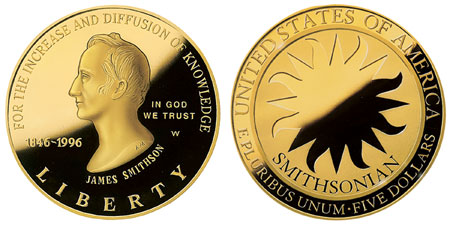
The obverse — the "heads" side — carries a classical bust of James Smithson, flanked by the dual date "1846–1996" that ties the founding to the anniversary. It was modeled by U.S. Mint sculptor-engraver Alfred Maletsky. It is a quiet kind of tribute: the face of a man almost no American would recognize, on the most valuable circulating-format coin the Mint makes.

The reverse — the "tails" side — is the institution itself. Sculptor Thomas James Ferrell rendered the Smithsonian's sunburst logo with the single word "Smithsonian," letting the brand speak for the whole sprawling empire of museums it had become.

The piece is a half eagle: a $5 gold coin in the same denomination America struck for circulation from 1795 to 1929. By 1996 the $5 face value was symbolic — the gold inside was worth far more — but the Mint kept the historic denomination as a nod to the classic coinage tradition.

Key facts

Years struck
1996 (sesquicentennial issue)
Denomination
$5 gold half eagle (commemorative)
Mint
West Point (W mint mark)
Obverse designer
Alfred Maletsky — bust of James Smithson
Reverse designer
Thomas James Ferrell — Smithsonian sunburst logo
Composition
.900 fine gold (90% gold, 10% alloy)
Weight
8.359 g (about 0.2419 oz actual gold weight)
Diameter
21.6 mm
Edge
Reeded
Uncirculated mintage
9,068
Proof mintage
21,772
Maximum authorized
100,000 ($5 gold coin)
Authorizing law
Smithsonian Institution Sesquicentennial Commemorative Coin Act — Public Law 104-96 (signed Jan. 10, 1996)
Released
August 5, 1996

Collecting it

Here is the number that matters to collectors: Congress authorized up to 100,000 of these $5 gold coins. The Mint struck fewer than 31,000. The uncirculated version — the business strike, struck once on a polished planchet — sold barely 9,068 copies.

That is a genuinely low mintage for a modern U.S. gold coin, and it happened for an unromantic reason. The coins launched at $180 to $225 apiece, and the gold inside was worth a fraction of that. Most buyers in 1996 saw a steep premium for a museum keepsake and passed. The collectors who did buy ended up holding one of the scarcer modern gold commemoratives the Mint has ever issued.

A note on grades: a "proof" is a specially made presentation strike — mirror fields, frosted devices, struck with extra care — and the proofs outnumber the uncirculated coins better than two to one here. So for this issue, the plainer uncirculated coin is actually the harder one to find. Top-grade examples of either format, certified at the highest mint-state and proof levels, are where the real scarcity lives.

Questions collectors ask

Who is the man on the 1996 Smithsonian $5 gold coin?

James Smithson — a British chemist and mineralogist who, on his death in 1829, left his fortune to the United States to found the Smithsonian Institution. He had never visited the country. The obverse shows a classical bust of him with the dual date 1846–1996.

Why is the 1996 Smithsonian $5 gold considered scarce?

Congress authorized up to 100,000 coins, but the Mint struck fewer than 31,000. The uncirculated version sold only 9,068 — a low figure for a modern U.S. gold commemorative. High issue prices over the value of the gold kept buyers away in 1996, which is exactly why the survivors are scarce today.

Where was the coin minted?

At the West Point Mint in New York. It carries a 'W' mint mark and was issued in both uncirculated and proof formats.

How much gold is in the coin?

It is a $5 half eagle of .900 fine gold, weighing 8.359 grams — roughly 0.2419 troy ounce of actual gold. The $5 face value is symbolic and far below the metal value.

What did the surcharges from the coins pay for?

Under Public Law 104-96, surcharges from each coin went to the Smithsonian Institution to support its 150th-anniversary programming and general activities, with a portion dedicated to the National Numismatic Collection — the Smithsonian's own coin collection.

Sources