US coin · series

The 1988 Seoul Olympiad Silver Dollar

Two torches melt into one flame — Liberty's and the Olympics' — on a coin minted to send America to Seoul.

The 1988 Seoul Olympiad Silver Dollar
U.S. Mint (www.usmint.gov) · public domain · source

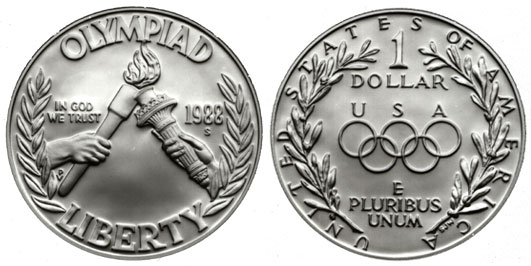
In 1988, the U.S. Mint struck a silver dollar that asked Americans to buy a piece of the Olympics. Every coin carried a built-in surcharge that went straight to training Team USA for the Seoul Games. The art said it plainly: the Statue of Liberty's torch and the Olympic torch, two hands, one rising flame.

The story behind the coin

By the mid-1980s, the U.S. government had discovered something it had spent thirty years forgetting: a commemorative coin could pay for things.

For most of the 20th century, Congress had let the commemorative program lapse — no special coins were authorized between 1954 and the early 1980s. Then came the 1984 Los Angeles Olympics. To help fund the Games and the U.S. Olympic effort, Congress authorized a set of Olympic coins, and they sold. The lesson stuck: attach a small surcharge to a beautiful coin, and collectors will happily fund a national cause.

So when the 1988 Summer Olympics in Seoul, South Korea approached, Congress reached for the same playbook. The 1988 Olympic Commemorative Coin Act — Public Law 100-141 — was signed on October 28, 1987. It authorized two coins: this silver dollar and a $5 gold half eagle. The money raised wasn't an afterthought. It was the point. Surcharges from sales went to the United States Olympic Committee to train American athletes, support amateur sports, and build facilities — turning every buyer into a small sponsor of Team USA.

The Seoul Games themselves mattered. They were the first Summer Olympics in twelve years that both the United States and the Soviet Union attended — the 1980 (Moscow) and 1984 (Los Angeles) Games had each been gutted by Cold War boycotts. Seoul in 1988 was, in a real sense, the Olympics coming back together. This coin was minted for that moment.

The design

The obverse — the "heads" side — is the part people remember. Two hands rise into frame: one grips the Statue of Liberty's torch, the other an Olympic torch, and their two flames merge into a single fire, wreathed in olive branches. It's a clean visual argument — America and the Olympic ideal, lit from the same flame. It was designed by Patricia Lewis Verani, and it carries the standard inscriptions: LIBERTY, IN GOD WE TRUST, OLYMPIAD, and the date 1988.

The reverse — the "tails" side — is quieter and more official. Sherl Joseph Winter, a U.S. Mint sculptor, placed the five interlocking Olympic rings at the center, framed by olive branches, with USA above. Around it run UNITED STATES OF AMERICA, E PLURIBUS UNUM, and the denomination, ONE DOLLAR.

This is a 90% silver coin — 90% silver, 10% copper — weighing 26.73 grams at 38.1 mm across, with a reeded (grooved) edge. In other words, a full-size, full-weight silver dollar in the classic American mold, made to be kept rather than spent.

Key facts

Years struck
1988 (one year only)
Denomination
$1 (silver dollar)
Obverse designer
Patricia Lewis Verani (two torches, one flame)
Reverse designer
Sherl Joseph Winter (Olympic rings)
Composition
90% silver, 10% copper
Weight / diameter
26.73 g · 38.1 mm · reeded edge
Uncirculated
1988-D (Denver) — 191,368 struck
Proof
1988-S (San Francisco) — 1,359,366 struck
Maximum authorized
10 million (actual output ~1.55 million)
Authorizing act
1988 Olympic Commemorative Coin Act (Pub. L. 100-141, Oct. 28, 1987)
Surcharge purpose
Paid to the U.S. Olympic Committee to train athletes

Collecting it

Two coins fall under this one design, and the difference between them is finish and mint.

The 1988-D is the uncirculated (sometimes called Mint State, or "BU") version, struck at Denver with a normal business-strike surface. The 1988-S is the proof — struck at San Francisco with specially polished dies on polished blanks, giving the mirror-bright fields and frosted devices collectors prize. A "die" is the engraved steel stamp that strikes the coin; proof dies are prepared with extra care, which is why a proof looks like it's lit from inside.

Here's the quiet twist for collectors. The proof is the common one — 1,359,366 struck — while the uncirculated 1988-D, at 191,368, is far scarcer. That inverts the usual instinct that proofs are rarer.

Because this is a modern commemorative, raw examples are not hard to find, and most trade close to their silver value plus a modest premium. Where the interest concentrates is at the top of the grading scale: a 1988-S proof in the highest mirror grades, or a 1988-D in pristine Mint State, separates from the common pile. As with most modern issues, condition — not date — is the whole game. The original Mint packaging and certificate, when present, also matter to many buyers.

Questions collectors ask

Why does the 1988 Olympic dollar show two torches?

The obverse joins the Statue of Liberty's torch and the Olympic torch into a single flame, designed by Patricia Lewis Verani. It's a deliberate image — America and the Olympic spirit lit from the same fire — fitting for a coin sold to fund the U.S. team going to Seoul.

What is the difference between the 1988-D and 1988-S Olympic dollars?

Both share the same design. The 1988-D is the uncirculated (business-strike) coin from Denver, with 191,368 struck. The 1988-S is the proof from San Francisco — mirror-finished, struck on polished blanks — with 1,359,366 struck. The proof is actually the more common of the two.

Is the 1988 Olympic silver dollar real silver?

Yes. It's 90% silver and 10% copper, the classic U.S. silver-dollar alloy, weighing 26.73 grams. That gives it a base value tied to silver, with a collector premium on top depending on finish and grade.

What was the surcharge on the 1988 Olympic dollar for?

Under the 1988 Olympic Commemorative Coin Act (Public Law 100-141), each coin carried a surcharge paid to the United States Olympic Committee. The money went toward training American Olympic athletes, supporting amateur sports, and building training facilities for the Seoul Games.

Was the 1988 Olympic dollar struck for more than one year?

No. It was a single-year commemorative, struck only in 1988 — the uncirculated 1988-D and the proof 1988-S. There is no later-date version of this design.

Sources