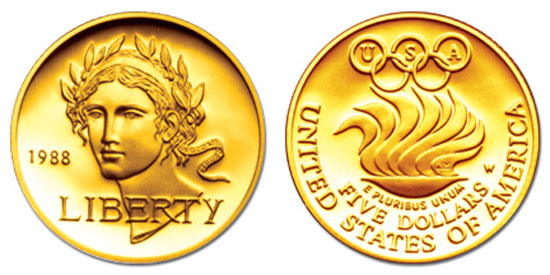
Why this coin exists
The United States does not fund its Olympic team out of the federal budget. It never has. So when American athletes were preparing for the 1988 Summer Games in Seoul, South Korea, Congress reached for a tool it had been sharpening for a few years: it sold collectors a coin and skimmed a little off each sale for the team.
That tool was the 1988 Olympic Commemorative Coin Act — Public Law 100-141, signed on October 28, 1987. It authorized two coins: a silver dollar and this small gold piece, a "$5 half eagle." Every coin carried a built-in surcharge on top of its price, and the law sent that surcharge straight to the United States Olympic Committee — earmarked to train athletes, support local amateur sports, and build training facilities.
A commemorative coin is one struck to honor a person or event rather than to make change at the grocery store. You buy it from the Mint directly, often at a premium, and the premium does the work. The 1988 program was the third time the modern U.S. Mint had run this play for the Olympics, after the 1983-84 Los Angeles coins — and by now the formula was set: a beautiful coin, a good cause, and a deadline.