US coin · series

The San Francisco Old Mint $5 Gold — a coin for the building that wouldn't burn

In 1906, one granite building held a third of America's gold and lived to tell about it.

The San Francisco Old Mint $5 Gold — a coin for the building that wouldn't burn
United States Mint (credit: United States Mint website) · public domain · source

When the 1906 earthquake and fire leveled San Francisco, the city's banks burned to the ground — all but one. The San Francisco Mint stood through the flames with the nation's gold inside it, then opened its doors as the only bank in a ruined city. A century later, the U.S. Mint struck this $5 gold half eagle in its honor.

The story behind the coin

At dawn on April 18, 1906, the ground under San Francisco moved. The earthquake — later estimated near magnitude 7.8 — killed thousands and toppled tens of thousands of buildings. Then came the fires, which finished what the shaking started. The downtown banks, the heart of the city's money, were gone.

One building refused to fall: the San Francisco Mint. Inside its vaults sat a staggering amount of gold — by one account roughly a third of the entire U.S. gold reserve at the time. As the fire closed in, mint employees and U.S. Army soldiers fought it for hours with one-inch hoses fed by a well in the courtyard. They saved the building. They saved the gold.

That mattered far beyond the fireproofing. With every other bank destroyed, the surviving Mint became the only working financial institution in the city. It took in the relief money pouring in from across the country and paid it back out to rebuild San Francisco. A building meant to make money became the place that helped the city buy back its life.

A hundred years later, Congress decided that story deserved a coin. The San Francisco Old Mint Commemorative Coin Act — introduced by Representative Nancy Pelosi — was signed into law on June 15, 2006. It authorized a silver dollar and this $5 gold piece, the surcharges going to help restore the old building as a museum. The coin marks the centennial of the disaster the Mint outlasted.

The design

The coin's two sides are a quiet conversation between the present and the past.

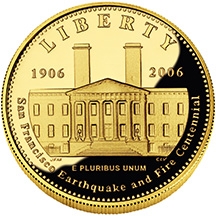
The obverse — the heads side — shows the Old Mint itself. Sculptor-engraver Charles L. Vickers drew the building's grand columned front from architect A. B. Mullett's original 1869 construction drawings. So you are looking not at a photograph of a weathered survivor, but at the building as its architect first imagined it — clean, classical, and built to last. (Mullett designed it to "float" on its foundation rather than shatter; he was not wrong.)

The reverse — the tails side — borrows from history on purpose. It revives the eagle of the old Liberty Head half eagle, the workhorse $5 gold coin that circulated for nearly seventy years. Mint engraver Don Everhart adapted it from a 1906-S Liberty Head half eagle — a coin struck in 1906, at the very San Francisco Mint the new piece honors. That original Liberty Head design traces back to engraver Christian Gobrecht. So the back of this 2006 coin is, in effect, a coin the Granite Lady herself once made, brought back for an anniversary.

The result reads in one glance: a $5 gold coin, struck with the S mint mark of San Francisco, picturing the building that struck $5 gold coins for generations.

Key facts

Denomination
$5 gold (half eagle)
Year struck
2006
Mint mark
S — San Francisco
Obverse designer
Charles L. Vickers (after A. B. Mullett's 1869 drawings)
Reverse
Liberty Head eagle, adapted by Don Everhart from a 1906-S half eagle
Composition
90% gold, 10% alloy
Weight
8.359 g (0.242 oz gold)
Diameter
21.6 mm
Uncirculated mintage
17,500
Proof mintage
44,174
Authorizing act
San Francisco Old Mint Commemorative Coin Act (Public Law 109-230, June 15, 2006)
Surcharge
$35 per coin to the San Francisco Museum and Historical Society

Collecting it

This is a modern commemorative, struck for one year only and sold directly by the U.S. Mint, so it is not a coin you hunt for in pocket change. Two versions exist: a proof (mirror-bright fields with frosted devices, struck for collectors) and an uncirculated business strike. Sales opened on August 15, 2006.

The numbers tell a small story of their own. The law allowed up to 100,000 of these gold coins, but far fewer sold — about 44,174 proofs and 17,500 uncirculated pieces. The uncirculated is the scarcer of the two by a wide margin, which is the first thing a collector notices: the version most people skipped is the one that's harder to find today.

Because each coin contains just under a quarter-ounce of gold, its value has two engines — the metal underneath and the collector demand on top. For a one-year commemorative with a genuinely good story and a modest surviving population, condition is where the interest concentrates. Top-graded examples in their original Mint packaging, with the certificate of authenticity, are what serious collectors chase.

Questions collectors ask

Why does a 2006 coin honor 1906?

It marks the centennial of the 1906 San Francisco earthquake and fire — and specifically the Old Mint, which survived the disaster, protected the nation's gold inside it, and reopened as the only working bank in the ruined city.

Why is the San Francisco Mint called the Granite Lady?

It's an affectionate nickname for the building's columned, fortress-like look — though the name is a later marketing coinage, not what people called it in 1906. The building's basement is granite; the upper stories are sandstone.

How much gold is in the coin?

It's a $5 half eagle: 90% gold, weighing 8.359 grams, with about 0.242 troy ounces of actual gold. The same recipe and size as the classic circulating half eagles struck up to the 1920s.

Which is rarer, the proof or the uncirculated?

The uncirculated. Only about 17,500 were sold, versus roughly 44,174 proofs — so the plainer-looking version is the harder one to find.

Where did the eagle on the back come from?

It's the Liberty Head half eagle eagle, adapted by Mint engraver Don Everhart from a 1906-S coin — a piece originally struck at the very San Francisco Mint the new coin celebrates. The underlying design goes back to engraver Christian Gobrecht.

Sources

1906 San Francisco Old Mint $5 Gold (2006 Commemorative) | colcur