US coin · series

The San Diego Half Dollar — a world's fair coin most people refused to buy

Robert Aitken gave San Diego a small masterpiece in 1935. The crowds walked right past it, and the Mint melted most of them down.

The San Diego Half Dollar — a world's fair coin most people refused to buy
Wikimedia Commons user Bobby131313 (uploaded by User:Searchme). Coin design: U.S. Mint · public domain · source

In 1935 San Diego threw a world's fair and minted a silver half dollar to pay for it. The coin was lovely. The sales were dismal. Tens of thousands were melted, re-struck with a new date, and offered again — and flopped a second time. The survivors are some of the most affordable classic commemoratives a newcomer can own.

The story behind the coin

In the depths of the Great Depression, San Diego decided to throw a party. The California-Pacific International Exposition opened in Balboa Park in 1935 — a sprawling world's fair on more than a thousand acres, meant to pull tourists, jobs, and optimism into a city that badly needed all three.

Fairs cost money. So the organizers reached for a trick other expositions had used: ask Congress for a commemorative coin. The plan was simple and a little cheeky. The Treasury would sell the fair's promoters half dollars at face value — 50 cents each — and the promoters would sell them to fairgoers at a markup, pocketing the difference to fund the show.

President Franklin Roosevelt signed the authorizing act on May 3, 1935, clearing up to 250,000 half dollars with no opposition in either chamber. On paper, free money. In practice, it became one of the great cautionary tales of American commemorative coinage.

The coins simply didn't sell. The Bank of America's San Diego branch handled distribution, and of the first batch only a fraction moved. The rest came back to the Mint — to be melted.

What the coin shows

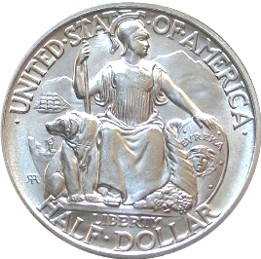
The design came from Robert Ingersoll Aitken, the sculptor who had made the celebrated 1915 Panama-Pacific commemoratives a generation earlier. He gave San Diego a coin that looks far older and grander than its sales numbers.

The obverse — the "heads" side — is California itself, lifted from the state seal. A seated Minerva, helmeted goddess of wisdom, rests one hand on a shield reading EUREKA ("I have found it," California's motto) set with the head of Medusa. A grizzly bear stands beside her, a cornucopia spills produce at her feet, and behind them a sailing ship and a gold miner work against the Sierra hills — the whole story of the state in one crowded frame.

The reverse — the "tails" side — turns to the fair itself. It shows the California Tower and the Chapel of St. Francis, the Spanish-Renaissance landmarks of Balboa Park, framed in an arch said to echo mission architecture. Around them run the exposition's name, the date, SAN DIEGO, and IN GOD WE TRUST.

It is a confident, sculptural coin. The strike is bold, the relief — the raised height of the design — gives the figures real depth. None of that was enough to move them at a dollar apiece.

Key facts

Years struck
1935 (S) and 1936 (D)
Denomination
Half dollar (50 cents)
Designer
Robert Ingersoll Aitken (both sides)
Composition
90% silver, 10% copper
Weight / diameter
12.5 g / 30.6 mm, reeded edge
Authorizing act signed
May 3, 1935 (recoinage act May 6, 1936)
1935-S struck
250,132 — about 70,132 distributed, 180,000 melted
1936-D struck
180,092 — about 30,092 distributed, 150,000 melted
Mints
San Francisco (S) and Denver (D) — never Philadelphia

Collecting it today

Here is the twist that makes this coin worth a stranger's attention. When the 1935 coins didn't sell, the exposition didn't give up — it went back to Congress. A 1936 act (signed by Roosevelt on May 6, 1936) let the unsold 1935 pieces be melted and re-struck with a fresh 1936-D date, the theory being that a new date would tempt collectors who wanted "one of each." It didn't work. The 1936-D sold even worse than the 1935-S, and most of those went to the furnace too.

So both dates exist because of the same failure. Of the 250,132 struck in San Francisco in 1935, only about 70,132 reached collectors. Of the 180,092 struck in Denver in 1936, only about 30,092 survived. The rest — 330,000 coins between them — were melted.

That gives the 1936-D the lower surviving count, but the lopsided story has a counter-intuitive payoff for new collectors: because the program was a sales flop rather than a rarity, both dates remain among the more affordable classic commemoratives. Most circulated and lower-mint-state examples trade modestly; the premiums climb only at the top grades, where a fully struck, unmarked coin with original luster is genuinely scarce — most surviving pieces were handled as souvenirs, not protected as investments.

One quirk collectors prize: this is the only U.S. commemorative of its era struck at San Francisco and Denver but never at Philadelphia. A small thing, but the kind of detail that makes a coin stick in the mind.

Questions collectors ask

Why does the San Diego half dollar come in both 1935-S and 1936-D?

Because the program failed twice. The 1935-S coins barely sold, so Congress authorized melting the unsold ones and re-striking them with a 1936 Denver date, hoping a new date would draw collectors. It didn't — the 1936-D sold even worse, and most of those were melted too.

How many San Diego half dollars actually survive?

Roughly 70,132 of the 1935-S and about 30,092 of the 1936-D were distributed; the rest of the 430,000-plus coins struck were melted. So the 1936-D is the scarcer of the two by surviving count.

Who designed the San Diego half dollar?

Robert Ingersoll Aitken, the sculptor behind the 1915 Panama-Pacific commemoratives. He designed both sides — the seated Minerva from California's state seal on the obverse, and Balboa Park's California Tower and Chapel of St. Francis on the reverse.

Is the San Diego half dollar made of real silver?

Yes — 90% silver and 10% copper, weighing 12.5 grams, the same alloy as a regular U.S. half dollar of the era. It contains about a third of a troy ounce of silver.

Why is the San Diego half dollar a good first commemorative?

It pairs a genuinely beautiful, history-rich design with low cost. Because the coin flopped at the fair rather than being deliberately rare, attractive examples stay affordable — so a newcomer can own a real classic commemorative without a steep premium.

Sources