US coin · series

The Roanoke Island Half Dollar: a coin for a colony that vanished

In 1937 the Mint struck a half dollar honoring the first English child born in America — and the settlers who disappeared without a trace.

The Roanoke Island Half Dollar: a coin for a colony that vanished
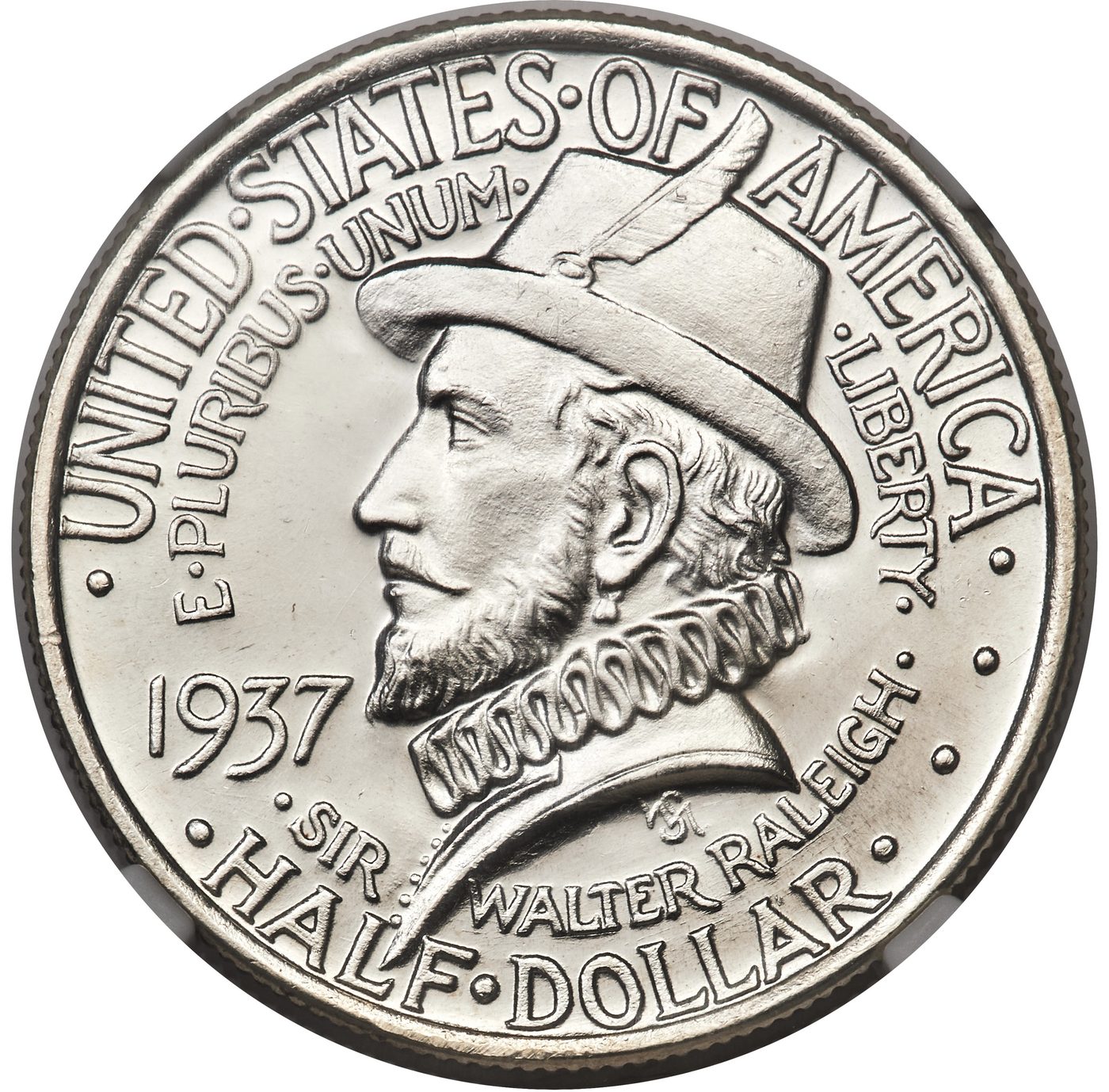
William Simpson designed the coin; image by Heritage Auctions (per Wikimedia Commons file record) · public domain · source

Three hundred fifty years before this coin was minted, more than a hundred English settlers stepped onto Roanoke Island — and then, somehow, stepped out of history entirely. The 1937 Roanoke Island half dollar is America's small silver memorial to the Lost Colony, and to the baby girl, Virginia Dare, who was born into it.

The story behind the coin

In 1587, more than a hundred English men, women, and children landed on Roanoke Island, off the coast of what is now North Carolina, hoping to build England's first permanent foothold in the New World. Their leader, John White, sailed back to England for supplies. War with Spain stranded him there for three years. When he finally returned in 1590, the settlement was empty. The colonists were gone — no bodies, no struggle, just a word carved into a post: CROATOAN. No one has ever proven what became of them. History remembers them as the Lost Colony.

In 1937, the 350th anniversary of that doomed landing, North Carolina wanted a monument the country could hold in its hand. The result was this half dollar — a 50-cent silver coin authorized by Congress and signed into law by President Franklin D. Roosevelt on June 24, 1936. Local groups, the Roanoke Memorial Association and the Roanoke Island Historical Association, would buy the coins from the Mint at face value and resell them to collectors and tourists, with the markup funding the anniversary celebrations.

This was the heyday of the U.S. commemorative coin — special-issue coins struck not for spending but for selling, each one a tiny fundraiser for a cause, a city, or an anniversary. Dozens poured out in the mid-1930s. The Roanoke coin arrived just as that boom was cooling, a timing problem that would shape its whole story.

The design

The coin was the work of William Marks Simpson, a Norfolk-born sculptor who had already designed commemorative half dollars for Norfolk and for the Battle of Antietam. On the obverse — the heads side — he placed Sir Walter Raleigh, the courtier who won the charter from Queen Elizabeth I to colonize Virginia. Raleigh wears a ruffled collar, an earring, and a plumed hat: every inch the Elizabethan adventurer. Simpson's monogram sits below the shoulder.

The reverse — the tails side — is the coin's heart. It shows Eleanor Dare cradling her infant daughter, Virginia Dare, the first child of English parents born in the Americas, on August 18, 1587. Two English sailing ships ride the sea behind them, and a small scrub pine grows from the pedestal beneath their feet — a quiet symbol of a settlement that tried to take root and could not.

Simpson cared about the details, sometimes to the point of argument. He wanted Raleigh's name spelled "Ralegh," noting that the man himself usually signed it that way. The Commission of Fine Arts, the federal body that reviews coin and monument designs, overruled him and kept the familiar "Raleigh."

Key facts

Year struck
1937
Denomination
Half dollar (50 cents)
Designer
William Marks Simpson
Commemorates
350th anniversary of the Roanoke Colony (1587–1937)
Obverse
Sir Walter Raleigh
Reverse
Eleanor Dare holding the infant Virginia Dare
Composition
90% silver, 10% copper
Weight
12.5 grams (0.36169 oz silver)
Diameter
30.61 mm
Edge
Reeded
Mint
Philadelphia (no mint mark)
Total struck
50,030 (incl. 30 for the Assay Commission)
Sold to public
About 29,000
Returned and melted
About 21,000
Issue price
$1.65 (including postage)

Collecting it

Here is the twist that makes this coin interesting to collectors. The Mint struck it in two batches — about 25,000 in January 1937 and about 25,000 more in June — for a total a little over 50,000. But the commemorative craze had passed its peak. The sponsors could not move them all. When the dust settled, roughly 29,000 had been sold to the public and about 21,000 unsold coins were shipped back to the Philadelphia Mint and melted down.

That melting is the key to the coin's place in the market. Its net mintage — the number that actually survives — is well under 30,000, which makes it scarcer than the raw 50,000 figure suggests. There are no date or mint-mark varieties to chase; every coin is a 1937 Philadelphia strike. So the game here is condition. Because these were sold to collectors who handled them gently, plenty survive in mint state — the grade for a coin that never circulated. But truly pristine, sharply struck examples in the highest grades command a sharp premium, and the very best specimens have sold for thousands.

For a newcomer, the Roanoke is one of the more affordable and approachable of the classic commemoratives, with a story far bigger than its price. For a seasoned collector, it is a single-issue type — one coin completes it — wrapped around one of the great unsolved mysteries of American history.

Questions collectors ask

What does the Roanoke Island half dollar commemorate?

It marks the 350th anniversary of the Roanoke Colony, the English settlement founded on Roanoke Island in 1587 that later vanished without explanation — the so-called Lost Colony. The coin also honors Virginia Dare, the first child born to English parents in the Americas.

Who is on the Roanoke Island half dollar?

The obverse shows Sir Walter Raleigh, who secured the charter to colonize Virginia from Queen Elizabeth I. The reverse shows Eleanor Dare holding her infant daughter, Virginia Dare, flanked by two English ships. Both sides were designed by sculptor William Marks Simpson.

How many Roanoke Island half dollars were made?

The Mint struck 50,030 in 1937, all at Philadelphia. But the commemorative boom had faded, so only about 29,000 sold; the remaining roughly 21,000 were returned to the Mint and melted. That gives the coin a net surviving mintage well under 30,000.

Why was it issued in 1937 when it was authorized in 1936?

Congress authorized the coin and President Roosevelt signed the act on June 24, 1936, but the coins were struck the following year — in two batches in January and June 1937 — to coincide with the 350th-anniversary year of the 1587 colony.

Are there rare dates or varieties?

No. Every Roanoke Island half dollar is a 1937 Philadelphia coin with no mint mark, and there are no recognized date or major design varieties. Value differences come almost entirely from condition, so high-grade, well-struck examples are the ones that command premiums.

Sources