US coin · series

The 1991 Mount Rushmore Half Dollar

A clad fifty-cent piece for the fiftieth year of the mountain that took fourteen to carve.

The 1991 Mount Rushmore Half Dollar
United States Mint (usmint.gov) · public domain · source

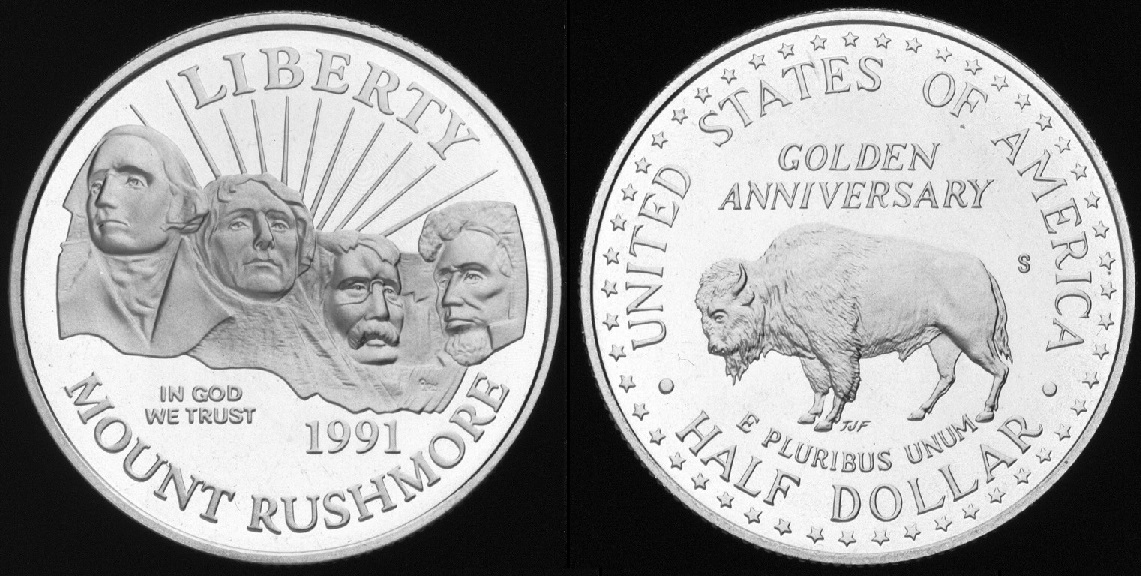
In 1991, the United States put its most famous cliff face on a fifty-cent coin — fifty years after the last blast of dynamite finished the carving. On the back, it added a buffalo, a quiet nod to the West the four presidents are still watching over.

The story behind the coin

By 1941, after fourteen years of dynamite and drills, the four faces on Mount Rushmore were done — Washington, Jefferson, Lincoln, and Theodore Roosevelt, each head sixty feet tall, blasted out of a South Dakota granite cliff. The sculptor who started it, Gutzon Borglum, died that March; his son Lincoln finished the last details, and the work was declared complete on October 31, 1941.

Fifty years on, the granite was weathering and the visitor facilities were aging. Congress decided the half-century mark deserved both a celebration and a fundraiser. It passed the Mount Rushmore Commemorative Coin Act (Public Law 101-332), authorizing three coins struck in 1991: a five-dollar gold piece, a silver dollar, and this copper-nickel half dollar. The point was twofold — honor the memorial, and raise money to fix it.

That second goal is built right into the coin. Every one carried a surcharge — an extra dollar added to the price, on top of the metal and the minting. Half of that dollar went to reducing the national debt; the other half went to the Mount Rushmore National Memorial Society of the Black Hills, to help improve and enlarge the site. Buying the coin was, by design, a small donation to the mountain.

What it looks like

The obverse — the heads side — is the obvious one: Mount Rushmore itself, the four presidents under a sunburst, designed by Marcel Jovine. It is one of the rare coins where the subject is literally a portrait of a sculpture of portraits.

Turn it over and the surprise is waiting. The reverse, by Mint engraver T. James Ferrell, shows an American bison — the buffalo of the Great Plains — ringed by fifty stars for the fifty states. It is a deliberate echo of the old Buffalo nickel and a reminder that Rushmore sits in the heart of bison country, on land sacred to the Lakota long before any face was carved.

The half dollar is clad: a copper-nickel skin bonded over a pure copper core, the same recipe as everyday circulating halves. There is no precious metal in it. That was the plan — it was meant to be the affordable coin of the three-coin set, the one a family could buy.

Key facts

Denomination
Half dollar (50 cents)
Year struck
1991
Occasion
50th anniversary of the completion of Mount Rushmore (1941)
Authorizing act
Mount Rushmore Commemorative Coin Act (Public Law 101-332)
Obverse designer
Marcel Jovine — Mount Rushmore and a sunburst
Reverse designer
T. James Ferrell — American bison, ringed by 50 stars
Composition
Copper-nickel clad over a copper core (no precious metal)
Weight
11.34 g
Diameter
30.6 mm
Edge
Reeded
Maximum authorized mintage
2,500,000 (across both finishes)
1991-D uncirculated mintage
172,754
1991-S proof mintage
753,257
Surcharge
$1 per coin — split 50/50 between national-debt reduction and the Mount Rushmore National Memorial Society

Collecting it

This is one of the easier modern commemoratives to find — but not the way you might guess. The proof version, struck at San Francisco (the 1991-S, with a frosted-on-mirror finish for collectors), is the common one: 753,257 were made. The uncirculated version from Denver (the 1991-D, a normal business strike) is far scarcer at just 172,754 — barely a quarter as many. For the half dollar, the everyday-looking coin is the harder one to get.

Neither is rare in absolute terms, and most survive in high grade because almost none ever circulated — they went straight from the Mint into collector holdings, boxes, and capsules. Where the value lives now, beyond the metal and the original issue price, is at the very top of the grading scale: a coin certified in the highest mint-state or proof grades stands well above an ordinary one, because a 30-plus-year-old commemorative that is flawless is genuinely uncommon. The fields are large and mirror-like; the smallest contact mark shows.

The half dollar is also the gateway to the bigger chase: collectors who want the complete 1991 Mount Rushmore set need all three coins — this half dollar, the silver dollar, and the five-dollar gold piece, ideally in matching finishes.

Questions collectors ask

What anniversary does the 1991 Mount Rushmore half dollar mark?

The 50th anniversary of the completion of the carving. The four faces were declared finished on October 31, 1941; the coin was issued in 1991, fifty years later.

Why is there a buffalo on the back?

The reverse, by Mint engraver T. James Ferrell, shows an American bison ringed by fifty stars — a nod to the Great Plains around Mount Rushmore and an echo of the old Buffalo nickel. It is not a portrait of the memorial; only the obverse shows the four presidents.

Is the Mount Rushmore half dollar silver?

No. The half dollar is copper-nickel clad — the same metal as a regular circulating half dollar, with no precious metal. The silver was reserved for the companion silver dollar; the gold for the five-dollar piece.

Which is scarcer, the 1991-D or the 1991-S half dollar?

The 1991-D uncirculated coin, by a wide margin: 172,754 struck versus 753,257 of the 1991-S proof. For this coin, the proof is the common one.

Did the coin actually raise money for Mount Rushmore?

Yes — by law. A $1 surcharge was added to every half dollar; half went to reducing the national debt and half to the Mount Rushmore National Memorial Society of the Black Hills to help improve and enlarge the site.

Sources